
Number Sense Playdough Mats 1 to 10: How to Build Early Math Skills Without the Battles
When a little one drops their pencil, slumps over their desk, or dissolves into tears during counting time, they are not acting up. Introducing calming Number Sense Playdough Mats 1 to 10 takes the pressure off narrow working memory, swaps handwriting stress for squishy tactile play, and helps young hands physically feel how numbers work.
Table of Contents
- Why Abstract Counting Worksheets Cause Early Stress
- Number Sense Playdough Mats 1 to 10 Layout and Structure
- Printable Overview: Number Sense Playdough Mats 1 to 10
- How to Introduce Number Sense Playdough Mats 1 to 10 at Home
- Connecting Tactile Math to Emotional Grounding
- Child Safety and Choking Prevention on the Floor
- What Happened on My Own Floorboards
- Download Your Free Number Sense Playdough Mats 1 to 10
- References & Research Foundations
- Safety & Editorial Disclaimer
Why Abstract Counting Worksheets Cause Early Stress
Fine motor fatigue, visual clutter, and performance anxietyHanding a three- or four-year-old child a thin lead pencil and a black-and-white worksheet filled with dotted lines often ends in tears. Before a young child can make sense of flat markings on paper, their brain needs direct physical contact with weight, volume, and space.
For neurodivergent kids, little ones with dyscalculia, or those still working on hand strength, traditional worksheets present too many obstacles at once. Clamping fingers around a pencil tires immature hand muscles in minutes. Flat dots offer no physical feedback, which forces the mind to guess what a number actually means. When little learners feel pushed to perform tasks their bodies are not ready for, task freeze takes over.
Using hands-on Number Sense Playdough Mats 1 to 10 moves early numeracy from rigid memorisation into physical discovery. Rolling, squeezing, and flattening warm dough into clear frames allows young learners to understand quantity through their palms and fingertips.
Flat Paper Worksheets (High Friction)
Demands mature pencil control and symbolic comprehension before spatial concepts exist. Triggers avoidance, frustration, and math anxiety early on.
Number Sense Playdough Mats 1 to 10 (Low Friction)
Pairs joint compression with spacious visual frames. Strengthens the muscles needed for writing, supports natural subitising, and keeps stress levels low.
Number Sense Playdough Mats 1 to 10 Layout and Structure
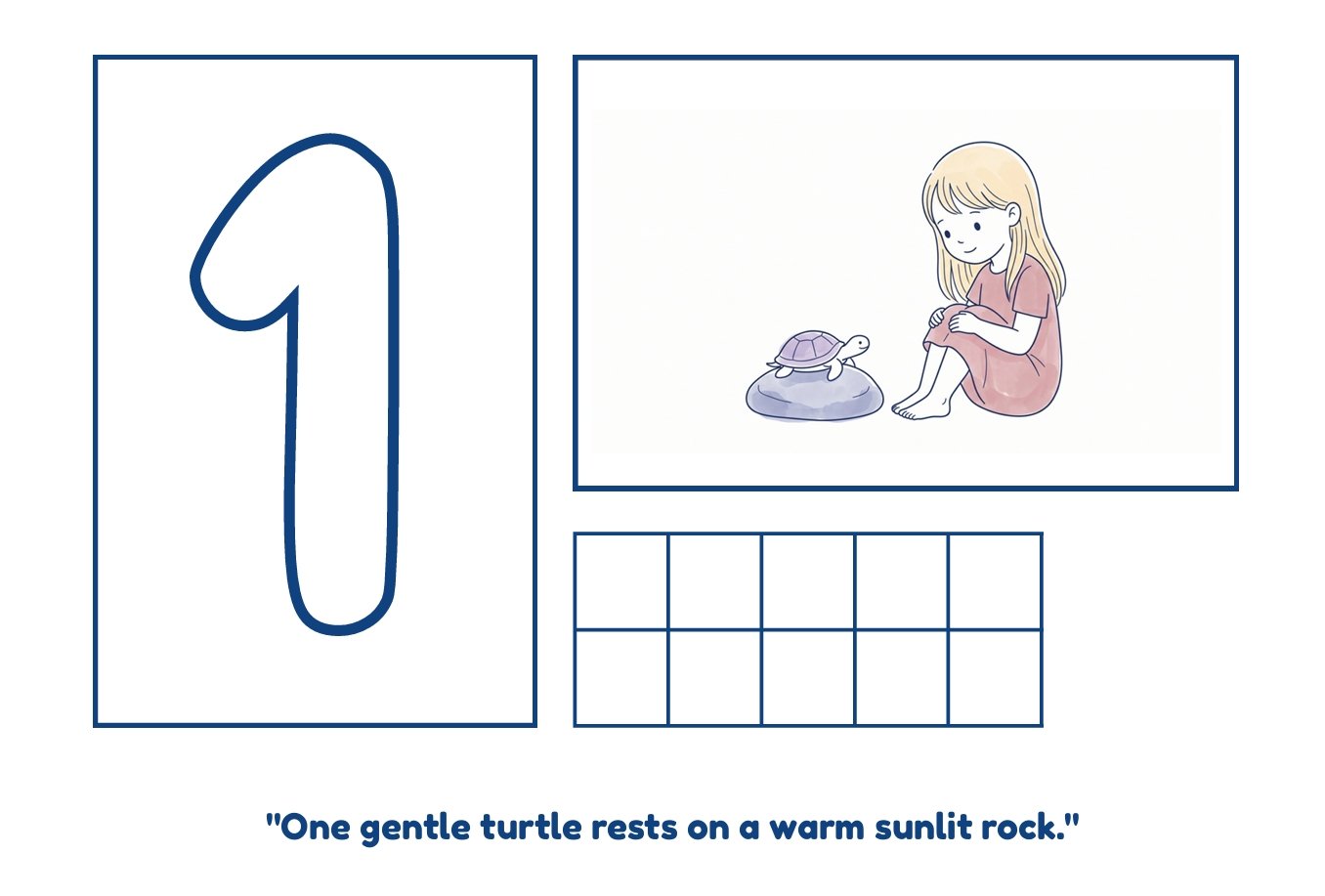
Minimalist artwork, subitising anchors, and generous white spaceMany printable packs overload sensitive children with busy checkerboard borders, neon backgrounds, and conflicting cartoon clip art. Our complete set of Number Sense Playdough Mats 1 to 10 uses quiet periwinkle blues, clean navy line work, and plenty of breathing room so sensory-sensitive eyes can settle.
| Card Feature | Physical & Sensory Role | Early Numeracy Benefit |
|---|---|---|
| Large Numeral Outline | Filling with rolled dough snakes or tracing with a finger | Builds stroke memory and directionality without pencil pressure. |
| Structured Ten-Frame | Squashing dough balls into neat individual boxes | Encourages instant quantity recognition (subitising) in a base-10 frame. |
| Storybook Vignette | Touching relatable treasures with familiar story characters | Reinforces one-to-one correspondence through gentle everyday context. |
1. The Large Numeral Outline
Positioned on the top left of each mat in our Number Sense Playdough Mats 1 to 10 series, the wide hollow numeral invites children to roll long coils of dough and press them into the shape. Guiding dough through loops and corners builds motor memory for number shapes long before handwriting starts.
2. The Structured Ten-Frame
Sitting on the top right, the ten-frame provides an immediate visual benchmark. Because the human brain can only hold four or five ungrouped items in working memory at once, arranging amounts across two rows of five helps children recognise quantities at a glance (subitising) rather than counting from one every single time.
3. The Storybook Vignette
At the bottom of every sheet, our recurring storybook characters—the spiky-haired boy and windswept girl—interact with real outdoor treasures, like three eucalyptus leaves or four smooth creek stones. Counting stays connected to a warm, gentle story rather than a sterile drill.
How to Introduce Number Sense Playdough Mats 1 to 10 at Home
Three gentle steps for calm numeracy on the living room rugWhen you bring out Number Sense Playdough Mats 1 to 10 on the living room rug or at the kitchen bench, keep the atmosphere unhurried. You do not need a strict lesson plan:
Step 1: Roll the Dough Snake
Sit down together on the rug. Warm up a handful of dough between your palms and roll it out into a smooth coil. Invite your child to bend and press the coil into the hollow numeral. If they prefer pinching off smaller chunks or flattening it with their knuckles, let them explore. The priority is positive, relaxed touch.
Step 2: Squish the Ten-Frame
Roll small balls of dough together. Ask your child to set one ball into each ten-frame square, starting from the top left, and squash each one flat with their thumb. That firm squish gives satisfying joint compression while cementing one-to-one correspondence: one ball, one push, one count.
Step 3: Gentle Flat-Finger Pointing
Count the story objects at the bottom of the page together. Encourage your child to use a slow, flat-finger tap rather than a rushed poke. Taking it slowly helps their spoken words keep pace with what their eyes and hands are doing.
Connecting Tactile Math to Emotional Grounding
Helping little learners build confidence during life transitionsExploring early numeracy through low-demand sensory activities helps children build real confidence in their own abilities. When a child learns that making a mistake at the table is completely safe, their resilience during school and kindergarten transitions grows naturally.
Personalised Resources for Confident Transitions
If big learning milestones, new classrooms, or school mornings bring worries into your home, take a look at our collection of low-arousal emotional anchors, custom transition stories, and regulation printables on Etsy Australia. Made with gentle watercolour art and neuro-affirming words, our tools help sensitive children navigate big feelings with calm reassurance.
From personalised first-day storybooks that normalise morning nerves to hands-on visual rhythm cards, every piece is designed to protect your connection with your child and bring peace back to your family routine.
Visit the earlychildhoodedu Etsy Shop →Child Safety and Choking Prevention on the Floor
Non-toxic dough, choking hazards, and handling laminated edgesChild Safety & Household Hazard Notes
Because playdough mats involve hands-on materials and small tactile counters, keep these practical safety steps in mind:
- Choking Hazard Prevention: Never give small loose counters like dried chickpeas, raw beans, buttons, glass gems, or small marbles to toddlers or children who still mouth objects. Any item that fits entirely inside a cardboard toilet roll is an airway hazard. Stick to soft playdough balls or large felt cutouts wider than an Australian 20-cent coin.
- Use Taste-Safe Dough: For toddlers and curious preschoolers, make a simple pantry-safe batch using plain flour, salt, cream of tartar, water, and vegetable oil. If using store-bought dough, confirm it is non-toxic and compliant with Australian safety standards.
- Round Off Laminated Corners: Plastic laminating sheets leave sharp, razor-like points when sliced straight. Always round off every single corner with a corner punch or scissors before handing mats to your child.
- Matte Write-and-Wipe Sleeves: To skip plastic lamination altogether, slide your printed sheets into heavy-duty matte dry-erase pocket sleeves to cut out harsh window reflections.
What Happened on My Own Floorboards
How simple dough transformed an afternoon of math frustrationA few years ago, trying to practice counting at our dining table was an uphill battle. Whenever I brought out a workbook or printed flashcards, my child would slump into their chair, say their fingers were aching, or push the papers away. The black lines and bare boxes made simple counting feel like a test.
One afternoon, I put the workbooks away in a drawer, pulled out a warm batch of homemade dough, and placed our Number Sense Playdough Mats 1 to 10 on the rug. We sat together with zero expectations. I didn’t ask what number was on the page; I simply rolled four dough balls and squashed them into the top row of the ten-frame with a satisfying pop.
My child watched quietly, picked up a piece of dough, and started rolling balls to fill the bottom row. Over the next half hour, we explored combinations of five, counted river pebbles, and laughed as we pressed flat dough pancakes over the numeral hollow. There was no pressure and no anxiety. Math had returned to what it should be: a natural, grounded discovery of the world.
“Young children do not learn what numbers mean through flat symbols on paper. They learn when their fingers squeeze, roll, place, and feel the physical boundaries of the world. Give them materials that respond to their touch, and deep understanding will follow.”
Dewi Griffith, PhD, Founder
Download Your Free Number Sense Playdough Mats 1 to 10
Get our calm, printable 10-page early numeracy set featuring clean navy ink art, soft watercolour tones, and generous ten-frame grids. Formatted for standard A4 printing and sensory table setups.
Download Free Printable PDF (A4 Set)References & Research Foundations
Embodied cognition, subitising, and early numeracy frameworks- Clements, D. H. (1999). Subitizing: What is it? Why teach it? Teaching Children Mathematics, 5(7), 400-405.
- Fischer, U., & Suggate, S. (2018). Embodied cognition and early numeracy: Fine motor skills predict mathematical competence. Frontiers in Psychology, 9, 2180.
- National Association for the Education of Young Children [NAEYC] & National Council of Teachers of Mathematics [NCTM] (2010). Early Childhood Mathematics: Promoting Good Beginnings. Joint Position Statement. naeyc.org
- Sarama, J., & Clements, D. H. (2009). Early Childhood Mathematics Education Research: Learning Trajectories for Young Children. Routledge.
- Sweller, J. (1988). Cognitive load during problem solving: Effects on learning. Cognitive Science, 12(2), 257-285.
This resource reflects personal family experience alongside research in developmental psychology and early childhood mathematics. It is provided for educational purposes and does not replace professional developmental or educational therapy advice. Always ensure play materials are age-appropriate and supervise children closely during sensory and tactile activities.