
Fine Motor Skills Neurodivergent Preschool: 5 Powerful Shifts for Reluctant Hands
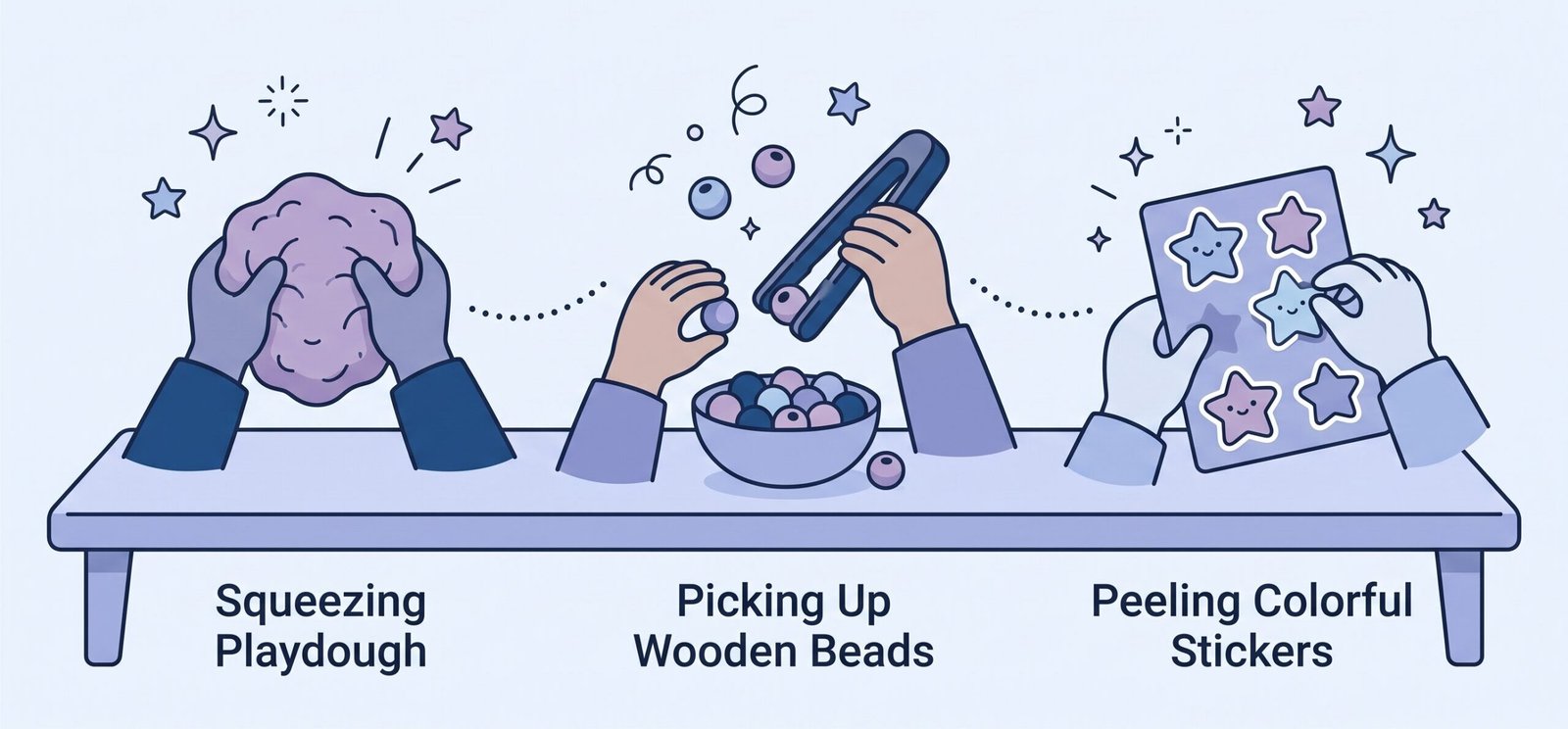
Rethinking how we support fine motor skills neurodivergent preschool children encounter every day begins when we look past the surface behaviour of task avoidance and see the physical exhaustion happening underneath.
When my daughter was four years old, her preschool room had a morning drawing table set up with small jars of triangular crayons, thick pencils, and crisp sheets of butcher paper. Other children sat down happily, picked up crayons with natural three-finger grips, and covered their sheets with bright scribbles, suns, and rainbow arches.
My daughter would not even sit down.
She would circle the perimeter of the table like a wary animal. If an educator gently guided her toward a chair, her shoulder would dip, her fingers would turn completely limp, and she would let her entire body slide onto the floor. If I sat beside her at home and handed her a crayon, she would clench it inside a tight, white-knuckled fist like a dagger, press down until the wax snapped, and fling the pieces across the lino with an explosive, angry cry.
A cold, familiar pit of worry settled into my stomach: She is avoiding every fine motor task. What will happen when she reaches formal schooling? Why is holding a pencil provoking a full meltdown?
At that time, I was working as a university lecturer in early childhood education. During the week, I stood in lecture halls delivering presentations on pre-writing patterns, pincer grasp milestones, and early literacy readiness. I would later spend years working directly as a childcare educator, eventually embarking on my doctoral research when she turned six.
Yet back then, in my own living room, my academic lecture slides gave me no comfort. I had no idea I had ADHD myself, and I had no understanding that my daughter was carrying her own sensitive, intense neurodivergent profile. I thought fine motor refusal was an issue of stubbornness, low motivation, or lack of interest.
What I did not understand then was that she was not refusing the paper. Her small hands were experiencing intense physical fatigue, low muscle tone, and a complete breakdown of motor planning. What looked like defiance was an intelligent nervous system putting up a defensive wall against physical exhaustion.
The hidden physiology: why fine motor skills neurodivergent preschool routines fail
In mainstream early childhood environments, fine motor development is frequently treated as a purely behavioural milestone. We hand children scissors, beads, and markers, assuming that if they practice enough, the hand muscles will naturally coordinate.
For neurodivergent children, whether autistic, ADHD, or carrying traits of Developmental Coordination Disorder (dyspraxia), holding a tool is not a simple habit. It is an intense, whole-body neurological challenge.
As clinical resources from Healthdirect Australia explain, Developmental Coordination Disorder (DCD or dyspraxia) affects how the brain plans, sequences, and executes coordinated motor tasks. When you look beneath the resistance, several physiological factors explain why fine motor skills neurodivergent preschool settings demand can trigger such deep resistance:
| Physiological Mechanism | What Is Happening Inside the Body | How It Looks on the Preschool Rug |
|---|---|---|
| Hypotonia (Low Muscle Tone) | The resting tension of muscle fibres is reduced; holding joints stable requires continuous conscious muscular effort. | Leaning their chest against the table, propping their chin with one hand, or slumping completely out of the chair. |
| Joint Hypermobility | Ligaments in the finger joints have excessive laxity, collapsing backward under downward pencil pressure. | Clenching the pencil in a tight “death grip” or wrapping the thumb completely over all fingers to artificially lock the joint. |
| Proprioceptive Gating Differences | The brain receives faint or inaccurate feedback from muscle spindles and joint receptors regarding force and body position. | Ripping paper by pressing too hard, or dropping crayons repeatedly because the hand cannot gauge required grip tension. |
| Motor Planning (Dyspraxia) | The neurological pathway between ideation (what to draw) and motor execution (how to move the fingers) is fragmented. | Freezing, staring at the page, or pushing materials away because initiating the motor sequence feels overwhelming. |
When a child with low tone and hypermobile finger joints is asked to sit upright in a chair and draw circles, their body is working three to four times harder than their neurotypical peers.
By minute three, their hand is burning with lactic acid buildup, their neck muscles are aching from holding up their head without core stability, and their cognitive energy is completely spent. Forcing them to “finish their drawing” is not teaching perseverance; it is demanding that they endure physical pain.
The myth of the isolated hand: proximal stability before distal control
One of the most common errors made by educators and parents alike is assuming that fine motor skills belong exclusively to the hand and fingers.
In developmental neuroscience and pediatric occupational therapy, motor control develops along a strict biological vector: proximal to distal. That is, control develops from the centre of the body outward.
You cannot have stable distal control (dexterous fingers holding a pencil) without stable proximal foundations (a strong core, a grounded pelvis, and stable shoulder girdles).
As research published in PubMed Central on pediatric proprioception and motor control demonstrates, children with neurodevelopmental differences often display distinct variations in body awareness that directly impact coordinated task execution. When a child lacks strong core muscle tone, their shoulder joints float. Without a locked, stable shoulder, the elbow cannot stabilise. Without a stable elbow, the wrist cannot extend into an efficient position.
The tiny intrinsic muscles of the hand are forced to do the heavy stabilisation work that the core and shoulders failed to provide.
The result? Instant hand cramping, claw grips, and immense task frustration. If we want to support fine motor skills neurodivergent preschool children need, we have to stop looking at the fingers and start looking at the whole body.
What didn’t work: the well-meaning mistakes I made as an academic mum
Because I was lecturing in early childhood education, I thought the solution was more educational scaffolding. I surrounded my daughter with specialized resources, and almost every single one backfired.
Here is what failed in our home:
1. Enforcing rigid pencil grips too early
I bought ergonomic rubber pencil grips, contoured claw holders, and triangular crayons. Every time she grabbed a marker, I would physically rearrange her fingers into a tripod grip, chanting cheerful phrases about “pinching the tip”.
It was disastrous. My physical interference interrupted her motor planning, made her feel incompetent, and turned a joyful sensory activity into an uncomfortable compliance test. She would drop the marker instantly and refuse to return to the table for days.
2. Over-prescribing tabletop cutting and tracing sheets
I printed stacks of developmental pre-writing worksheets featuring straight lines, zig-zags, and scissor tracks.
For an ADHD child with high rejection sensitivity and sensory defensiveness, a black-and-white worksheet looks like an exam. The visual glare of the white page, combined with the precision required to stay on a dotted line, triggered immediate fight-or-flight responses. She would scribble wildly across the page in anger or tear the sheet in half.
3. Ignoring the emotional cost of fine motor fatigue
I failed to realise that fine motor fatigue was the direct trigger for our late-afternoon meltdowns. On days when her preschool had an extended craft session, her capacity to handle basic transitions at home collapsed. Her nervous system had spent all its regulatory fuel simply trying to hold a paintbrush and keep her torso upright. When we explored the mechanisms behind polyvagal theory and early childhood meltdowns, it became clear that physical exhaustion triggers autonomic survival alarms just as quickly as emotional distress.
What actually helped: 5 powerful shifts for fine motor skills neurodivergent preschool children
Real progress did not arrive from corrective drills or handwriting sheets. It arrived when I stripped away the pressure, took play off the chair, and rebuilt her motor foundation from the ground up.
These five practical shifts transformed how my daughter engaged with her hands:
1. Moving to vertical surfaces
Sitting at a flat table is the hardest posture for a child with low muscle tone. It encourages slouching, forward neck tilt, and wrist flexion.
I taped large sheets of butcher paper directly onto our hallway walls, the kitchen fridge, and external fence palings. I had her draw standing up, or kneeling on both knees.
- Automatic Wrist Extension: Working vertically naturally bends the wrist back into extension, which automatically encourages the fingers to form an efficient tripod grasp without adult intervention.
- Shoulder Girdle Activation: Holding an arm up against gravity recruits the latissimus dorsi and core muscles, building the proximal strength needed for future pencil control.
- Core & Balance Engagement: Standing while drawing requires active posture, reducing the lethargy and postural collapse seen in tabletop seating.
- Whole-Body Proprioceptive Feedback: Children can lean into the wall, providing heavy proprioceptive grounding to their joints as they work.
2. Replacing tabletop pencil drills with heavy-work play
Before asking small hand muscles to perform delicate fine motor tasks, the brain needs intense proprioceptive feedback to map where the joints are in space. As detailed in our foundational guide on the sensory-seeking toddler and proprioception, deep pressure calms and organises the central nervous system.
We replaced pencil practice with heavy-hand work:
- Hiding glass beads inside dense therapeutic putty that required two-handed pulling and ripping to extract.
- Squeezing heavy plastic spray bottles filled with water to wash chalk off outdoor pavers.
- Climbing rope ladders and swinging from overhead monkey bars to build latissimus and grip strength naturally.
- Tearing thick corrugated cardboard strips into pieces to make bedding for toy animals.
These activities strengthened her intrinsic hand muscles without ever making her feel like she was performing a clinical task.
3. Using broken crayons and golf pencils
If you hand a preschooler with motor planning challenges a standard, long marker, their entire hand instinctively wraps around the shaft in a full palmar grasp. The pencil is simply too long and top-heavy for small hands to control.
The simplest solution cost zero dollars: I took her crayons and deliberately snapped them into one-inch stubs. I bought miniature golf pencils without erasers.
When a writing utensil is only two or three centimetres long, the human hand cannot physically wrap a whole fist around it. The child is mechanically compelled to hold it between the tips of their thumb, index, and middle finger. It eliminates the need for adult nagging or awkward rubber grips; the physical tool itself cues the correct motor grasp.
4. Offering low-demand, sensory-rich mark-making
To rebuild her confidence with writing tools, I had to divorce mark-making from precision. Precision induces anxiety; exploration builds connection.
We used dynamic, low-demand sensory mediums:
- Drawing pathways through a baking tray filled with damp salt or shaving foam using a single index finger.
- Using wet paintbrushes to “paint” giant disappearing lines on hot concrete in the driveway.
- Tracing wide paths using chunky chalk on textured brick walls.
By removing the permanent finality of paper and pencil, her fear of making a mistake evaporated. When she needed structured interaction, using gentle, child-led connection strategies inspired by DIR Floortime play at home helped us turn mark-making into a shared game rather than an evaluation.
5. Providing story-led, open-ended tracing paths
Once her hand strength and confidence returned, we reintroduced paper, but in a completely different way.
Instead of dry, repetitive handwriting drills, we used story-led tracing paths. These were not worksheets with rigid, narrow lines where drifting off-track felt like failure. They were wide, calming, narrative-driven pathways: helping a little bear find its way through a forest, or guiding a shooting star across the sky.
When mark-making is embedded within an imaginative story, an ADHD brain receives the dopamine reward it needs to stay engaged. The hand moves not for compliance, but to discover what happens next in the story.
The neurodivergent parent factor: executive fatigue and motor mess
There is a reality to supporting fine motor skills neurodivergent preschool development that clinical textbooks rarely acknowledge: the intense sensory and executive toll it takes on the parent.
Sensory fine motor activities are messy. Shaving cream, playdough crumbs trodden into carpet fibres, water spills, and snapped crayons scattered across floorboards directly trigger adult sensory overload.
For an adult with undiagnosed ADHD, the executive functioning required to set up a sensory tray, supervise it, and clean it up while managing domestic chaos can feel paralysing.
For years, I felt guilty because I could not maintain the elaborate sensory bins I saw on parenting blogs.
I had to learn to protect my own regulation first. I stopped setting up messy activities in our living room. We moved wet and crumbly sensory play outside onto the grass where clean-up meant turning on the garden hose. I embraced contained, dry materials like our quiet story-tracing pages that offered high developmental value with zero executive mess.
Remember: an unhurried, emotionally calm parent offering a five-minute chalk game on a patio wall builds far more neural safety than an overwhelmed, stressed parent managing a thirty-minute Pinterest-worthy craft disaster.
Building motor confidence over time: the long view
Looking back across the years, the patience we invested during those volatile preschool mornings paid off in ways I could not have imagined.
When my daughter entered primary school, her hands did not shake or cramp. She still wrote with a unique, slightly loose grip, and she still preferred breaks during long writing sessions, but she never experienced the shame-driven task avoidance that plagued her early years. She knew how to advocate for herself. She knew that when her hand felt tired, she could squeeze a therapy ball, roll her shoulders, and return to the task when ready.
Broad societal child development milestones often tell us that every four-year-old should be drawing recognizable figures, writing their name, and cutting neat circles with metal scissors.
If your neurodivergent preschooler is nowhere near those milestones today, take a deep, grounding breath.
Drop the compliance worksheets. Put the triangular pencil grips back in the drawer. Tape a large piece of scrap cardboard to your kitchen wall, hand them a broken stub of chalk, and let them push against the surface with all the energy in their body.
Fine motor dexterity is not built by forcing small hands to conform to rigid adult tools. It is built from the core outward, through strength, shared play, and the steady confidence that their body is capable, trusted, and safe.
Looking for Calm, Story-Led Tracing for Reluctant Hands?
When delicate hand muscles feel fatigued, our wide-path, Montessori-inspired story tracing printables provide a soothing, low-pressure way to build fine motor control without tears.
Explore Calm Story Tracing BundlesReferences
- Healthdirect Australia. (2024). Developmental coordination disorder (DCD or Dyspraxia). Australian Government Department of Health and Aged Care.
- Martín-López, M., Hurtado-Pomares, M., & Terol-Cantero, M. C. (2024). Proprioception, emotion and social responsiveness in children with neurodevelopmental conditions. Children, 11(6), 708.
- Center on the Developing Child at Harvard University. (2014). Enhancing and Practicing Executive Function Skills with Children from Infancy to Adolescence. Harvard University.
- Zwicker, J. G., Missiuna, C., Harris, S. R., & Boyd, L. A. (2012). Developmental coordination disorder: A review and update. European Journal of Paediatric Neurology, 16(6), 573–581.
- American Academy of Pediatrics. (2018). The power of play: A pediatric role in enhancing development in young children. Pediatrics, 142(3), e20182058.
- Greenspan, S. I., & Wieder, S. (2006). Engaging Autism: Using the Floortime Approach to Help Children Relate, Communicate, and Think. Da Capo Lifelong Books.
This article is based on my personal parenting experience, reflections on late-diagnosed adult ADHD, and my background in early childhood education as a former university lecturer, educator, and doctoral researcher. It is shared for educational, supportive, and informational purposes only and does not constitute medical, pediatric, or occupational therapy advice. Every child develops motor skills along their own developmental timeline. If your child experiences significant, persistent motor difficulties, joint pain, hand tremors, or coordination challenges that interfere with everyday functioning, please consult with your GP, a pediatrician, or a qualified pediatric occupational therapist for comprehensive, individualized assessment and support.
Related topics for parents
- Child development milestones: what every parent should know
- Sensory-seeking toddler and proprioception: calming the chaos
- DIR Floortime play at home: 5 powerful shifts for parents
- Polyvagal theory & meltdowns in early childhood: beyond the tantrum label
- Signs of ADHD in girls: recognizing subtle early cues
- Autism in girls closing the gender gap: practical guide
- Toddler hair pulling & frustration tolerance: what’s really happening
- Toddler sleep resistance & ADHD: 5 real bedtime shifts
- Autism and attachment myths: 5 powerful truths for parents
- Reggio Emilia approach at home: fostering curiosity and calm
- Montessori and QuietSprout story tracing bundles