
First Then Regulation Reset Mats: How to Ease Daily Transitions Without Battles
When a child unravels halfway through getting ready, hides under the dining table, or meets simple transitions with fierce resistance, they are rarely choosing to be difficult. Introducing low-demand First Then Regulation Reset Mats removes auditory pressure, grounds a dysregulated nervous system, and provides an intentional safety valve before task freeze turns into a full meltdown.
Table of Contents
- Why Traditional First-Then Boards Trigger Resistance
- Anatomy of First Then Regulation Reset Mats
- Printable Layout: First Then Regulation Reset Mats
- How to Introduce First Then Regulation Reset Mats at Home
- Pairing Visual Tools Across the Day
- Storybook Anchors for School Anxiety on Etsy
- Child Safety and Choking Prevention Around Visual Boards
- What Happened on My Own Floorboards
- Download Your Free First Then Regulation Reset Mats
- References & Research Foundations
- Safety & Editorial Disclaimer
Why Traditional First-Then Boards Trigger Resistance
The Premack principle, demand anxiety, and missing regulation exitsStandard First-Then boards have been staples in early education for decades. Rooted in the Premack principle, the basic premise is simple: complete a less-preferred task first, followed immediately by an enjoyable one. While the theory is sound, the real-world application often feels like a high-pressure ultimatum: “First finish your worksheet, then you get playdough.”
For an autistic child, a child with ADHD, or one with a Pathological Demand Avoidance (PDA) profile, this transactional phrasing registers through neuroception as a threat to autonomy. When the brain perceives a loss of control, the sympathetic nervous system activates fight, flight, or freeze.
Most traditional boards fail because they offer no exit ramp. If the child dysregulates during the “First” step, the adult is left repeating the command, escalating tension on both sides. First Then Regulation Reset Mats transform a compliance tool into a co-regulation partnership by building a physical somatic reset directly onto the page.
Rigid Compliance Boards (High Friction)
Uses preferred activities as leverage. Provides no support when motor initiation fails, spiking demand anxiety and triggering power struggles.
First Then Regulation Reset Mats (Low Friction)
Breaks steps down into single visual anchors while providing an immediate somatic grounding strip to settle the nervous system when overload hits.
Anatomy of First Then Regulation Reset Mats
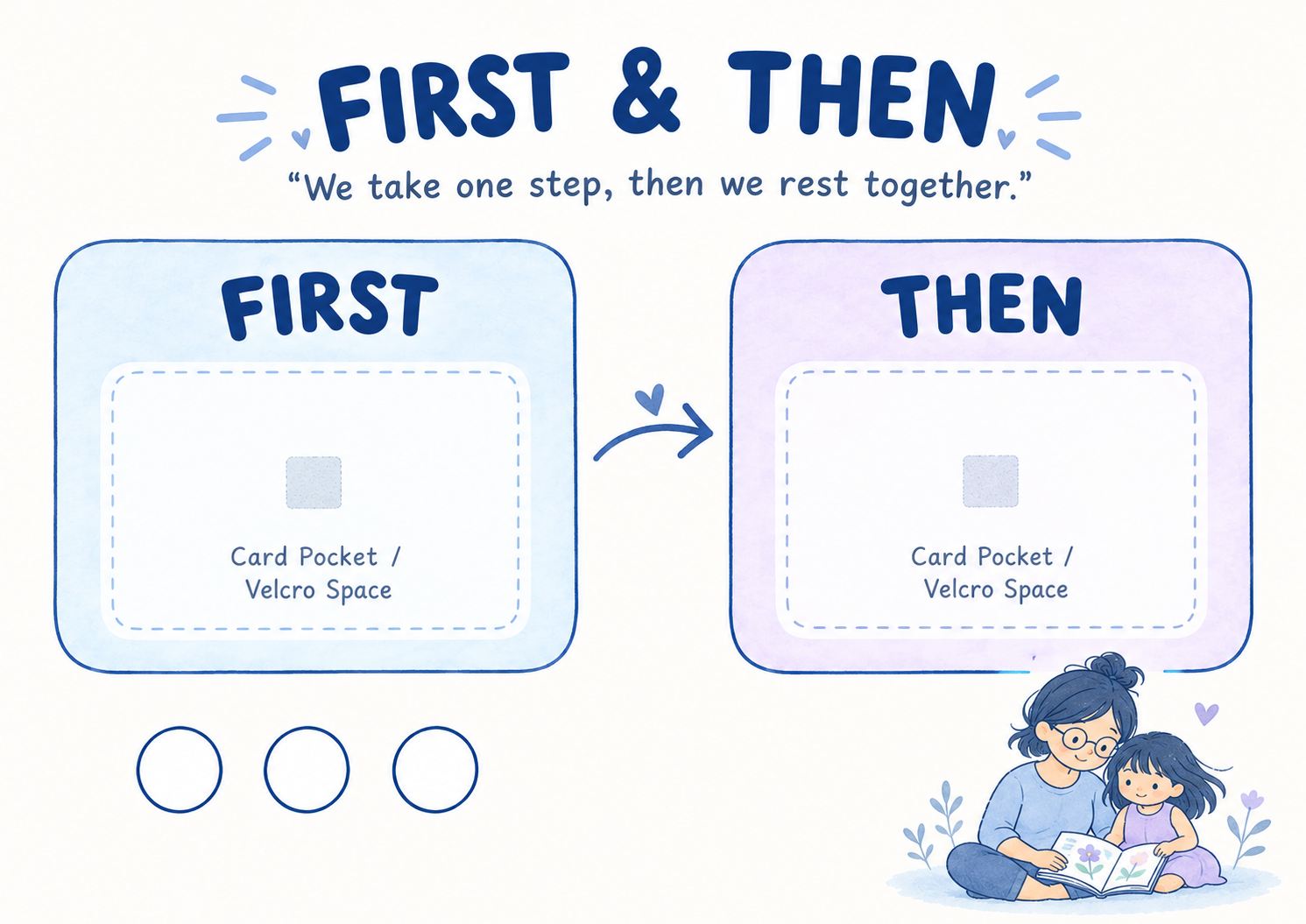
Low-arousal artwork, directional flow, and built-in groundingInstead of bright primary colours and clinical icons, our printable uses calming navy contour lines, soft watercolour tones, and generous white space. The layout splits cleanly into two distinct functional zones.
| Board Zone | Visual & Somatic Element | Neurological Purpose |
|---|---|---|
| The “First” Box | Single visual card representing an immediate action | Removes working memory overload by showing one micro-step. |
| The “Then” Box | Visual anchor representing a comforting activity | Provides dopamine predictability and clear closure. |
| The Reset Strip | Two tactile hand outlines and a wave-breathing groove | Delivers isometric joint compression to activate vagal braking. |
1. The “First” Frame (Bite-Sized Initiation)
The upper-left box holds a single visual token. To prevent executive dysfunction freeze, the task must be broken down to its smallest component. Instead of “Get ready for school,” the tile shows “Put on socks.”
2. The “Then” Frame (Predictable Safety)
The upper-right box illustrates what immediately follows. This is not a prize to be earned; it is an unchanging rhythm that provides nervous system certainty, such as warm toast, listening to an audiobook, or heading to the backyard swing.
3. The Regulation Reset Grounding Strip
The bottom third of First Then Regulation Reset Mats is an intentional somatic safety valve. It contains two palm outlines for firm downward hand presses and an undulating breath wave. When a child freezes, the focus pivots away from the task and onto physical grounding.
How to Introduce First Then Regulation Reset Mats at Home
Three low-pressure steps to restore calm transitionsIntroducing new tools during a live meltdown will backfire. Use these three gentle steps to build familiarity on quiet afternoons:
Step 1: Explore the Board During Calm Windows
Sit on the lounge room floor when energy is steady. Show your child the board and place two preferred tiles on it: “First we read a story, then we have afternoon tea.” Let them feel the Velcro, trace the breath wave, and place the cards. This ensures the brain tags the board with feelings of safety rather than pressure.
Step 2: The Silent Point Instead of Verbal Reminders
When moving from play to a morning transition, avoid calling instructions from across the house. Walk over to where your child is, crouch down, and gently point to the “First” card without talking. Visual cues bypass auditory processing fatigue, allowing motor planning to take place without friction.
Step 3: Honour the Reset Exit Ramp
If your child shows early signs of overwhelm—stiff shoulders, avoidance, or tears—pause the transition immediately. Point down to the reset zone: “Your body feels tricky right now. Let’s do three heavy palm presses together.” Press your hands down flat onto the board beside them. Engaging proprioceptive receptors lowers arousal, helping the prefrontal cortex return online.
Pairing Visual Tools Across the Day
Building a cohesive, low-arousal home environmentNo single visual tool solves every daily bump. Creating a predictable home rhythm works best when tools support each other across different spaces and energy levels:
- For whole-morning sequencing: When your child is ready to see the wider morning arc without being overwhelmed, our Visual Routine Cards for ADHD Kids provide a modular, eye-level schedule.
- For afternoon sensory crashes: When school pickup brings wild running or couch crashing, use our Pocket Heavy Work Cards to give muscles the deep joint resistance they are craving.
- For quiet table transitions: When hands need focused tactile grounding before meals or rest, pair simple routines with our Number Sense Playdough Mats 1 to 10.
Storybook Anchors for School Anxiety on Etsy
Relational connection to validate big morning feelingsTransitions between home and school are often where resistance surfaces most intensely. When morning hesitation is fueled by separation worries or classroom sensory overload, pairing visual routines with responsive storytelling creates deep reassurance.
Personalised School Anxiety Support: Wobblin Storybook
If big school transitions trigger morning tears or task freeze, our personalised storybook offers a gentle emotional bridge between home and the classroom. Customised with your child’s name, this story normalises first-day nerves, validates sensory wobbles, and reminds children that home connection remains unbroken while they are away.
Explore our complete range of low-arousal regulation aids, routine companions, and mindful early childhood gifts on Etsy Australia.
Visit the earlychildhoodedu Etsy Shop →Child Safety and Choking Prevention Around Visual Boards
Magnets, laminate edges, and small parts precautionsChild Safety & Household Hazard Notes
Visual schedules involve small interchangeable tiles and laminated materials. Keep these household safety standards in place:
- Swallowed Magnet Hazard: Avoid using self-adhesive magnet strips on the backs of tiles if you have babies, toddlers, or children who mouth objects at home. If peeled off and swallowed, multiple magnets can pull together across intestinal walls, causing life-threatening internal injuries. Stick firmly to hook-and-loop (Velcro) dots or fabric pocket charts.
- Sharp Laminated Corners: Trimming laminated pouches with standard scissors leaves sharp 90-degree plastic corners that can scratch eyes or skin. Always trim every card corner with a radius punch or curved scissors.
- Choking Hazard Prevention: Ensure all interchangeable visual tiles measure at least 45 mm x 45 mm (larger than an Australian 20-cent coin) so they do not present an airway obstruction risk for young siblings. Keep spare tiles stored out of reach in a secured zip pouch.
What Happened on My Own Floorboards
Learning to stop pushing when the body says pauseEarly in our parenting journey, our hallway was a battleground. Getting out the door required a mountain of words. I would find myself repeating instructions four, five, six times, each time a little louder and a little more frayed.
I made a traditional First-Then board, convinced it would solve everything. On paper, it was straightforward: First shoes, then park. But one rainy Thursday, my son sat on the floorboards, stared at his boots, and froze. When I pointed to the board and insisted, he kicked his boots across the hallway and hid behind the sofa, sobbing.
I realised then that the board was acting as an enforcer rather than a helper. His nervous system was overloaded, and my board gave him nowhere to go. That afternoon, I drew two handprints at the bottom of the card. The next time his body froze, I didn’t mention the shoes. I sat beside him, pressed my hands firmly onto the handprints, and took two slow, audible breaths.
He crawled out from behind the cushions, placed his small palms over mine, and pushed down. We stayed there for thirty seconds in complete silence. Once his breathing slowed, he looked up, picked up his boot, and slipped it on his foot without a single word from me. The transition didn’t need more pressure; it needed a physical bridge back to calm.
“A child stuck in transition freeze is not refusing your request; their body has lost its footing. When we stop talking and offer a physical moment of grounding, we show them that regulation always comes before expectation.”
Dewi Griffith, PhD, Founder
Download Your Free First Then Regulation Reset Mats
Get our calm, printable visual transition mat featuring clear task frames, soft watercolor tones, and a built-in somatic reset strip. Includes an A4 printable base board and starter transition tiles.
Download Free Printable PDF (A4 Mat)References & Research Foundations
Polyvagal theory, transition latency, and executive functioning evidence- Bandini, L. G., et al. (2010). Food selectivity in children with autism spectrum disorders and typically developing children. The Journal of Pediatrics, 157(2), 259-264.
- Bryan, L. C., & Gast, D. L. (2000). Teaching on-task and on-schedule behaviors to high-functioning children with autism via picture activity schedules. Journal of Autism and Developmental Disorders, 30(6), 553-567.
- Dettmer, S., et al. (2000). The use of visual schedules to improve the on-task and transition behaviors of students with autism and intellectual disabilities. Focus on Autism and Other Developmental Disabilities, 15(3), 163-169.
- Porges, S. W. (2011). The Polyvagal Theory: Neurophysiological Foundations of Emotions, Attachment, Communication, and Self-regulation. W. W. Norton & Company.
- Premack, D. (1959). Toward empirical behavior laws: I. Positive reinforcement. Psychological Review, 66(4), 219-233.
- Sweller, J. (1988). Cognitive load during problem solving: Effects on learning. Cognitive Science, 12(2), 257-285.
This resource reflects personal parenting experience alongside established neuro-developmental research and is provided for educational purposes only. It is not a substitute for individualized assessment by a registered occupational therapist, psychologist, or pediatrician. Always ensure visual boards are securely mounted and supervise young children around loose or laminated parts.