
Calm Corner Design Early Childhood: 4 Powerful Ways to Build a Sanctuary
In neurodivergent learning design, calm corner design early childhood practice creates an opt-in spatial retreat that lowers environmental demands. By providing tactile boundaries, acoustic buffering, indirect illumination, and low-demand grounding materials, the space invites a dysregulated child to down-regulate their physiology without shame, isolation, or behavioural penalties.
Mastering calm corner design early childhood educators and families can rely on requires abandoning the idea of a discipline chair. A real calm corner is an autonomic nervous system sanctuary built to restore biological safety when emotional or sensory bandwidth collapses.
- The Corner Behind Our Sofa: An ADHD Mother and Six Year Old Daughter Reality
- Why Most Commercial Calm Down Corners Fail Overwhelmed Children
- 4 Powerful Ways to Build a Calm Corner Design Early Childhood Sanctuary
- Low Demand Sensory Resources: What Belongs and What Overstimulates
- Operational Rules: How Adults Introduce and Protect the Space
- Classroom Settings vs Family Living Rooms: Practical Spatial Nuance
- Connected Guides in the Sensory Environment Cluster
- Academic References and Architectural Science
The Corner Behind Our Sofa: An ADHD Mother and Six Year Old Daughter Reality
When my daughter turned six here in Victoria, Australia, our domestic routines reached an unmistakable sensory tipping point. Both of us share an ADHD neurotype, which means our nervous systems absorb sensory input without a natural volume filter. On busy weekday afternoons after school, our living room could quickly turn into an emotional storm.
In the beginning, I tried creating what mainstream parenting blogs recommended. I set up a bright little table with a feelings chart, an hourglass timer, and plastic tubs filled with colourful sensory squish toys. Whenever my daughter became overwhelmed, I would suggest she sit there to calm down.
The result was almost always an explosive meltdown. To her nervous system, being sent to a brightly lit, exposed table with an emotion wheel felt like being put on trial. The chart asked her prefrontal cortex to analyse complex feelings at the exact moment her thinking brain was offline. The squish toys became projectiles, and the hourglass timer felt like a ticking threat.
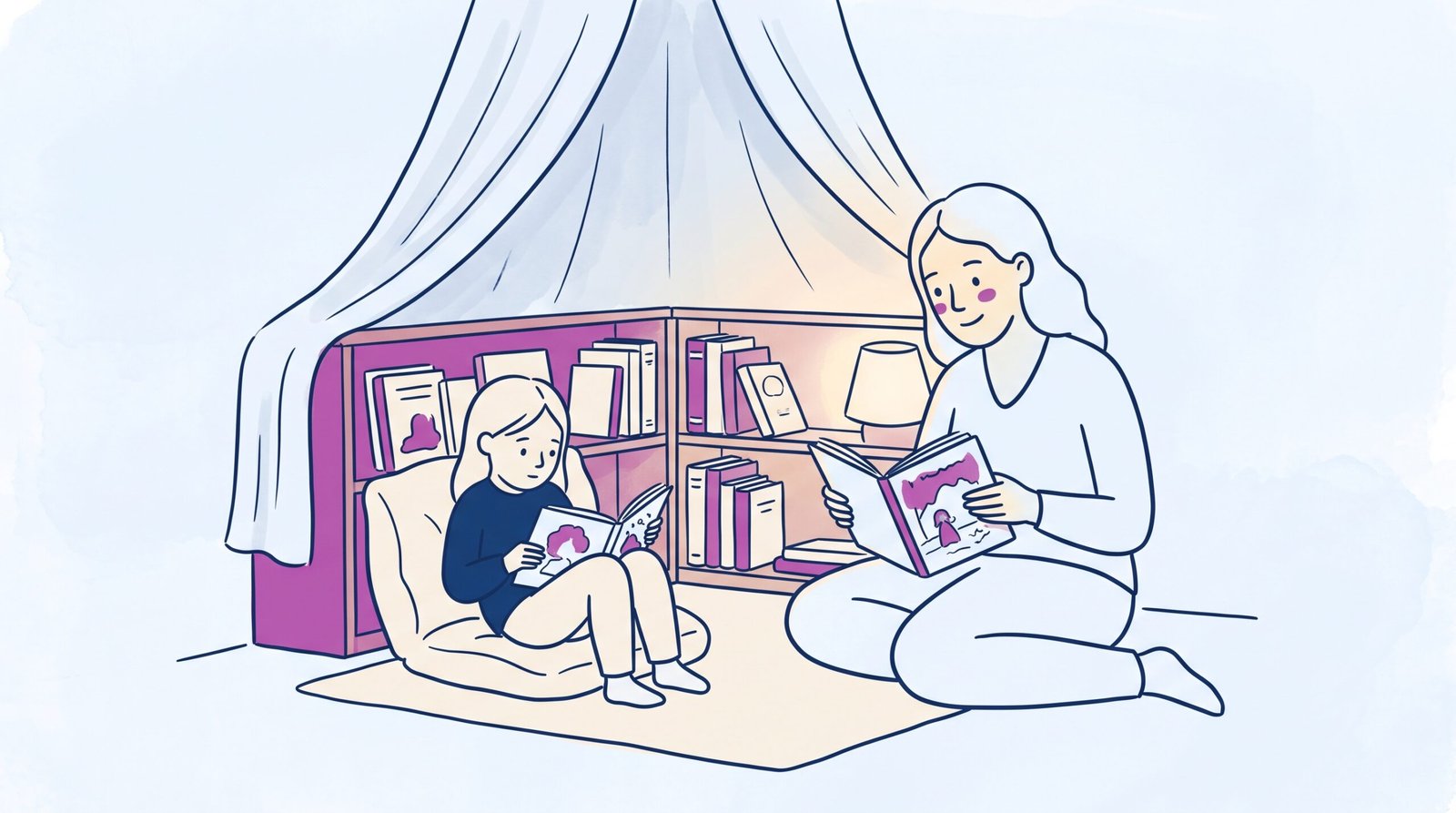
The breakthrough came when I discarded the commercial advice and applied the spatial principles from my early childhood doctoral research. We looked for the quietest corner of our living room, tucked into the alcove behind our sofa away from walking paths. We laid down a heavy, second-hand wool rug, piled up dense calico floor cushions, and enclosed the nook with a low wooden bookshelf.
There were no charts on the wall and no timers. The space was semi-enclosed, visually quiet, and protected from foot traffic. The first time my daughter felt her body accelerating, she walked into that corner on her own, crawled under a soft knit blanket, and rested with her back against the bookshelf. Within ten minutes, her breathing slowed to a peaceful rhythm. Seeing her body relax confirmed what developmental architecture has always proven: children do not need behaviour management lessons during distress; they need physical geography that feels safe.
Under Australia’s Early Years Learning Framework (EYLF), educators are tasked with building learning environments that honour children’s emotional wellbeing and sense of belonging. Establishing a thoughtful calm corner design early childhood retreat is one of the most practical ways to turn that principle into daily reality.
Why Most Commercial Calm Down Corners Fail Overwhelmed Children
Walk into many modern early learning centres or primary classrooms, and you will see calm down spaces that unintentionally trigger the very dysregulation they are intended to soothe. The failure usually comes down to three architectural and psychological mistakes:
| Flawed Commercial Setup | Neurological and Autonomic Problem | Effective Calm Corner Design Early Childhood Practice |
|---|---|---|
| Exposed Central Placement Positioned in open sightlines near teacher desks, group rugs, or bathroom doors. |
Activates social anxiety and fear of peer judgment. The child feels watched while emotionally vulnerable. | Perimeter Nesting: Tucked into a quiet corner with low physical barriers shielding sightlines from peer traffic. |
| Cognitive Emotion Worksheets Laminated feeling faces, breathing wheel dials, and verbal reflection sheets posted on the wall. |
Demands complex language processing from Broca’s area while the brain is in subcortical survival mode. | Zero Demand Visuals: Neutral, undecorated walls that allow optic pathways to rest without demanding answers. |
| Punitive Mandates Adult directs the child: “You are not listening, go to the calm corner for five minutes.” |
The nervous system registers the space as isolation and rejection, triggering deeper fight-or-flight panic. | Universal Opt-In Access: The space is always open, freely chosen, and never tied to disciplinary consequences. |
| Overstimulating Plastic Toys Baskets overflowing with neon squish balls, pop tubes, and noisy sensory fidgets. |
Floods sensory channels with excessive visual and tactile noise, accelerating motor agitation. | Muted Heavy Proprioception: Weighted lap pads, dense wool cushions, and quiet natural open-ended materials. |
As developmental research from Harvard’s Center on the Developing Child emphasizes, executive functioning and self-regulation rely on low-stress environments. A space that adds cognitive demands or public exposure cannot support regulation.
4 Powerful Ways to Build a Calm Corner Design Early Childhood Sanctuary
To transform a classroom corner or domestic nook into an authentic sanctuary, follow these four foundational structural pillars of calm corner design early childhood architecture:
1. Provide Physical Perimeter Security
In polyvagal theory and environmental psychology, the human nervous system constantly scans behind itself for approaching threats through neuroception.[1] An exposed back creates low-level autonomic tension.
- Enclose Three Sides: Position the sanctuary so it is bordered by two solid walls, with a low timber bookshelf forming the third boundary. This leaves only one open entry point that the child can easily see.
- Low Visual Profile: The bookshelf should stand between waist and shoulder height for an adult, allowing teachers to maintain gentle supervision while giving the seated child complete visual privacy from peer sightlines.
- Back Protection: When a child sits inside the corner, their back should rest firmly against a solid, unmoving surface. This physical support quietens subcortical alarm systems immediately.
2. Buffer Decibels and Diffuse Glare
High-frequency acoustic echo and overhead lighting flicker are two of the fastest ways to push an ADHD nervous system into sensory overload.
- Dense Floor Textiles: Lay down a thick woven wool rug with a felt underlay to deaden floor vibrations and absorb room echo.
- Draped Calico Canopies: Suspend a lightweight calico fabric canopy across the corner ceiling to diffuse downward glare from fluorescent troffers.
- Indirect Amber Illumination: Place a small, sturdy table lamp fitted with a warm 2700 Kelvin LED globe inside the nook, keeping illumination soft, warm, and inviting.
3. Anchor the Body with Proprioceptive Weight
When emotional storms peak, higher-order thinking disconnects. The fastest biological route back to calm is through deep proprioceptive pressure.
- Dense Floor Cushions: Provide oversized cushions stuffed with natural cotton or heavy textile offcuts rather than light foam, giving the child firm physical resistance when leaning back.
- Weighted Lap Pads: Keep a clean two-kilogram weighted lap blanket or a bean-filled fabric animal accessible on a low shelf. Deep pressure stimulates the parasympathetic nervous system, lowering elevated heart rates.
- Soft Woven Blankets: A breathable knit blanket allows an overwhelmed child to pull fabric over their shoulders, creating their own micro-cocoon when external visual stimuli feel unbearable.
4. Select Simple, Non-Directive Resources
The resources placed inside a calm corner should never require instructions, rules, or performance.
- Familiar Picture Books: Provide three or four beautifully illustrated, gentle picture books with minimal text that the child already knows and loves.
- Natural Smooth Objects: Offer a small woven basket holding large river stones, smooth timber blocks, or felted wool balls that offer soothing tactile feedback without flashing lights or noise.
- Slow Moving Visual Bottles: A sealed liquid motion bottle filled with dense glycerine and mica powder allows the child to watch slow, rhythmic swirling, helping anchor darting eye movements.
Low Demand Sensory Resources: What Belongs and What Overstimulates
Choosing what goes into your calm corner design early childhood layout requires intentional subtraction. Well-meaning educators often fill bins with too many novelty items, inadvertently turning a peaceful retreat into an overstimulating toy box:
- What Truly Calms Developing Nervous Systems Heavy woven blankets, firm floor cushions, weighted lap pads, smooth wooden rolling objects, liquid motion bottles, noise-dampening ear defenders, and soft neutral textiles.
- What Unintentionally Dysregulates the Space Squeaking rubber toys, plastic pop tubes that snap loudly, high-contrast neon fidget spinners, timers that beep, mirrors that demand self-evaluation, and complex emotional classification worksheets.
- The Rule of Three Resources Never place more than three distinct sensory choices in the corner at one time. Rotating items every fortnight preserves novelty without creating visual competition.
Operational Rules: How Adults Introduce and Protect the Space
Even the most thoughtfully built calm corner design early childhood setup will fail if adults manage it with punitive or demanding language. To ensure the space functions as a genuine sanctuary, early childhood educators and parents must uphold three operational guidelines:
1. Introduce the Space During Times of Peace
Never introduce a calm corner to a child in the middle of a conflict or meltdown. Introduce it during a slow, settled morning when the child is calm and relaxed. Sit together inside the cushions, explore the smooth stones, and explain the space with simple language:
“This is our quiet sanctuary. When your body feels fast, loud, or tired, you can always come sit here to rest. Nobody will ask you big questions here. It is always open for you.”
2. Maintain Strict Universal Opt-In Access
A calm corner should never become an involuntary destination. If an adult says, “You hit your friend, go to the calm corner,” the sanctuary instantly turns into a time-out space. The child’s brain connects the area with shame, rejection, and exclusion.
Instead, offer gentle co-regulation invitations: “The room is really loud right now. I am going to sit by the soft cushions for a few minutes. You are welcome to join me.” If the child declines, respect their autonomy and offer supportive proximity where they are.
3. Protect the Border from Peer Intrusions
For the sanctuary to work, children must trust that other children will not crowd them while they are inside. Establish a firm group understanding: the calm corner is a single-child or adult-and-child space. When someone is inside, peers do not lean over the bookshelf, talk to the child, or take materials from the corner. It is a sacred, uninterrupted zone of recovery.
Classroom Settings vs Family Living Rooms: Practical Spatial Nuance
While the underlying biological principles of calm corner design early childhood practice remain consistent across all settings, physical architecture differs between an early childhood centre and a domestic family home:
| Design Parameter | Early Childhood Classroom Setting | Domestic Family Living Room |
|---|---|---|
| Supervision Sightlines | Low timber shelves allow the educator to see the child’s shoulders while preserving the child’s privacy from seated peers. | Tuck the space into the alcove behind an L-shaped lounge or beneath a low window where parents can glance over casually. |
| Peer and Sibling Dynamics | Requires clear group rules so peers do not treat the corner as an active dramatic play fort. | Explain to siblings that when someone is inside the cushion nest, they are resting and cannot be disturbed. |
| Acoustic Protection | Position the sanctuary as far away from block building, carpentry benches, and outdoor doors as physically possible. | Keep the corner away from kitchen appliances, dishwashers, and television screens to protect sensory quiet. |
| Cleaning and Hygiene | Use machine-washable cotton cushion covers and wipeable weighted lap pads that comply with health regulations. | Use cosy family blankets and soft pillows that carry comforting, familiar domestic scents. |
By adapting your calm corner design early childhood layout to the unique footprint of your room, you build an enduring environmental bridge that supports emotional regulation throughout the day.
- Discover practical ways to buffer room acoustics using simple domestic textiles in our guide on Low-Cost Sensory Classroom Setup: 4 Powerful Layout Shifts →
- Learn how overhead lighting flicker drains neurodivergent attention and working memory in Lighting Fluorescent Flicker ADHD: 4 Powerful Ways Light Drains Focus →
- Explore the decibel thresholds and sound reflections that trigger fight-or-flight in Classroom Noise and Sensory Overload Decoded →
- Return to our overarching cluster hub for the foundational architecture of the Sensory Environment in Early Childhood Knowledge Hub →
Academic References and Architectural Science
- Porges, S. W. (2011). The Polyvagal Theory: Neurophysiological Foundations of Emotions, Attachment, Communication, and Self-Regulation. W. W. Norton & Company. [Neuroception of environmental safety, autonomic regulation, and middle-ear acoustic gating].
- Mostafa, M. (2008). An architecture for autism: Concepts of design intervention for the autistic user. International Journal of Architectural Research, 2(1), 189-211. [Peer-reviewed architectural framework for sensory zoning, escape spaces, and spatial thresholds].
- Barrett, P., Davies, F., Zhang, Y., & Barrett, L. (2015). The impact of classroom design on pupils’ learning: Final results of a holistic, multi-level analysis. Building and Environment, 89, 118-133. [Empirical verification of spatial containment, visual comfort, and acoustic quality in early learning progress].
- Dunn, W. (2014). Sensory Profile 2: User’s Manual. Pearson. [Sensory processing models, environmental accommodation, and physiological down-regulation].
- Shanker, S. (2016). Self-Reg: How to Help Your Child (and You) Break the Stress Cycle and Successfully Engage with Life. Penguin Random House. [Biological and environmental stressors affecting childhood self-regulation].