
Classroom Noise Sensory Overload: 4 Powerful Ways Sound Triggers Meltdowns
In early learning spaces, classroom noise sensory overload occurs when continuous acoustic reverberation, sudden sharp decibel spikes, and competing human voices overwhelm a child’s auditory gating capacity. This persistent acoustic strain trips the middle-ear stapedius reflex, sending immediate threat alarms to the autonomic nervous system and forcing children into fight, flight, or behavioural distress.
If you have ever watched a young child plug their ears with their fingers in a crowded kindergarten room, or seen a settled morning collapse into shouting the moment five children begin building with wooden blocks together, you have witnessed classroom noise sensory overload in real time.
Sound is one of the most intrusive, invisible forces shaping childhood behaviour. We spend significant time thinking about daily schedules, visual charts, and educational toys. Yet the acoustic architecture of our rooms often decides whether a neurodivergent child feels safe or terrified long before any learning activity begins.
When an autistic child or a child with ADHD becomes dysregulated in a loud room, adults often assume the child is struggling with social sharing or emotional control. Living through this as an early childhood researcher with a doctorate from Deakin University, and as an ADHD mum raising my lively six-year-old daughter in Victoria, I know the truth is much simpler. The child’s ears are in biological agony, and their nervous system is trying to survive.
- The School Hall Echo: What Happened to My Daughter at Six
- The Polyvagal Ear: Why Background Clatter Triggers Survival Defense
- 4 Powerful Ways Classroom Noise Sensory Overload Triggers Meltdowns
- Acoustic Reverberation and the Breakdown of Auditory Gating
- 4 Powerful Low-Cost Acoustic Shifts for Real Australian Rooms
- Ear Defenders, Rest Nooks, and Sensory Boundaries Done Right
- References
The School Hall Echo: What Happened to My Daughter at Six
When my daughter turned six here in Victoria, she transitioned from a quiet, familiar preschool setting into a bustling primary school environment. In the early weeks of first term, her teachers noticed an unexpected pattern.
During outdoor play on the grass, she was joyful, cooperative, and engaged. She ran with other children, invented imaginative nature games, and listened happily to educator prompts.
However, the moment her group moved inside to the multipurpose hall for indoor music and movement, everything unraveled. Within ten minutes, she would press her back against the brick wall, slide down to the floor, and begin shouting at anyone who walked past. When an educator approached her with gentle words, my daughter threw her shoes across the floorboards and curled into a tight ball, completely unreachable.
The initial assumption was that she disliked group music or struggled with transitions. When I visited the multipurpose hall and sat on the floorboards myself, the cause became immediately obvious. The high ceilings, polished timber floors, and bare brick walls created massive acoustic bounce. Twenty-four children singing, clapping, and shuffling runners sounded like a roaring train tunnel.
For my daughter’s ADHD nervous system, that acoustic bounce was intolerable. She was experiencing severe classroom noise sensory overload. She could not separate her teacher’s spoken instructions from the scraping of chairs and the echo of singing. Her subcortical brain read that sonic roar as physical danger, and her outward behaviour was a desperate attempt to protect herself.
Under Australia’s national early childhood framework administered by ACECQA, education providers have an explicit duty to design physical environments that nurture children’s wellbeing. Addressing classroom noise sensory overload is essential to meeting that benchmark.
The Polyvagal Ear: Why Background Clatter Triggers Survival Defense
To understand why sound causes such profound distress, we have to look closely at Stephen Porges’ Polyvagal Theory and the anatomy of the human middle ear.[1]
The human ear contains tiny muscles, primarily the stapedius and tensor tympani, that regulate the tension of the eardrum. When we feel safe, these muscles contract, dampening low-frequency predator rumbles and tuning the ear to the precise frequencies of the human speaking voice. This state allows for calm social engagement, facial mirroring, and easy conversation.
When a space is flooded with unpredictable decibels, mechanical humming, and echoing clatter, the autonomic nervous system senses physical threat through neuroception. The middle-ear muscles instantly relax. This anatomical shift broadens the ear’s aperture to detect low-frequency rumbles and sharp sudden noises, while making it physically difficult to process human speech.
When an educator speaks to a child experiencing classroom noise sensory overload, the child cannot clearly perceive the adult’s soothing voice. The words sound muffled, garbled, and lost within the acoustic static of the room.
As developmental neurobiology from Harvard’s Center on the Developing Child emphasizes, elevated physiological stress immediately impairs executive working memory and impulse control. If a child’s ears are locked in survival defense, their thinking brain is offline.
4 Powerful Ways Classroom Noise Sensory Overload Triggers Meltdowns
Sound disruptions rarely occur as a single flat noise. In early childhood settings, classroom noise sensory overload operates through four distinct acoustic pathways:
| Acoustic Factor in Real Rooms | What Happens in the Body and Nervous System | Observable Behavioural Presentation |
|---|---|---|
| 1. High-Frequency Reverberation Sound waves bouncing off hard plaster, uncurtained glass windows, and polished vinyl flooring. |
Continuous auditory gating fatigue. The brain must spend immense energy filtering out old reflections of sound. | Clenching teeth, covering ears, vocal humming to block external sound, and sudden irritability by mid-morning. |
| 2. The Lombard Effect Spiral As room decibels rise, children and educators naturally speak louder to be heard, escalating the noise floor. |
Elevated sympathetic heart rate and autonomic tension as background decibels surpass sixty-five decibels. | Shouting during normal conversation, motor pacing, running across open spaces, and climbing on furniture. |
| 3. Sudden Sharp Decibel Spikes A plastic tub of wooden blocks dropping on floorboards, chair legs screeching, or a loud bell chime. |
An acute startle reflex that triggers a surge of cortisol and adrenaline into the bloodstream. | Bolting for the door, hitting out at nearby peers, bursting into tears, or dropping to the floor in shutdown. |
| 4. Competing Speech Channels Multiple adults and small groups talking simultaneously across shared tables with zero physical barriers. |
Auditory figure-ground collapse. The brain cannot isolate individual words from background conversational chatter. | Staring blankly, inability to follow two-step directions, and apparent defiance when spoken to directly. |
Acoustic Reverberation and the Breakdown of Auditory Gating
In their landmark study on holistic classroom architecture, Professor Peter Barrett and his research team proved that acoustic quality accounts for a massive proportion of student learning progress across early childhood years.[2]
When sound reverberation time exceeds zero point six seconds, speech intelligibility drops dramatically. In an untreated room, every spoken word hangs in the air, bouncing back and forth like a ping-pong ball.
For a neurotypical adult, the brain’s thalamus handles sensory gating efficiently, quietly discarding ninety percent of those echoes before they reach conscious awareness. For a child with ADHD, autism, or sensory processing differences, that gating threshold is fundamentally altered.[3]
The neurodivergent brain receives every acoustic reflection at full volume. Imagine trying to read an intricate book while three different radios play static right behind your head. That is what a standard, untreated kindergarten room feels like to a sensitive child.
Canadian scholar Stuart Shanker reminds us that sensory stress is an invisible energy thief.[4] A child who spends seventy percent of their biological energy filtering out classroom reverberation has almost nothing left for patience, handwriting, or sharing materials. When they snap at three in the afternoon, it is because their auditory battery is completely empty.
4 Powerful Low-Cost Acoustic Shifts for Real Australian Rooms
Correcting classroom noise sensory overload does not require thousands of dollars in commercial soundproofing panels. You can soften acoustic bounce immediately using simple, budget-conscious layout shifts:
1. Silence Furniture Scraping with Tennis Balls or Felt
The high-frequency screech of chair and table legs dragging across bare vinyl or timber is an immediate trigger for sensory-sensitive ears.
- Immediate Action: Cut small X slits into donated tennis balls and slip them over the metal tips of all classroom chairs, or apply heavy industrial felt pads to table legs.
- Nervous System Result: Eliminating the metallic screech immediately drops the room’s sudden decibel spikes, protecting the startle reflex during whole-group transitions.
2. Stretch Heavy Painter Drop Cloths or Quilts
Bare drywall and plasterboard act like acoustic mirrors, bouncing sound waves directly back into the centre of the room.
- Immediate Action: Stretch heavy cotton painter drop cloths over cheap timber frames, or hang second-hand woven quilts along large open wall expanses.
- Acoustic Result: The dense woven cotton fibers trap sound waves instead of reflecting them, noticeably reducing the room echo within minutes of installation.
3. Anchor Construction Zones on Thick Woollen Rugs
The sound of wooden blocks, plastic connecting bricks, or magnetic tiles tumbling onto hard floors is loud enough to register above eighty decibels.
- Immediate Action: Source second-hand woven wool rugs with dense rubber underlays from community op shops. Position all building and construction activities strictly within those fabric boundaries.
- Acoustic Result: Natural wool absorbs sound five times more effectively than thin synthetic carpeting, softening block drops into gentle, quiet thuds.
4. Break Ceiling Echo with Suspended Calico Baffles
High ceilings trap sound and send it raining back down onto children’s heads throughout the morning.
- Immediate Action: Where safety regulations allow, suspend horizontal strips of unbleached calico fabric or linen across high corners using secure tension wires.
- Acoustic Result: The fabric breaks the sound wave’s upward trajectory, preventing echoes from gathering overhead and softening room resonance.
Ear Defenders, Rest Nooks, and Sensory Boundaries Done Right
While modifying room geography is essential, giving children personal acoustic agency is just as vital for preventing classroom noise sensory overload:
- Keep Neutral Noise-Dampening Defenders Accessible Place two or three pairs of comfortable ear defenders on a low, unlabelled shelf. Teach children that ear defenders are tools, not toys. Let them put them on and take them off freely without needing adult permission or clinical diagnoses.
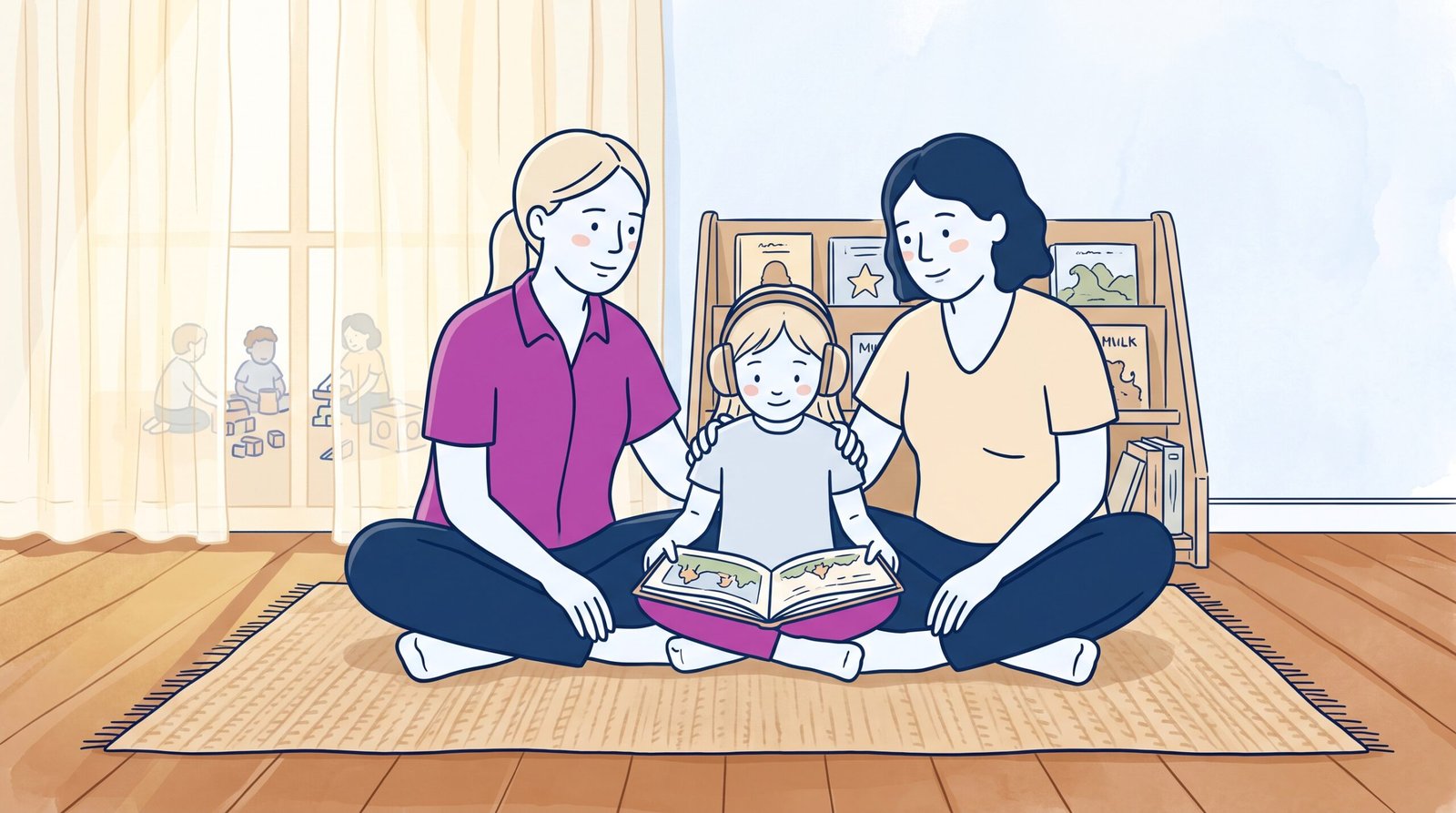
- Create a Low-Acoustic Reading Sanctuary Surround your quiet corner with dense floor cushions, heavy blankets, and low timber bookshelves to absorb ambient room chatter, creating an opt-in space where a child can hear themselves think.
- Replace Whistles and Bells with Visual Lighting Chimes Avoid piercing metal whistles, high-pitched electronic timers, or loud clapping routines to call group attention. Dimming overhead floor lamps or playing two gentle notes on a wooden glockenspiel respects delicate ears.
- Discover full room zoning and furniture buffering in Low-Cost Sensory Classroom Setup: 4 Powerful Layout Shifts →
- Learn how sub-visible light oscillation drains focus in Lighting Fluorescent Flicker ADHD: 4 Powerful Ways Light Drains Focus →
- Build an opt-in recovery sanctuary from scratch in Calm Corner Design in Early Childhood: Step-by-Step Setup →
- Return to our overarching cluster foundation on the Sensory Environment in Early Childhood Hub →
References
- Porges, S. W. (2011). The Polyvagal Theory: Neurophysiological Foundations of Emotions, Attachment, Communication, and Self-Regulation. W. W. Norton & Company. [Autonomic reactivity, neuroception of threat, and middle-ear stapedius muscle gating during acoustic distress].
- Barrett, P., Davies, F., Zhang, Y., & Barrett, L. (2015). The impact of classroom design on pupils’ learning: Final results of a holistic, multi-level analysis. Building and Environment, 89, 118-133. [Demonstrating the direct statistical impact of acoustic reverberation and ambient noise on early learning engagement].
- Dunn, W. (2014). Sensory Profile 2: User’s Manual. Pearson. [Sensory processing models, auditory threshold differences, and environmental accommodation for neurodivergent children].
- Shanker, S. (2016). Self-Reg: How to Help Your Child (and You) Break the Stress Cycle and Successfully Engage with Life. Penguin Random House. [Understanding auditory and environmental stressors that drain children’s self-regulation reserves].