
Why Child Can Do It Some Days Not Others: The Reality of Uneven Days
If you are asking why child can do it some days not others after watching your little one breeze through an activity on Tuesday only to fall apart over the exact same task on Thursday morning, you are not imagining the shift, and you have not failed as a parent.
That sharp swing between what our children can handle on a good morning and what brings them unstuck forty eight hours later is one of the loneliest experiences in neurodivergent parenting. When relatives, kinder teachers, or neighbours see our kids thriving in one moment, they naturally expect that same performance every single day. When it collapses, the questions start creeping in.
People genuinely wonder about the reasons for this inconsistency when the child is bright, capable, and clearly knows the household routine. Too often, the conclusion people jump to is that our kids are simply choosing when to cooperate and when to be obstinate. Having lived this from both sides of the kitchen bench, as an early years educator with a doctorate from Deakin University and as an ADHD mum raising a lively six year old ADHD daughter here in Victoria, I know how untrue and exhausting that judgment feels.
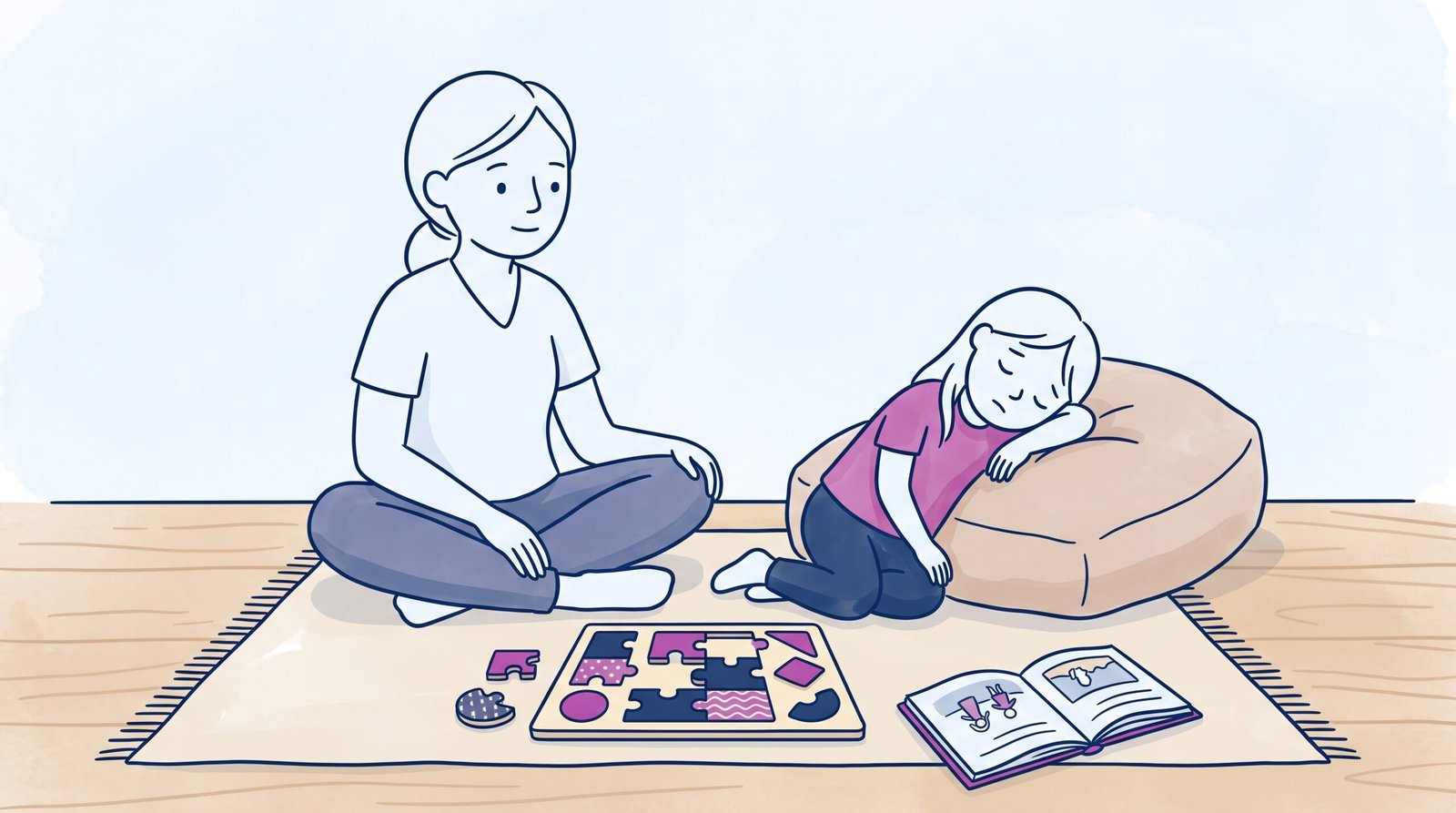
Why Child Can Do It Some Days Not Others in Our Hallway
To make sense of why child can do it some days not others, let us step away from clinical terms and talk about real mornings. In our home, Tuesday and Thursday often look like they belong to two completely different families.
On Tuesday morning, my daughter woke with energy to spare. She dressed herself down to her socks, buttered her own toast, and chatted away about the family of wattlebirds nesting outside her bedroom window. She had her hat in her bag and her shoes on before I even found my car keys. As a parent, those mornings make you exhale. You think to yourself that everything is finally settling down.
Then Thursday arrived. Same hallway. Same pair of blue runners sitting by the front door. Same time of the morning.
I handed her the shoes, and her entire posture folded. She dropped straight onto the floorboards, shoved the runners away, and began sobbing that her feet felt too hot, that the tongue of the shoe was hurting her ankle, and that she could not do it.
In the early years of parenting, that moment would have made my stomach drop. Old scripts from conventional parenting books would start shouting in my head: She did this without help two days ago. If you kneel down and put those runners on her feet now, you are rewarding a tantrum. You are letting her manipulate the morning.
It took living with my own fluctuating ADHD energy to recognise the physiological cause. My daughter had not forgotten how to pull a velcro strap. She was not trying to make us late for school out of spite. Her nervous system was running on fumes. She had spent Wednesday coping with loud classroom chatter, filtering the buzz of overhead lighting, sitting upright on a mat, and holding her body together. By Thursday, her sensory and cognitive battery was completely flat.
Why Child Can Do It Some Days Not Others Rather Than Choosing Won’t
The phrase that causes the most damage to neurodivergent families is: “They can do it when they want to.”
We hear it constantly. A teacher notices that a child can sit mesmerised by Lego for ninety minutes, so they assume the child is simply being stubborn when they cannot manage five minutes of handwriting. A relative sees them chat happily at the park, so they think the child is being rude when they go quiet and look away at a busy family dinner.
This misunderstanding turns an energy deficit into a deliberate moral choice. It assumes that because a brain can pull off a complex task under ideal circumstances, it possesses the physical capacity to do so under any condition. That fundamental error prevents adults from seeing the underlying pattern through a compassionate, nervous system lens.
| The Moment We Witness | What Others Tend to Assume | Why Child Can Do It Some Days Not Others Inside the Body |
|---|---|---|
| Independent Dressing Today, Tears Tomorrow Getting completely dressed on Monday, melting down over a jumper seam on Wednesday morning. |
The child is testing boundaries, being lazy, or looking for attention from mum or dad. | Sensory and Motor Depletion: Cumulative clothing friction, poor sleep, or ambient noise makes starting a physical task feel impossible. |
| Deep Focus on Passions, Stuck on Basics Building an elaborate world for hours, but unable to pick up three coloured pencils off the rug. |
They only cooperate when something entertains them and refuse to do everyday chores. | Dopamine Regulation: High interest topics supply their own fuel to get going; low interest tasks require heavy cognitive effort that has run dry. |
| Gentle Play in the Morning, Outbursts at Two Sharing beautifully during morning activities, then hitting, shouting, or hiding by early afternoon. |
The child has behavioural problems and needs firmer discipline and time outs. | Social and Auditory Saturation: The nervous system managed the room as long as it could. When sensory input tipped over the edge, fight or flight took over. |
As child development research from Harvard’s Center on the Developing Child proves, developing executive functions are extraordinarily sensitive to environmental and biological stressors. Furthermore, as child psychologist Ross Greene has written for years, children do well if they can.[4] No six year old wants to spend their morning crying on a cold hallway rug. When we recognise this reality, we stop viewing inconsistent days as defiance and start offering practical help.
Understanding Why Child Can Do It Some Days Not Others Through Hidden Drains
To understand what drives these fluctuations, we have to look beneath the surface. When an adult has a rough day at work, we look at the whole picture: maybe we slept poorly, skipped lunch, fought through heavy traffic, or felt a migraine coming on. We give ourselves grace.
Our children deserve that exact same grace. In early childhood environments across Australia, such as those governed by the national quality standards of ACECQA, their little bodies are constantly handling invisible loads:
The Work of Masking: Many children, especially girls with ADHD or quiet autistic traits, work immensely hard to fit in at kinder or school. They copy their peers, sit still when their legs ache to run, and hold back their big feelings so they do not stand out. That effort takes huge amounts of energy. This invisible strain is a central reason why child can do it some days not others. When they walk through the front door at home and fall apart over a cracked biscuit, it is because they finally feel safe enough to let go.
Sensory Clatter and Room Bounce: In many classrooms and centres, sound bounces endlessly off polished vinyl and bare walls. Research by Winnie Dunn shows that children with sensitive sensory thresholds burn real energy just dampening down that background roar.[3] By Wednesday afternoon, their auditory system is exhausted, which directly affects their ability to follow spoken directions.
Working Memory and Dopamine Drops: Executive functions like task initiation and working memory are not constant. Russell Barkley’s work on ADHD demonstrates that dopamine pathways fluctuate based on interest, novelty, and physical rest.[2] When dopamine is scarce, getting started on an uninteresting task is like trying to start a car with an empty fuel tank. This dopaminergic variation explains the uneven execution without any deliberate disobedience.
My daughter always knows how to put on her shoes. The mental map of socks, tongues, and velcro does not disappear on Thursday morning. What disappears is her capacity to overcome the friction of the task when she is tired. When we understand why child can do it some days not others, we stop testing our kids and start supporting their nervous systems.
Why Child Can Do It Some Days Not Others: The Masking Hangover
Another biological factor that illuminates this pattern is the cumulative cost of performance, often referred to as the masking hangover. When a child expends every ounce of self-control to manage a high-stakes transition or social event on Monday, their autonomic reserves are heavily drawn down.
On Tuesday, the biological invoice arrives. Because energy was borrowed from future reserves, the child exhibits lower tolerance for tactile irritation, decreased working memory, and heightened emotional vulnerability. Recognising these post-effort cycles helps parents predict low-capacity mornings and proactively reduce household demands before friction erupts.
Supporting Your Child When Capacity Drops
Knowing the biological foundation of why child can do it some days not others is comforting, but what do we actually do when the clock is ticking, the school bell is twenty minutes away, and our child cannot move? Here is how we handle those moments in our home, stripped of unrealistic parenting theories:
Drop Every Demand That Is Not About Safety: When capacity is low, simplify everything. If putting on the stiff school jumper is causing genuine sensory pain, put it in the backpack and let them wear a soft cotton tee in the car. If eating with a fork feels like too much effort, cut the toast into strips they can hold. Navigating uneven days means protecting their remaining fuel for getting through the door safely.
Loan Them Your Hands Without a Lecture: The biggest mistake we make as tired parents is adding a lecture to our help. Saying “I will put your shoes on this time, but you did this fine yesterday so you better do it tomorrow” just heaps shame onto an overloaded child who is already struggling with depleted physical reserves.
Instead, sit on the floorboards with them. Soften your shoulders, take a slow breath, and say something simple: “Your hands feel really tired this morning, mate. That is okay. I will do your shoes today.” Putting on their shoes does not create learned helplessness. It creates a child who knows they are supported when life feels heavy.
Check the Physical Basics First: When a child suddenly cannot manage a basic skill, check their engine. Hand them a drink of cold water through a straw. Give them a piece of cheese or half a banana. Turn off the television in the background. Often, twenty percent of their capacity returns simply because their body received a little fuel and sensory quiet. This simple biological check directly resolves the immediate friction on the hardest mornings.
By releasing the expectation of flat, mechanical consistency, we align ourselves with our children’s true developmental biology. We celebrate the high-energy peaks without punishing the low-capacity valleys, providing grounded safety through every uneven day.
- Read our deep dive into dopamine and focus in ADHD Skills Inconsistency Explained →
- Why standard developmental checklists fall short for uneven profiles in Why Milestones Don’t Fit Neurodivergent Children →
- How to look after yourself when your own battery is flat in Parent and Teacher Burnout in Neurodivergent Care →
- Return to our main cluster guide on Spiky Profiles and Capacity in Neurodivergent Children Hub →
References
- Silverman, L. K. (2002). Upside-Down Brilliance: The Visual-Spatial Learner. DeLeon Publishing. [Examining asynchronous development and uneven learning profiles in children].
- Barkley, R. A. (2012). Executive Functions: What They Are, How They Work, and Why They Evolved. Guilford Press. [The neurology of dopamine regulation, task initiation, and variable performance in ADHD].
- Dunn, W. (2014). Sensory Profile 2: User’s Manual. Pearson. [How environmental noise and sensory thresholds drain nervous system reserves].
- Greene, R. W. (2014). Lost at School: Why Our Kids with Behavioral Challenges Are Falling Through the Cracks and How We Can Help Them. Scribner. [The foundational principle that children do well when they have the capacity to do so].
- Shanker, S. (2016). Self-Reg: How to Help Your Child (and You) Break the Stress Cycle and Successfully Engage with Life. Penguin Random House. [Understanding the hidden stressors that undermine daily regulation].