
Sink Water Play for Preschoolers (20-Minute Kitchen Activity That Actually Works)
A practical, contained indoor water routine that resets an overstimulated nervous system, builds early STEM thinking, and buys you twenty peaceful minutes to get dinner cooked.
Table of Contents
- The Unravel Hour: When 5:00 PM Hits the Kitchen
- Why Sink Water Play for Preschoolers Actually Works
- Why the Kitchen Sink Is the Perfect Sensory Setup
- Sink Water Play for Preschoolers Ideas That Hold Attention
- What Children Are Actually Learning (Without You Hovering)
- The Real Benefit: Buying Time Without Parental Guilt
- What Happened in My Own Kitchen
- What Does Not Work (Common Mistakes to Skip)
- How to Keep It Contained: Realistic Mess Management
- References & Research Foundations
The beef mince was sizzling in the stainless steel frypan, right on the edge of catching, and hot onion steam was stinging my eyes. It was 5:14 pm. Anyone parenting a young child recognises that specific window of the afternoon. In our home, we call it the unravel hour.
My four-year-old daughter was alternating between tugging hard on the waistband of my tracksuit pants, attempting to climb the pantry shelving, and dropping heavy wooden blocks onto the timber floorboards with rhythmic, jarring crashes. Her nervous system was completely fried from a long day at preschool. Mine, already running on the low-dopamine, chaotic fumes of an adult ADHD brain, was fraying fast.
“Mummy. Look. Watch this. Look at my shoe. Watch me jump off this box. Mummy, can I have a biscuit? Look at the spoon.”
“Sweetheart, step back from the stove, please. Oil is spitting. Hot pan.”
Two seconds later, she was back, wedging her small body directly between my shins and the hot oven door.
Every parenting manual tells you to invite them into the meal preparation. Let them chop zucchini with a safety knife! Measure the uncooked pasta together! Realistically, on an exhausted Tuesday evening when your internal bandwidth is down to zero, handing an emotionally dysregulated preschooler a knife or a cup of dry macaroni feels like signing an open invitation for a massive meltdown. Screen time was already maxed out for the day, and turning on the television right then was only going to guarantee a bedtime explosion later on.
I glanced down at the chopping board full of raw carrots. Then I looked over at the double kitchen sink.
My immediate gut reaction pushed back hard. Do not do this. Water will end up inside the cutlery drawers. Socks will be drenched. The sleeves of her jumper will soak through to her armpits, and you will be mopping floorboards until 8:00 pm.
I hesitated. I really did not want to wipe down benches. But the whining was escalating, dinner was close to burning, and the sound in the room was buzzing at a pitch that made my teeth grind.
I dragged our heavy wooden step stool across to the bench with a dull scrape.
“Up you come,” I said, peeling off her socks so they would not end up wet.
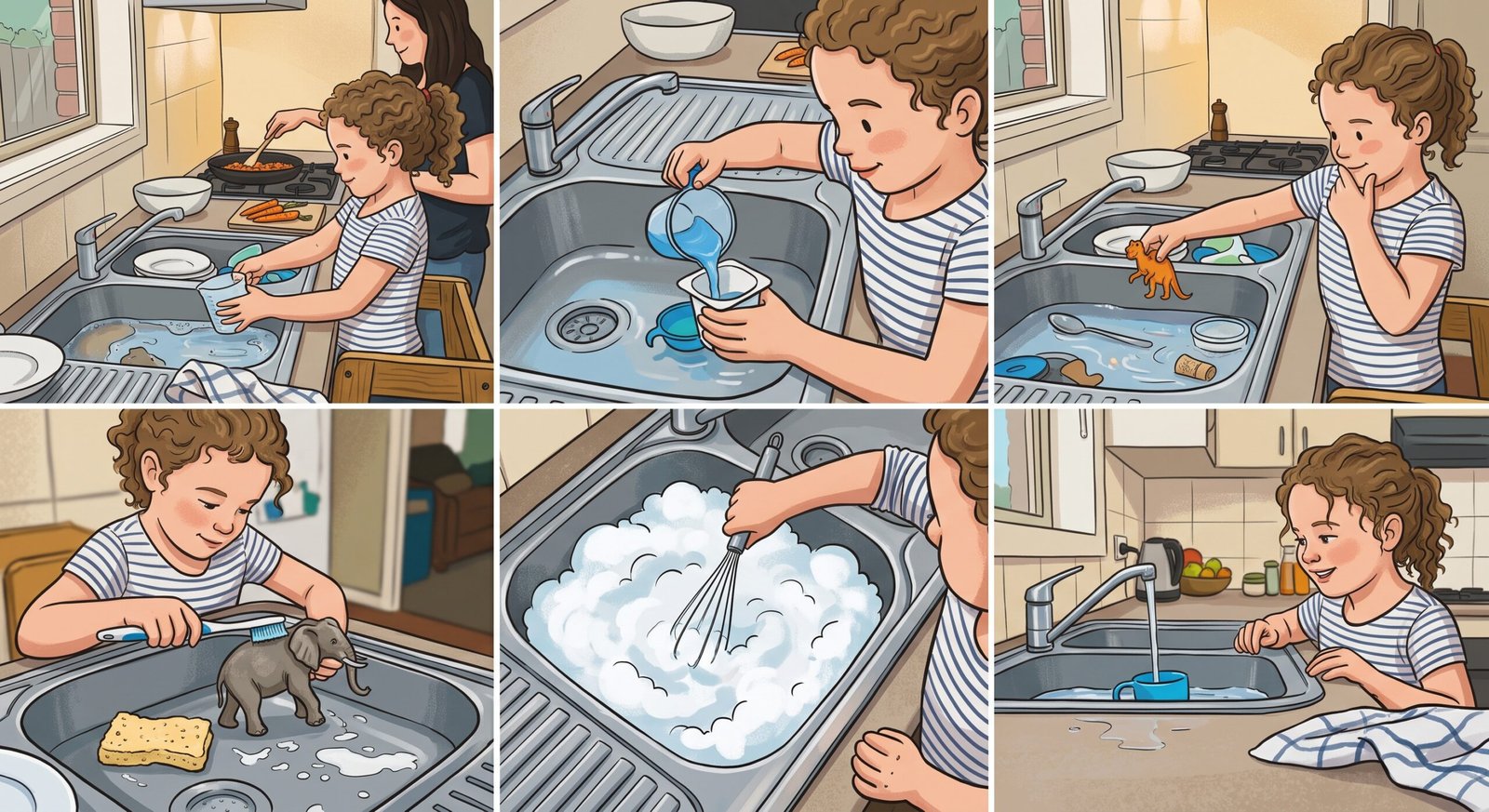
I shoved the plug into the drain, swung the mixer tap to warm, and ran about five centimetres of water into the stainless steel basin. I added half a pump of standard dishwashing liquid and tossed in an old silicone basting brush along with an empty yoghurt tub from the dish rack.
She went quiet instantly. Her hand hovered above the stream, fingers spread wide. The rushing white noise of the tap filled the room, washing away the frantic hum of the house. She plunged the brush underwater, watching the grey bristles spread out against the metal base, and let out a long, shuddering sigh.
Her entire posture softened. Her shoulders dropped.
I turned back to the frypan, stirred the meat, tipped in the crushed tomatoes, and realised the entire kitchen had fallen peacefully silent. Setting up deliberate sink water play for preschoolers had turned an impending evening trainwreck into twenty minutes of pure calm.
Why Sink Water Play for Preschoolers Actually Works Sensory regulation, repetitive focus, and autonomic settling
When educators talk about water play, parents usually imagine warm summer afternoons in the backyard with large plastic tables, water wheels, and garden hoses. Bringing water play directly into the kitchen in the middle of late-afternoon domestic stress feels counterintuitive. Yet practical sink water play for preschoolers is one of the most reliable regulatory tools available in a family home.
The rapid calming effect is rooted in how a young child’s nervous system responds to fluid tactile input:
- Autonomic Nervous System Down-Regulation: Warm water running continuously over hands delivers steady, low-demand tactile and proprioceptive stimulation. For a preschooler who has spent hours navigating social rules, loud classrooms, and emotional transitions, water acts like an instant sensory reset button. Clinical insights from Harvard Health Publishing demonstrate that repetitive sensory play down-regulates an overstimulated central nervous system, restoring emotional equilibrium.
- Rhythmic Repetition Builds Sustained Attention: Dysregulated preschoolers often struggle with complex, open-ended tasks because their executive control is exhausted. Water in a basin provides immediate, predictable physics. Scoop water, tip it out, watch it fall. That rhythmic loop satisfies the brain’s craving for feedback without overwhelming working memory.
- Zero-Failure Autonomy: Most structured home activities require adult directions, rules, and corrections. Water does not break. It has no right or wrong answers. As research from the Harvard Center on the Developing Child notes, hands-on, exploratory play strengthens emerging executive function because children can plan, predict, and manipulate materials completely under their own steam.
Why the Kitchen Sink Is the Perfect Sensory Setup Natural boundaries, fast clean-up, and shared physical space
Parents often assume they need dedicated commercial sensory tables to provide quality sensory experiences. In reality, your built-in kitchen sink is far superior for everyday use:
- True Physical Containment: Sensory bins on a coffee table or rug invite children to lift dripping cups into the air and wander across living room carpets. A kitchen sink basin encloses their hands within high stainless steel or porcelain walls. Any stray splashes land on tiles designed to handle moisture.
- Zero Preparation Friction: Getting a stand-alone sensory table ready requires fetching a tub, filling jugs, balancing heavy water through the hallway, and then hauling buckets out to empty it. At the kitchen sink, setup takes thirty seconds: plug the drain, turn the tap, and pull the plug when finished.
- Parallel Connection: Late-afternoon meltdowns often happen because young children perceive emotional separation when a parent turns toward cooking. By positioning your child on a safe step stool right at the counter, they share your working perimeter. They feel your physical presence, chatter as they pour, and feel securely connected while you finish your chores.
Sink Water Play for Preschoolers Ideas That Hold Attention Simple, low-prep kitchen invitations using everyday household items
Handing a child an open tap without simple parameters can result in soaked clothes and overflowing basins. The key to sustaining twenty solid minutes of independent focus is offering purposeful, open-ended “jobs” that mimic adult kitchen work.
Here are four practical variations of sink water play for preschoolers that require zero specialty purchases.
1. Volume Estimation Play (The Pouring Station)
Preschoolers are drawn to moving liquids between vessels of contrasting proportions. To an adult, this looks like repetitive tipping; to a child, it is a hands-on physics experiment.
- The Tools: Pull out two plastic measuring cups (like a 1/4-cup and 1-cup measure), one tall narrow bottle (such as a rinsed sauce or dressing bottle), and a wide yoghurt tub.
- The Prompt: Keep prompts brief and curious while you chop dinner vegetables: “I wonder how many of that little blue scoop it takes to fill that wide white tub?”
- The Learning: The child watches liquid bulge at the rim from surface tension and discovers that a narrow bottle can hold the same volume as a short, squat container. According to the National Association for the Education of Young Children (NAEYC), hands-on measurement experiences build intuitive foundations for early mathematics far earlier than paper worksheets.
2. Sink or Float Predictions (The 5-Minute Science Lab)
Children are natural hypothesis testers. Adding a simple element of prediction turns water play into an active inquiry session.
- The Tools: Gather a metal teaspoon, an unpeeled lemon, an empty plastic bottle lid, a wooden peg, and a plastic building brick. Line them along the counter edge.
- The Prompt: “Hold that lemon in your hand. It feels heavy, doesn’t it? Do you think it will dive to the bottom or float like a raft?”
- The Learning: Children are surprised when a heavy lemon floats due to the air pockets in its rind, while a light metal spoon sinks immediately. Educational research from Project Zero at the Harvard Graduate School of Education highlights that playful prediction games help children formulate theories, test assumptions, and learn through direct observation.
3. Washing Plastic Animals (Purpose-Driven Narrative Play)
When an overstimulated child is feeling irritable or oppositional, pure pouring play might not hook their attention. Providing a practical caretaking task redirects their focus toward purposeful play.
- The Tools: Take four or five washable plastic animals or figurines. Dab a tiny bit of peanut butter, vegemite, or soil onto their feet. Provide an old soft toothbrush or half a kitchen sponge with a drop of soap.
- The Prompt: “The farm animals were outside in the mud and need a warm bath. Can you scrub their feet clean and dry them on this towel?”
- The Learning: Purposeful dramatic play exercises working memory and self-regulation. The child holds the steps of the narrative in mind: scrub, rinse, inspect, and dry. This matches our findings on outdoor sensory mechanics in our guide to mud kitchen play ideas at home, where functional tasks create calm immersion.
4. Bubble Foam Whisk Play (Heavy Hand Work)
When a child arrives at the counter with restless motor energy and an urge to slam items, whisking soap provides immediate physical resistance that helps settle the body.
- The Tools: Run three centimetres of warm water, add two squirts of gentle dish soap or bubble bath, and hand them a metal balloon whisk or silicone egg whisk.
- The Prompt: “Let’s see if you can whip that water fast enough to make foam mountains that touch the top of the tap.”
- The Learning: Whisking provides heavy work for the hand and forearm muscles, improving wrist extension and bilateral integration. As noted by the American Academy of Pediatrics (AAP), physical play that builds hand strength directly supports the motor foundations children require later for pencil grip and scissor control.
The “Two Tools” Rule
Avoid dumping a whole tub of bath toys into the basin. Providing just one pouring tool and one container deepens focus and prevents chaotic splashing.
Warm Water for Calming
Cold water stimulates and energises; warm water soothes and grounds. Keep the water comfortably warm to support physical down-regulation at the end of the day.
What Children Are Actually Learning (Without You Hovering) Cognitive schema, early physics, and fine motor precision
It is easy to look at a child swirling bubbles in a sink and see it simply as a distraction to get through dinner. Yet beneath the suds, their developing brain is running complex physical and spatial calculations.
| What the Child Does at the Sink | The Underlying Early STEM Concept | Long-Term Developmental Value |
|---|---|---|
| Pouring water from wide tub to tall bottle | Volume conservation, capacity, and estimation. | Foundational mathematical intuition before formal classroom instruction. |
| Dropping sponges, spoons, and pegs into water | Buoyancy, relative density, and displacement. | Scientific reasoning, testing predictions, and causal thinking. |
| Whisking suds and squeezing kitchen sponges | Palmar grasp, wrist extension, and hand arches. | Hand strength and bilateral coordination needed for handwriting and tools. |
| Keeping water inside basin walls | Spatial awareness and motor impulse control. | Executive function, boundary recognition, and sensory regulation. |
Physical play allows abstract principles to take root through the senses. Much like the cardboard construction techniques we outline in our article on cardboard play for preschoolers, manipulating simple materials gives young children a tangible grasp of structural problem-solving.
The Real Benefit: Buying Time Without Parental Guilt Active learning versus passive digital exhaustion
Modern parenting advice often assumes parents have limitless emotional reserves. We are repeatedly told to sit on the rug, make prolonged eye contact, and turn every moment into a rich educational lesson, even when we are running on empty at the end of a exhausting day.
That advice often generates unnecessary guilt.
You do not need an elaborate Pinterest activity at 5:00 pm. You need twenty minutes of peace so you can finish dinner, unpack school bags, and breathe. Engaging your child in sink water play for preschoolers eliminates guilt because it offers genuine developmental benefits:
- Active Cognition Over Passive Screens: While a tablet keeps a child stationary, it feeds their brain fast frame transitions and bright lights that can lead to explosive dysregulation when switched off. Sink play puts the child in charge of the physical action, leaving them grounded and calm when it is time to sit down for dinner.
- Releasing the Entertainer Role: You are not responsible for orchestrating every second of your child’s day. Providing a warm basin of water and stepping back lets your child build internal motivation and learn to sustain their own attention.
What Happened in My Own Kitchen Realities, adjustments, and messy lessons
Even with a background in early childhood education, nothing prepared me for the reality of managing late-afternoon burnout with my own daughter. She has high sensory-seeking needs, big emotions, and an ADHD profile that makes standard parenting strategies ineffective when she is tired.
In our house, the kitchen sink has been a lifeline, though we certainly made mistakes along the way.
One night, feeling adventurous, I added blue food dye to the basin to make an “ocean”. Within five minutes, my daughter’s forearms, the silicone splashback seals, and our wooden chopping board were dyed vivid blue, requiring two days of bicarb soda scrubbing to remove. Another evening, I turned around to check the oven and discovered she had found the extendable tap sprayer, sending a stream of water directly onto the kitchen ceiling.
The biggest breakthrough came when I stripped the activity back to its simplest elements.
One evening when she was in tears over tired legs, I set her up at the sink with just warm water and three empty spice shaker jars. She spent twenty-five minutes discovering that plunging the inverted jars underwater made bubbles burp out one by one with a steady glug-glug rhythm. She stood there, fascinated by the rising bubbles, completely calm. I finished cooking our meal, wiped down the bench, and drank a hot cup of tea. It was a clear reminder that children do not need complicated setups; they need space to explore real physical materials.
“The kitchen sink taught me to let go of perfection. On afternoons when sensory meltdowns were building, five centimetres of warm soapy water consistently reset my daughter’s mood, calmed my own buzzing ADHD brain, and turned our hardest hour of the day into a pocket of quiet calm.”
Dewi Griffith, PhD, Founder
What Does Not Work (Common Mistakes to Skip) Save your counters, your floorboards, and your patience
To keep this activity working week after week, steer clear of these common friction points:
- Hovering and Micromanaging: If you stand over the sink saying, “Careful, don’t drop that! Pour it here, do it like this,” the play loses its calming value. Step back, let them pour on their own terms, and only step in if safety boundaries are crossed.
- Too Many Toys at Once: Piling half a dozen plastic cups, funnels, and animals into the sink creates visual clutter. Overstimulated brains get overwhelmed and end up throwing items onto the floor. Keep it to two or three carefully chosen tools.
- Expecting Bone-Dry Benches: Water play will always create some moisture. If your measure of success is a spotless counter, you will spend the entire twenty minutes stressed. Plan for a few damp patches, put down an absorbent towel, and wipe the surface down once dinner is ready.
How to Keep It Contained: Realistic Mess Management Clear boundaries that protect your floorboards
A solid containment setup keeps the water where it belongs, so you do not spend your evening mopping floors:
- The Rolled Towel Barrier: Roll a dry bath towel lengthwise into a firm snake shape and place it along the front rim of the counter, between the sink and your child’s tummy. This catches stray splashes before they can drip down cabinet doors or onto the floor.
- The Water Rule: State the boundary once before the tap turns on: “Water stays inside the sink. If water gets thrown on the floor, the plug comes out and sink play is finished for today.” If water is deliberately splashed outside, calmly pull the plug and end the activity without anger. Children learn quickly that respecting the boundary keeps their water station open.
- Push Up Sleeves: Soggy jumper sleeves can trigger sensory discomfort. Strip long sleeves off beforehand or push them well past the elbows, holding them in place with soft hair scrunchies.
- Non-Slip Stool Placement: Ensure your step stool sits securely on a dry floor mat to provide stable footing and catch any drips as your child steps down.
Looking for Grounding, Low-Mess Activities for Restless Days?
When you need quiet, table-based activities that soothe busy minds and strengthen fine motor control, our Montessori-inspired story tracing printables offer a peaceful, structured transition.
Explore Calm Story Tracing BundlesReferences & Research Foundations Credible developmental, paediatric, and early learning research
- Center on the Developing Child at Harvard University. (2014). Enhancing and Practicing Executive Function Skills with Children from Infancy to Adolescence. Harvard University. developingchild.harvard.edu
- Harvard Health Publishing. (2018). The importance of sensory and physical play for emotional self-regulation in young children. Harvard Medical School. health.harvard.edu
- National Association for the Education of Young Children (NAEYC). (2020). Early Math and Science Inquiry Through Everyday Materials in Early Childhood Classrooms. naeyc.org
- Project Zero, Harvard Graduate School of Education. (2023). Pedagogy of Play: Playful Thinking and Inquiry Routines in Early Childhood. Harvard University. pz.harvard.edu
- American Academy of Pediatrics (AAP). (2018). The Power of Play: A Pediatric Role in Enhancing Development in Young Children. Clinical Report. aap.org
This article is based on personal lived experience parenting in a neurodivergent household alongside professional early childhood education research. It is shared for educational and supportive purposes only and does not constitute medical, paediatric, or clinical therapy advice. Every child has unique sensory profiles and developmental patterns. If you have concerns about your child’s sensory processing, coordination, or emotional regulation, please consult your GP, a paediatrician, or an accredited occupational therapist.