
Preschool Kitchen Science Experiments (Simple Activities Using Pantry Items)
Practical, zero-fuss preschool kitchen science experiments using everyday staples to spark curiosity, encourage prediction, and buy you twenty minutes of peace while you cook dinner.
Table of Contents
- The 5:20 PM Kitchen Reality: When Interruption Sparks an Idea
- Why Preschool Kitchen Science Experiments Actually Work
- What Parents Often Misunderstand About “Teaching Science”
- 3 Preschool Kitchen Science Experiments That Actually Hold Focus
- What Children Are Really Learning (Without Realising It)
- What Happened on My Own Kitchen Counter
- What Does Not Work: Traps That Kill Curiosity
- How to Keep Experiments Manageable on Real Weekdays
- Expanding Your Low-Stress Play Toolkit
- References & Research Foundations
- Safety & Editorial Disclaimer
The pasta pot was boiling over on the back burner, sending starchy white foam hissing against the hot metal. I had three chicken fillets half-diced on the cutting board, and the onion in the pan was just starting to take on that dark, acrid edge that means you have about ninety seconds before it burns.
My four-year-old daughter was right at my elbow.
She was not having a full meltdown, but she was hovering in that restless, buzzing orbit that every parent recognises. She was repeatedly opening and slamming the bottom cutlery drawer, asking why the pasta water had bubbles, and tugging at the pocket of my cardigan with sticky fingers.
“Mummy. Look at this spoon. Can I cut the chicken? Watch how fast I can open this door. Mummy, what does that white powder do?”
She was pointing up at the open pantry door, where a cardboard box of bicarb soda was sitting on the second shelf next to the white vinegar.
Every sensible, exhausted part of my brain said to shut the pantry door and tell her to go look at a picture book. My adult ADHD brain was already juggling hot grease, boiling water, and raw meat. The very last thing I needed was white vinegar running into the floorboard cracks or sticky bicarb paste smeared across the toaster.
I hesitated. I looked at the chicken, then down at her wide, impatient eyes. If I shooed her away, she would be back in thirty seconds, climbing the pantry shelves or weeping on the floor mat.
I reached into the pantry, grabbed a flat metal baking tray from the oven, tipped two tablespoons of bicarb soda into an empty ramekin, and filled an old medicine syringe with white vinegar.
“Here,” I said, setting the tray on the kitchen counter well away from the cooktop. “Squirt this liquid onto that powder and tell me what sound it makes.”
She pushed the plunger down. The liquid hit the white mound with a sharp, violent hiss, erupting into a furious dome of white froth.
She gasped, snatched her hands back to her chest, and let out a delighted, astonished laugh. Then she peered right over the rim of the dish, watching the tiny bubbles pop one by one.
I turned back to the stove, stirred the onions, dropped the heat, and took a full, deep breath. That was the evening I realised that simple preschool kitchen science experiments are not an extra chore you schedule for a weekend; they are an absolute domestic survival tool for an ordinary weekday afternoon.
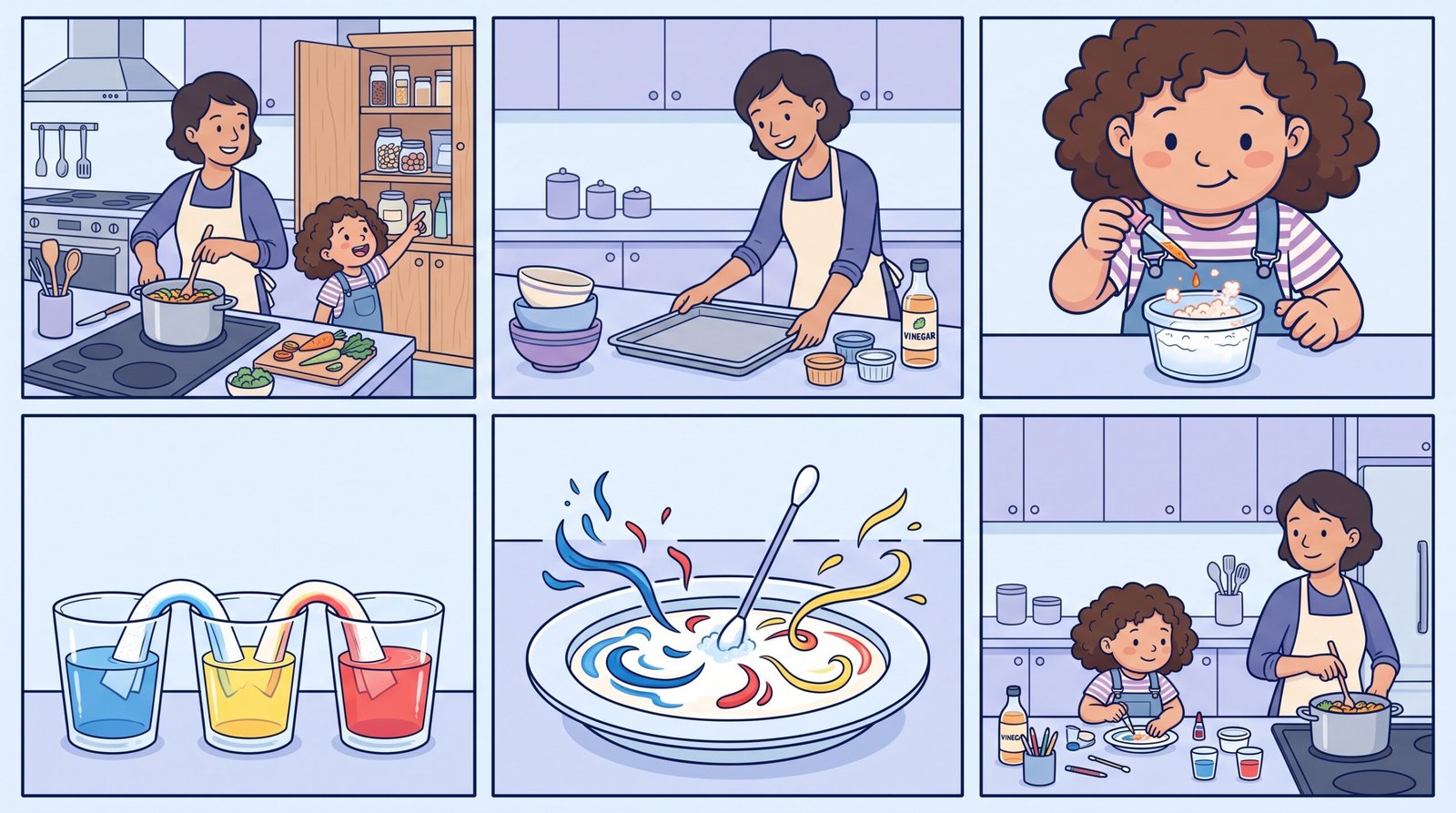
Why Preschool Kitchen Science Experiments Actually Work Sensory grounding, causal feedback, and autonomic down-regulation
When many adults think about science for young children, they imagine structured laboratory kits, safety goggles, plastic test tubes, and dry worksheets. Trying to introduce that kind of formal instruction into a busy home kitchen is a recipe for tears.
In contrast, spontaneous preschool kitchen science experiments succeed because they tap directly into how a young child’s nervous system and cognitive architecture process the physical world:
- Immediate Cause and Effect: Young children spend their days living in an adult-controlled environment where rules can feel abstract. When a child squirts liquid onto a powder and watches it froth instantly, the feedback is direct, neutral, and unmistakable. According to early learning frameworks from the National Association for the Education of Young Children (NAEYC), hands-on exploration of cause-and-effect provides the concrete foundation children need to develop logical reasoning long before they encounter formal academic instruction.
- Rhythmic Sensory Engagement: Seeing colour bleed across porous fibres, listening to the crackle of carbon dioxide bubbles, or watching dish soap scatter milk droplets provides rich multi-sensory input. Clinical reports from the American Academy of Pediatrics (AAP) show that hands-on, sensory-rich play stimulates neural connectivity, helping young children regulate their bodies and sustain focus without feeling overwhelmed.
- Autonomous Exploration: A preschooler does not need an adult hovering and explaining chemical formulas. As documented by the Harvard Center on the Developing Child, play-based exploration builds essential executive function skills by allowing children to formulate their own intentions, test physical boundaries, and experience intrinsic problem-solving without fear of making a mistake.
What Parents Often Misunderstand About “Teaching Science” Dropping the lecture and focusing on the experience
The single biggest mistake well-meaning parents make with preschool kitchen science experiments is trying to turn a five-minute kitchen moment into a classroom chemistry lecture.
When parents launch into lengthy explanations about acetic acid, sodium bicarbonate, and exothermic reactions, young children simply glaze over. Their brains are not built for abstract molecular theory. When an adult over-explains, the magic vanishes, and the child disengages because the cognitive load is too heavy.
Real scientific thinking in early childhood is not about memorising facts or knowing the right answers. It is entirely about:
Noticing Nuance
Observing small physical shifts in the environment, such as changes in texture, sound, smell, and colour, using all available senses.
Active Prediction
Formulating simple, playful hunches about what might happen next: “What do you think happens if we drop this in?”
When you view preschool kitchen science experiments through this lens, the pressure evaporates. You do not need to be a scientist or an early childhood teacher. You only need to be the person who holds the tray, steps back, and gives your child space to wonder.
3 Preschool Kitchen Science Experiments That Actually Hold Focus Three simple pantry investigations that keep cleanup under three minutes
You do not need specialised equipment or synthetic craft supplies. Some of the most compelling preschool kitchen science experiments rely on humble ingredients already sitting in your kitchen cupboards.
Here is how three core pantry investigations unfold on a busy weeknight.
1. Baking Soda and Vinegar: The Immediate Reaction Station
Nothing captivates a preschooler faster than fizzing bubbles. It is the gold standard of preschool kitchen science experiments because the chemical feedback happens in a fraction of a second.
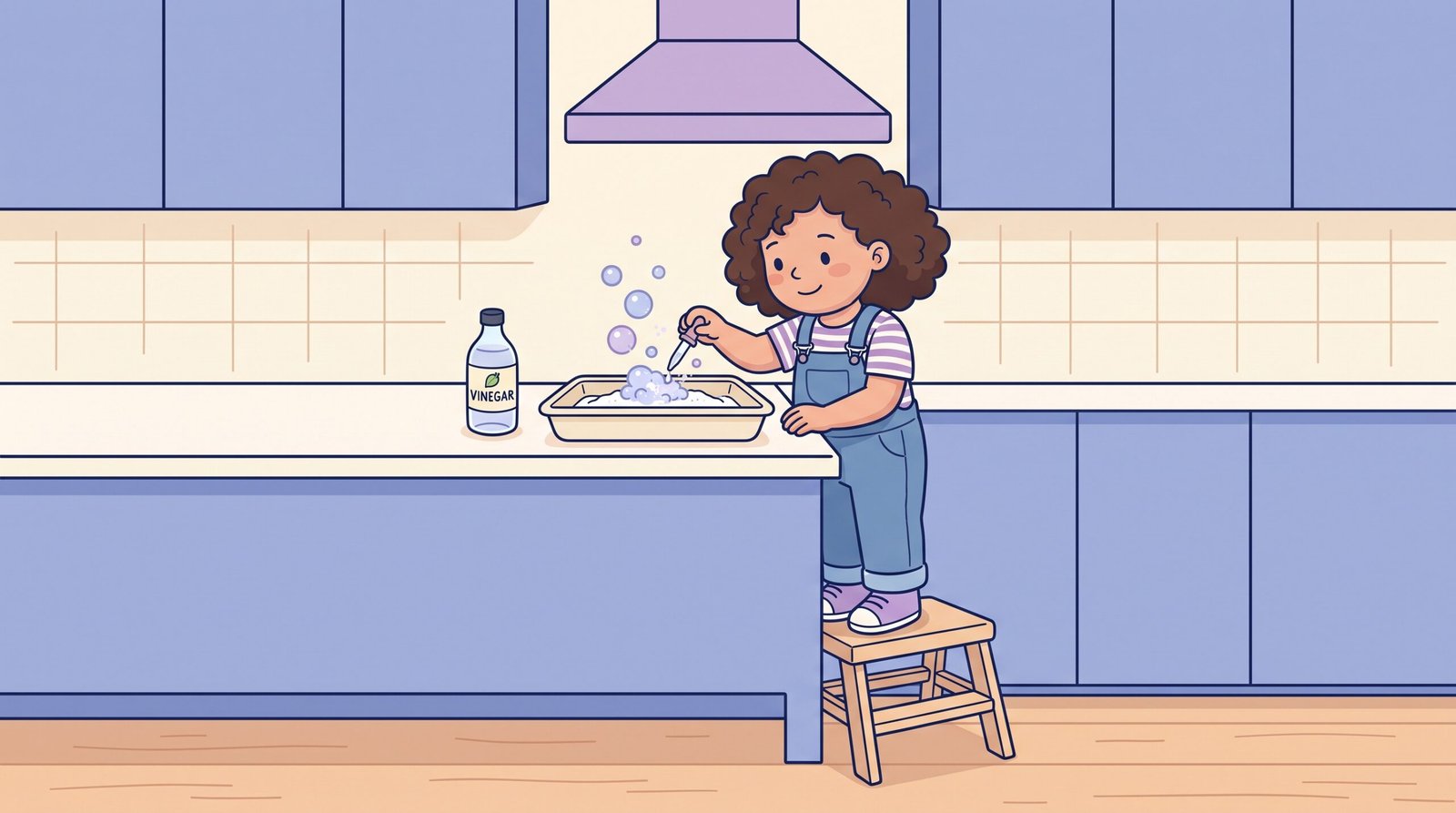
- The Pantry Setup: Place a flat baking tray or shallow oven dish on the counter to contain any splashes. Tip three tablespoons of bicarb soda (baking soda) onto the tray, flattening it into a thin layer. Pour half a cup of cheap white vinegar into a small glass or ramekin. Add a single drop of food colouring to the vinegar if you have it on hand.
- The Tools: Hand your child an everyday tool that limits liquid flow: an old plastic medicine dropper, a child syringe, a small teaspoon, or a silicone pastry brush.
- What Happens: As drops of vinegar hit the alkaline baking soda, they react instantly to produce carbon dioxide gas. The tray erupts in tiny, crackling craters.
- The Child’s Experience: Instead of explaining acid-base chemistry, simply prompt their observations: “Put your ear down close. What does that sound like? Does it smell like hot chips?” The child controls the pace of the reaction, testing what happens when they squirt one tiny drop versus tipping an entire teaspoon.
2. The Walking Water Journey: Capillary Action and Colour Blending
If your child is in a quieter, more contemplative mood, this visual exploration offers a slow, hypnotic rhythm that calms busy bodies.
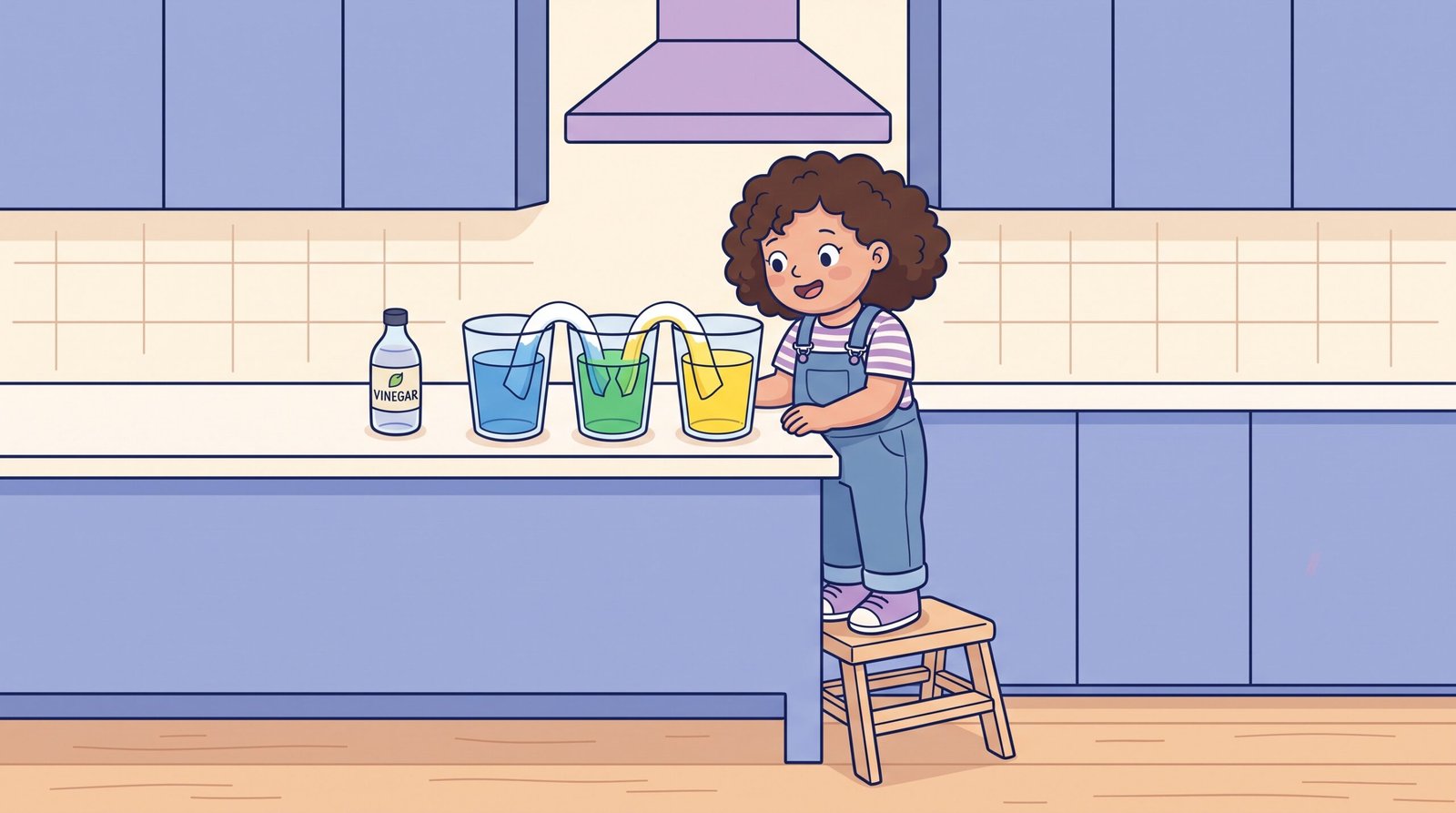
- The Pantry Setup: Line up three clear drinking glasses side-by-side on the counter. Fill the two outside glasses half-full with water, leaving the middle glass completely empty. Add two drops of red or blue food dye to the first glass, and two drops of yellow food dye to the third glass.
- The Absorbent Bridge: Take two sheets of everyday absorbent kitchen paper towel. Fold each sheet lengthwise into a long, firm strip about three centimetres wide. Place one end of the first paper strip into the coloured water glass, draping the other end into the empty centre glass. Repeat with the second strip from the opposite glass.
- What Happens: Water slowly climbs up through the tiny cellulose fibres of the paper towel against gravity, traveling across the bridge and slowly dripping into the empty central glass. As the two primary colours meet, they blend to create a new colour.
- The Scientific Inquiry: As researched by Project Zero at the Harvard Graduate School of Education, encouraging children to observe changes that occur over time builds patience and deepens inquiry routines. Check in on the glasses between peeling potatoes: “Look how high the blue water has climbed. Where do you think it will go when it hits the top curve?”
3. Magic Milk Surface Tension: The Living Canvas
This investigation feels like pure wizardry to a four-year-old, yet it requires nothing more than everyday breakfast ingredients.
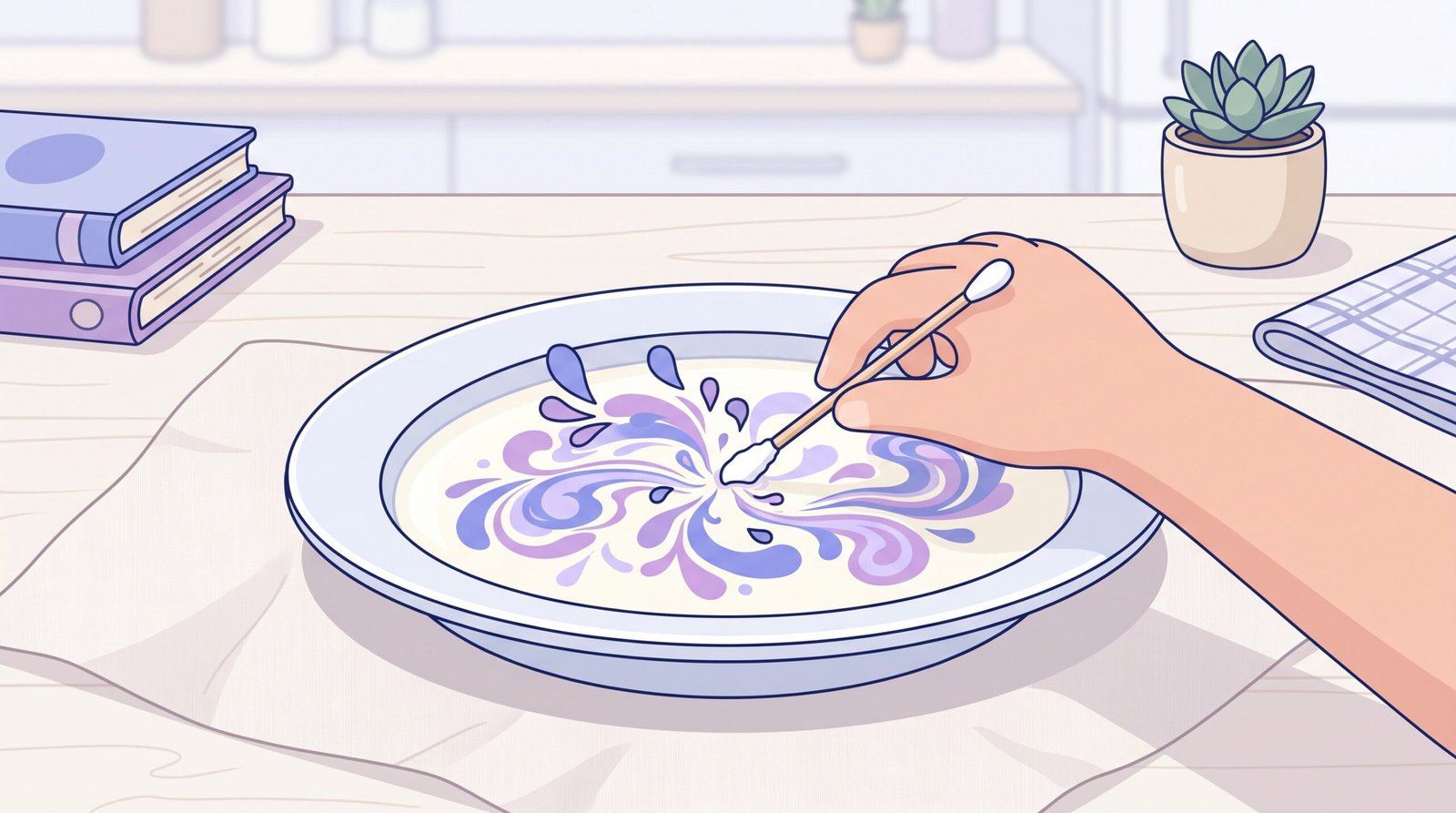
- The Pantry Setup: Pour a thin layer of full-cream milk into a shallow ceramic dinner plate or wide saucer, just enough to cover the base. Let the liquid settle completely until it is still.
- The Colour Drops: Gently add three or four separate droplets of different food colourings near the centre of the milk. Keep the drops close together, but do not stir them.
- The Catalyst: Dip the tip of a cotton bud or the handle of a teaspoon into standard dishwashing detergent. Hand it to your child and instruct them to touch the soapy tip gently right into the centre of the colour drops without stirring.
- What Happens: The instant the detergent touches the milk, the surface tension breaks and the fat molecules scatter rapidly away from the soap, dragging the food dye with them in swirling, psychedelic ribbons across the plate.
- The Simple Explanation: You do not need to deliver a lecture on hydrophobic molecules. A simple observation is enough: “The soap loves to chase the tiny bits of fat in the milk, and as it pushes them away, the colours go for a wild ride.”
Use Shallow Boundaries
Always place ramekins, plates, and cups inside a standard baking sheet. This catches any accidental spills before liquids reach your kitchen floorboards.
Small Doses Only
Provide vinegar or water in tiny containers rather than handing over the whole bottle. When supplies are capped, cleanup takes sixty seconds.
What Children Are Really Learning (Without Realising It) Inquiry routines, vocabulary growth, and sensory regulation
When adults observe a four-year-old poking a soapy cotton bud into a saucer of milk, it can look like simple amusement. Yet underneath the playful surface, their brain is forming the foundational schemas of scientific inquiry.
Children do not learn STEM concepts through dry academic lectures; they build them by touching, testing, and observing physical materials. Participating in regular preschool kitchen science experiments fosters vital developmental skills:
| What the Child Does at the Counter | The Underlying Scientific / Cognitive Principle | Long-Term Developmental Benefit |
|---|---|---|
| Squirting vinegar onto baking soda in bursts | Chemical reactivity, gas release, and fluid displacement. | Intuitive cause-and-effect reasoning and fine motor pinch control. |
| Watching water crawl up a paper towel | Capillary action, porosity, and absorption rates. | Visual tracking, longitudinal observation, and predictive thinking. |
| Touching soap to full-cream milk | Surface tension, molecular bonds, and lipid dispersion. | Pattern recognition, hypothesis formation, and curiosity. |
| Refilling droppers and balancing ramekins | Spatial awareness, volume limits, and motor planning. | Hand-eye coordination, bilateral control, and spatial judgment. |
Research from the Raising Children Network (Australia) underscores that young children learn best when science is woven naturally into their everyday home routines, allowing them to explore without the stress of performance expectations.
What Happened on My Own Kitchen Counter Messy truths, broken expectations, and practical wins
Despite my background in early childhood education and research, managing evening domestic duties with an intense, sensory-seeking child was a masterclass in humility. My daughter possesses an extraordinary amount of physical drive, high emotional sensitivity, and an ADHD profile that turns standard parenting advice upside down when she is tired.
When I first tried introducing preschool kitchen science experiments, I brought all my academic baggage into the kitchen.
I tried to set up elaborate colour-mixing charts with six different glasses. I printed little prediction cards. I explained what the word “reaction” meant while she bounced restlessly on her stool.
The result was a disaster. She knocked over two glasses of purple water, burst into tears because she wanted to tip the whole bag of bicarb into the sink, and ran into the hallway, thoroughly dysregulated. I spent twenty minutes mopping the kitchen floor while dinner went stone cold.
The turning point came when I abandoned my Pinterest-worthy expectations and treated science as a functional, low-pressure invitation.
One night when my own adult ADHD brain was completely fried, I simply handed her an old plastic ice cube tray containing tiny smears of bicarb soda and a small bowl of coloured vinegar with a plastic teaspoon.
She didn’t follow any scientific method. She made brown, murky sludge. She carefully fished out wet clumps of powder with her fingers and pressed them against the metal tray, listening to the faint fizz.
She was focused, quiet, and completely calm for twenty-four minutes.
I finished cooking our stir-fry in peace. That evening proved to me that preschool kitchen science experiments do not exist to turn our preschoolers into mini university professors; they exist to give their bodies a rich sensory anchor while life happens around them.
“Science at four years old is not about knowing why the molecules move. It is about the look on your child’s face when the vinegar hisses, the quiet curiosity that settles their breathing, and the twenty minutes of calm it buys you to get dinner on the table.”
Dewi Griffith, PhD, Founder
What Does Not Work: Traps That Kill Curiosity Save your pantry ingredients and your patience
If you want these kitchen investigations to remain sustainable week after week, avoid these common friction points:
- Delivering Academic Lectures: If you find yourself explaining carbon dioxide molecules or surface tension formulas to a four-year-old, pause. If they ask why something happens, keep it simple: “Those two things do not like sitting together, so they make a big fizzy push!” Keep the focus on what their eyes, ears, and hands are discovering.
- Handing Over Whole Containers: Never place a two-litre bottle of vinegar or an entire kilo bag of baking soda in front of a preschooler unless you want an empty pantry and a soaked kitchen bench. Always dole out tiny portions in ramekins or small plastic cups.
- Correcting “Wrong” Methods: If your child wants to stir the milk with their fingers instead of watching the food dye move, let them. If they want to dump all the vinegar in at once instead of using the dropper, that is their experiment. As long as the setup is safe and contained, let their curiosity guide the direction of play.
- Expecting Sustained Concentration: Preschool attention spans are brief. If your child stays absorbed in simple preschool kitchen science experiments for eight to fifteen minutes, that is a massive developmental win. Do not force them to stay when their focus wanders.
How to Keep Experiments Manageable on Real Weekdays Practical boundaries that protect your sanity
You do not need to turn your home into a laboratory to make this work. These three baseline rules keep everything contained:
- The Tray Rule: Every liquid, powder, and dropper lives inside the perimeter of a raised metal baking tray or plastic roasting dish. Establish the boundary before the first drop of vinegar is measured: “The fizzy bubbles live on the tray. If vinegar splashes onto the floor, the tray takes a rest.”
- Work Adjacent, Not Isolated: Set your child’s stool right next to the prep counter, but safely back from the cooktop and sharp knife zone. They feel connected to your workspace without being underfoot.
- Two-Minute Clean-Up Routine: When the experiment wraps up, carry the entire baking tray to the sink, rinse it under warm running water, and wipe the counter with a single cloth.
Expanding Your Low-Stress Play Toolkit Practical sensory ideas for every area of your home
Once your family gets comfortable with simple pantry science, you can easily extend these hands-on principles into other everyday routines without adding extra clutter:
- When late-afternoon domestic stress peaks, turn to our tried-and-tested guide to sink water play for preschoolers using warm tap water and everyday kitchen utensils.
- Protect your living room rugs with contained, low-stress setups from our collection of low mess sensory bins for preschoolers.
- Head into the backyard and let heavy motor work settle restless energy using our practical guide to mud kitchen play ideas at home.
- Transform delivery packaging into open-ended spatial challenges with our favourite cardboard play ideas for preschoolers.
Looking for Grounding, Low-Mess Activities for Restless Days?
When you need quiet, table-based activities that soothe busy minds and build fine motor precision without kitchen mess, our Montessori-inspired story tracing printables offer a peaceful, structured transition.
Explore Calm Story Tracing BundlesReferences & Research Foundations Credible developmental, paediatric, and early childhood research
- Center on the Developing Child at Harvard University. (2014). Enhancing and Practicing Executive Function Skills with Children from Infancy to Adolescence. Harvard University. developingchild.harvard.edu
- National Association for the Education of Young Children (NAEYC). (2020). Early Math and Science Inquiry Through Everyday Materials in Early Childhood Classrooms. naeyc.org
- American Academy of Pediatrics (AAP). (2018). The Power of Play: A Pediatric Role in Enhancing Development in Young Children. Clinical Report. aap.org
- Project Zero, Harvard Graduate School of Education. (2023). Pedagogy of Play: Playful Thinking and Inquiry Routines in Early Childhood. Harvard University. pz.harvard.edu
- Raising Children Network (Australia). (2024). Play, learning and development: Preschoolers. Australian Government Department of Social Services. raisingchildren.net.au
This article is based on personal lived experience parenting an active child with ADHD traits alongside my professional early childhood education research background. It is shared for supportive and educational purposes only and does not constitute formal paediatric, clinical, or chemical instruction. Every child develops at their own unique pace, with distinct sensory thresholds and motor capabilities. If you have concerns about your child’s physical coordination, attention, or sensory processing, please seek individual guidance from your GP, a paediatrician, or an accredited occupational therapist.