
Animal Walks Gross Motor Preschool (Simple Movement Games That Actually Help Kids Settle)
Zero-prep animal walks gross motor preschool routines that provide deep joint pressure, build core stability, and turn indoor physical restlessness into calm, grounded self-regulation.
Table of Contents
- The 11:30 AM Living Room Launchpad: When Restlessness Takes Over
- Why Animal Walks Gross Motor Preschool Actually Works
- Why Kids Do Not “Just Calm Down” Without Movement
- Core Animal Walks Gross Motor Preschool Activities That Settle the Body
- What Children Are Actually Developing Inside the Body
- What Happened on My Own Kitchen Tiles
- What Does Not Work: Traps That Add More Chaos
- How to Use Animal Walks in Real-Life Routines
- Keeping the Movement Structured, Not Chaotic
- Expanding Your Grounded Home Play Toolkit
- References & Research Foundations
- Safety & Editorial Disclaimer
The dining room table had officially become an elevated launchpad.
My four-year-old daughter was perched on the edge of the timber surface, her toes gripping the polished wood, her hands flapping in quick, erratic bursts. She dropped down to the linoleum floor with a sharp, heavy thud that reverberated straight through my shins.
She did not pause to register the impact. She instantly rolled across the floorboards, scrambled up onto all fours, crawled under the kitchen island, and rammed her back against the pantry door.
Thump.
“Look at my rocket ship! Mummy, watch! I am flying into the wall! Watch me smash the asteroid!”
“Sweetheart, feet on the floor, please,” I said, leaning both hands heavily against the laminate bench. “We don’t climb on the dining table. Come sit down for lunch.”
“I can’t! My legs are jumping! My legs are super rockets!”
She launched herself again, this time diving sideways onto the dog’s bed, kicking her legs furiously against the wall plaster.
I stood there, holding a half-buttered slice of sourdough, feeling that familiar, prickling surge of sensory overload that comes with adult ADHD. The noise, the sudden unpredictable trajectories, the near-misses with furniture corners: my own nervous system was screaming for quiet.
Every conventional parenting instinct whispered that she was misbehaving, testing boundaries, or simply refusing to listen. I wanted to declare a strict timeout. I wanted to firmly command her to sit in a chair and hold still.
Yet looking closely at her face, I could see that she wasn’t defying me. Her pupils were dilated, her breath was shallow, and her movements were jerky and uncalibrated. She was not trying to be difficult; her physical body was adrift. She was crashing into walls and throwing herself onto floorboards because she could not feel where her body ended and the room began.
Telling a child in that state to “just sit still” is like ordering water not to boil while the burner is turned to high. Her nervous system was starving for heavy physical resistance.
I put down the butter knife. I dropped down onto my hands and knees on the kitchen floor, right in front of the hallway entrance.
“The bridge is closed to rockets,” I whispered, keeping my voice low, flat, and slow. “Only heavy, slow brown bears can cross this river. Can you put your paws flat on the ground and show me how heavy a bear walks?”
She paused, one foot still tangled in the dog bed blanket. She looked at me on the floor.
Slowly, she rolled over, planted both palms flat against the timber, pushed her bottom high into the air, and took one slow, deliberate step forward with her heavy hands.
Her wild breathing hitched, then deepened. The chaotic, manic velocity of the room evaporated. That was the afternoon I stopped viewing frantic indoor crashing as defiance, and began using intentional animal walks gross motor preschool routines to give her body the deep sensory resistance it was calling for.
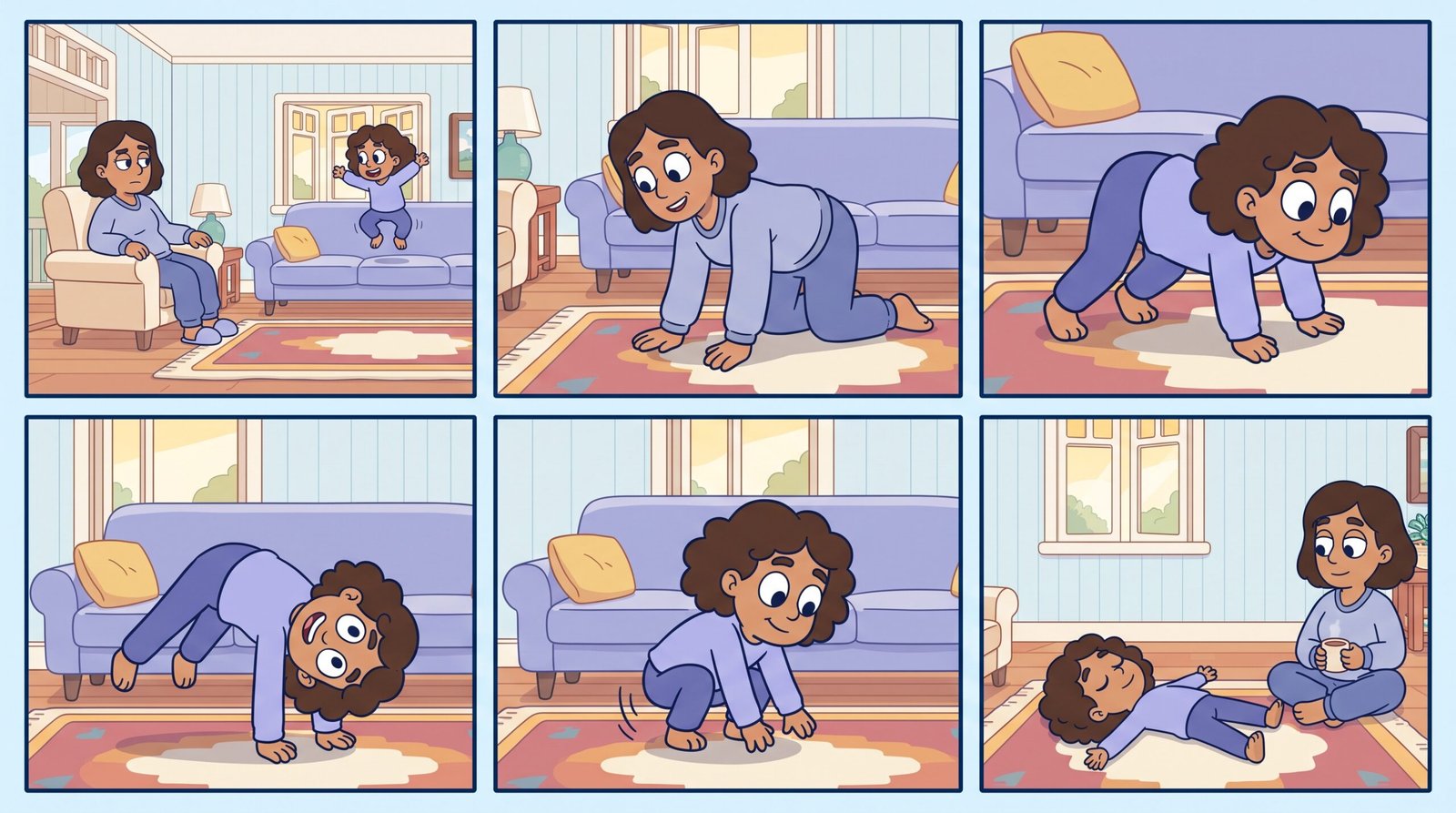
Why Animal Walks Gross Motor Preschool Actually Works Proprioceptive resistance, joint compression, and neurological down-regulation
When early childhood educators and paediatric occupational therapists talk about children needing to “burn off energy,” they often use the phrase as convenient shorthand. But for parents trying to survive an indoor afternoon, that idea can be deeply misleading.
A child who is throwing their body into sofas, leaping off coffee tables, and crashing into hallways does not merely have excess petrol in the tank. If that were the case, having them sprint around the house would always produce a sleepy, calm child. Instead, unstructured sprinting often leaves sensitive or neurodivergent preschoolers significantly more frantic, tearful, and dysregulated.
Targeted animal walks gross motor preschool exercises succeed where random running fails because they deliver specific, heavy sensory feedback directly to the central nervous system:
- The Power of Proprioceptive Feedback: Proprioception is our internal sense of body position and force. Receptors embedded in our muscles, joints, and tendons inform the brain where our limbs are in space without us having to look at them. When a preschooler bears their full body weight through their palms and feet, those joint receptors experience deep compression. In occupational therapy, this is known as heavy work. Proprioceptive heavy work acts like a neurological thermostat, lowering autonomic arousal and anchoring an overstimulated brain.
- Vestibular and Motor Integration: Movement experiences literally construct the architecture of the developing brain. Clinical guidance from the American Academy of Pediatrics (AAP) confirms that active physical play is essential for building emotional resilience, motor planning competence, and impulse control.
- Building Core Neural Pathways: Foundational neurodevelopmental research from the Harvard Center on the Developing Child shows that early physical exploration builds neural connections that link balance, motor sequencing, and emotional self-regulation.
Why Kids Do Not “Just Calm Down” Without Movement Crashing as an unconscious coping mechanism rather than misbehaviour
The most common adult reaction to an overactive preschooler is to demand immediate physical stillness: “Sit on your bottom, keep your hands in your lap, stop bouncing.”
While entirely understandable for an exhausted parent navigating a messy room, demanding physical stillness from a dysregulated child is biologically counterproductive.
Forced Stillness (High Friction)
Strips away the child’s physical coping mechanism without providing replacement input. Cortisol spikes, internal tension rises, and a behavioural meltdown follows.
Structured Heavy Work (Low Friction)
Provides deep compression to muscles and joints. The central nervous system receives the sensory boundaries it needs, allowing the body to settle from the inside out.
When a young child feels internally disorganized, they naturally seek sensory input to anchor themselves. If their brain cannot clearly register where their limbs are in space, they will slam their heels into the floorboards, press their weight against furniture, or dive onto cushions to feel gravity and resistance.
Crashing is not defiance; it is the body’s unconscious attempt to find physical grounding.
If you force an under-regulated child to sit motionless in a chair, you take away their only regulatory tool. By contrast, purposeful animal walks gross motor preschool routines supply the missing sensory input in an organised, safe, and deliberate format.
Core Animal Walks Gross Motor Preschool Activities That Settle the Body Bear crawls, crab walks, and frog jumps for deep sensory grounding
You do not need an endless roster of thirty animal impressions. Offering too many choices simply overwhelms an already tired child.
Focus on three primary movement patterns that recruit maximum core stability, shoulder joint compression, and motor planning, along with a few minimal variations kept in reserve.
1. The Bear Crawl: Core Stability and Joint Compression
The bear crawl is the foundation of sensory motor regulation. It places the child in a prone, weight-bearing posture that engages both the upper and lower body simultaneously.
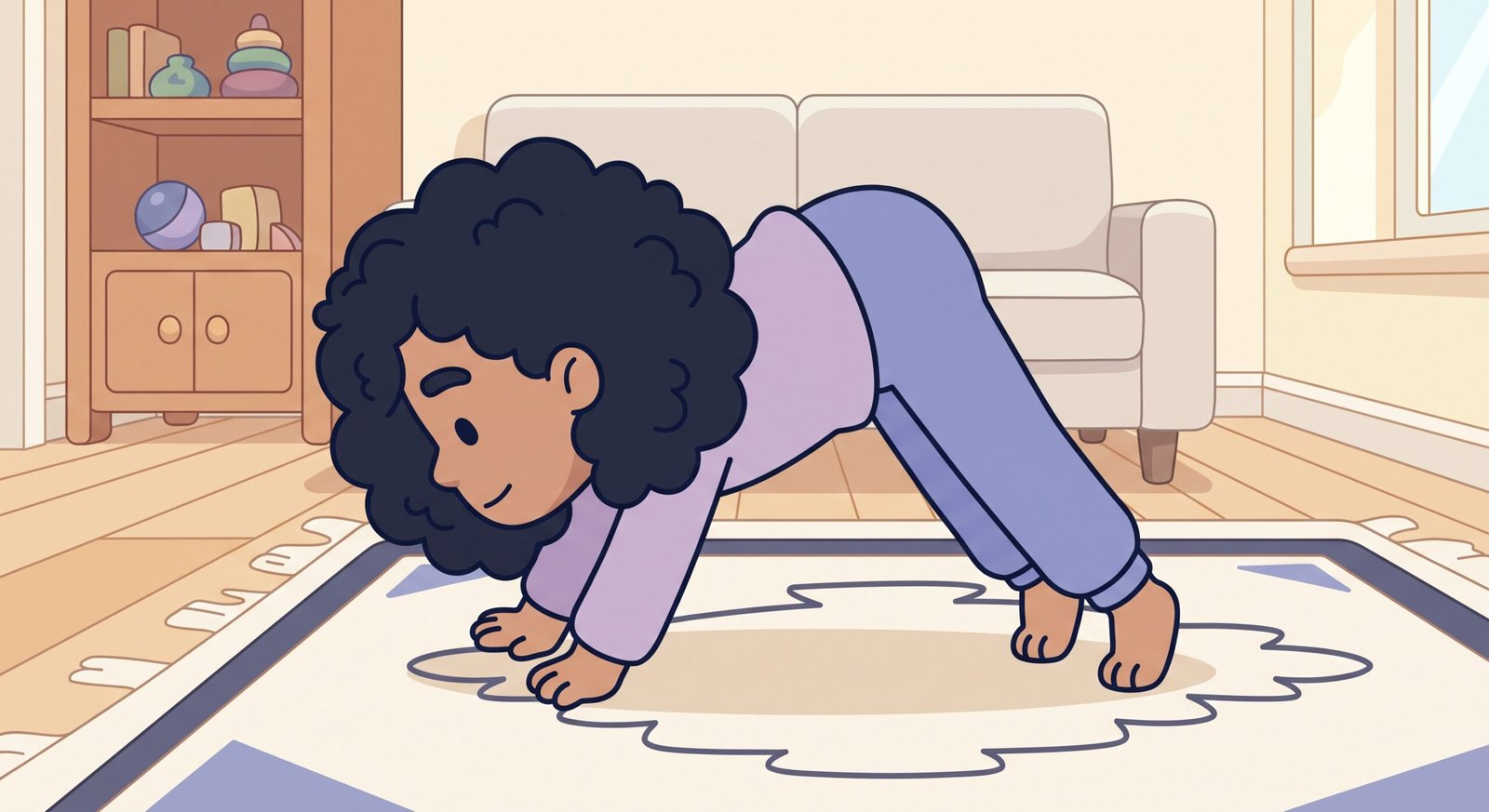
- The Physical Mechanics: The child places both hands flat on the carpet, fingers spread wide like large paws. Feet remain on the floor with hips pushed high into the air in an inverted “V” shape. The knees stay slightly bent but elevated off the ground, unlike a baby crawl. The child steps forward by coordinating opposite hands and feet in a slow, rhythmic sequence.
- Why It Regulates: Bear crawling delivers intense proprioceptive feedback into the shoulder joints, wrists, and hamstrings. Elevating the hips higher than the head also delivers a gentle, calming vestibular shift. Because the palms are pressed flat against the floor, the palmar arches are activated, building the intrinsic hand strength needed later for holding writing tools.
- Motor Development Backing: Early childhood physical guidelines from the National Association for the Education of Young Children (NAEYC) highlight that weight-bearing crawling movements strengthen the shoulder girdle and core muscles, laying the essential biomechanical foundation for coordination and physical stability.
- How to Cue It: Keep the tone heavy and slow: “Bears do not run. Bears are heavy, slow, and strong. Press your paws flat into the carpet like you are leaving giant footprints in the mud.”
2. The Crab Walk: Shoulder Girdle and Bilateral Effort
If bear crawling targets the front of the body, the crab walk activates the entire posterior chain. It is one of the most physically demanding animal walks gross motor preschool children can perform, making it exceptionally effective for rapidly discharging manic energy.
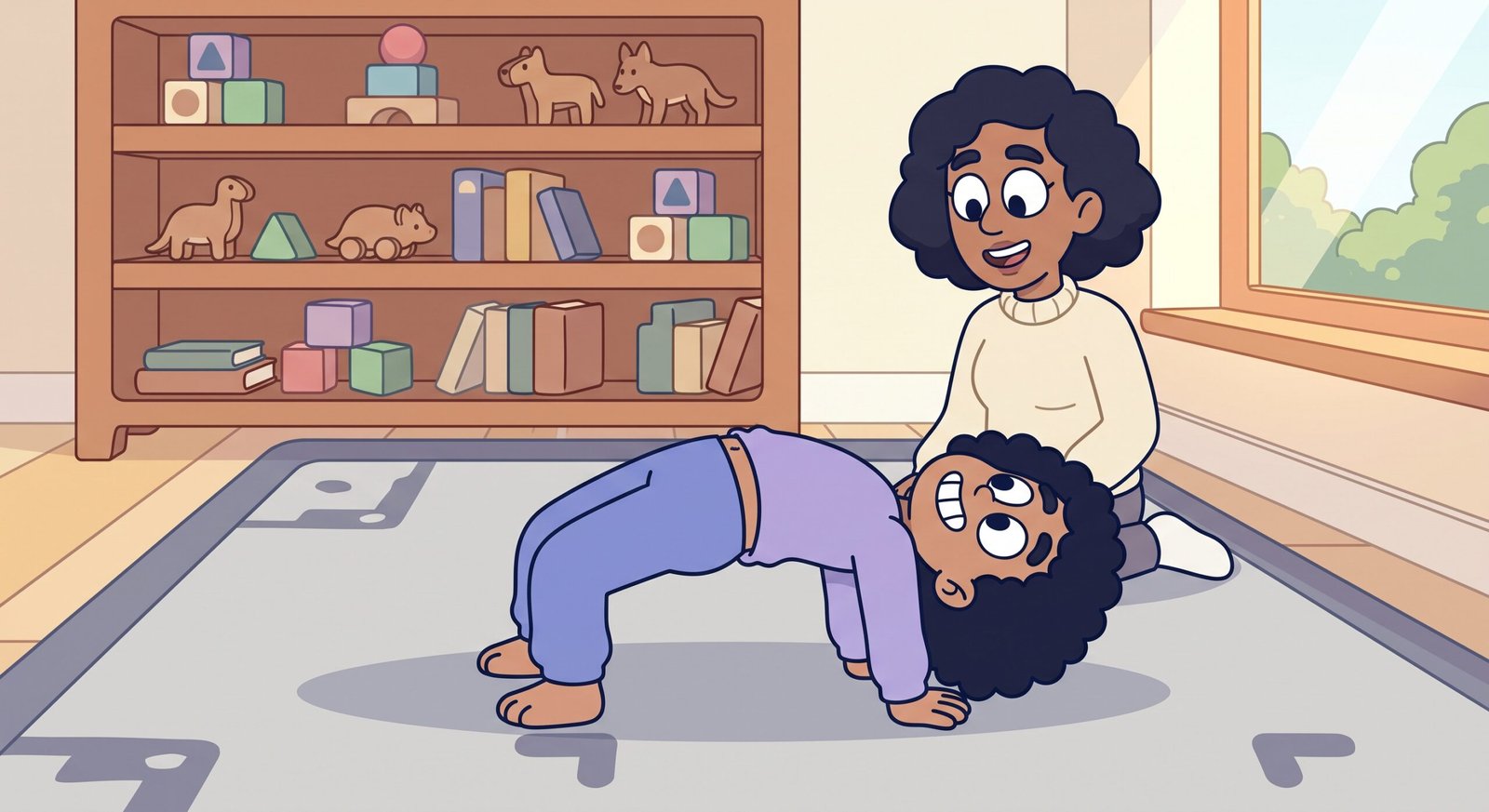
- The Physical Mechanics: The child sits on the floor with knees bent and feet flat on the carpet. They place their hands behind their hips, fingers pointing toward their heels. Pushing down through their palms and heels, they lift their bottom completely off the floor into a reverse tabletop position and step backward or sideways.
- Why It Regulates: Crab walking requires co-contraction across the triceps, shoulders, glutes, and core. Moving backward or sideways without being able to see directly behind them forces the child to construct a precise mental map of their space, which instantly halts impulsive sprinting. The sustained muscular effort required to keep the hips lifted delivers continuous proprioceptive input to the elbow and shoulder joints.
- How to Cue It: “Push your tummy up to the ceiling like a little table. Don’t let your shell touch the sand. Can you scuttle backward three steps to the sofa without dropping your picnic lunch?”
3. The Frog Jump: Explosive Force and Landing Control
Many active preschoolers love to jump, but their jumps are often wild, uncalibrated, and end in painful crashes. The frog jump introduces structural discipline to vertical movement.
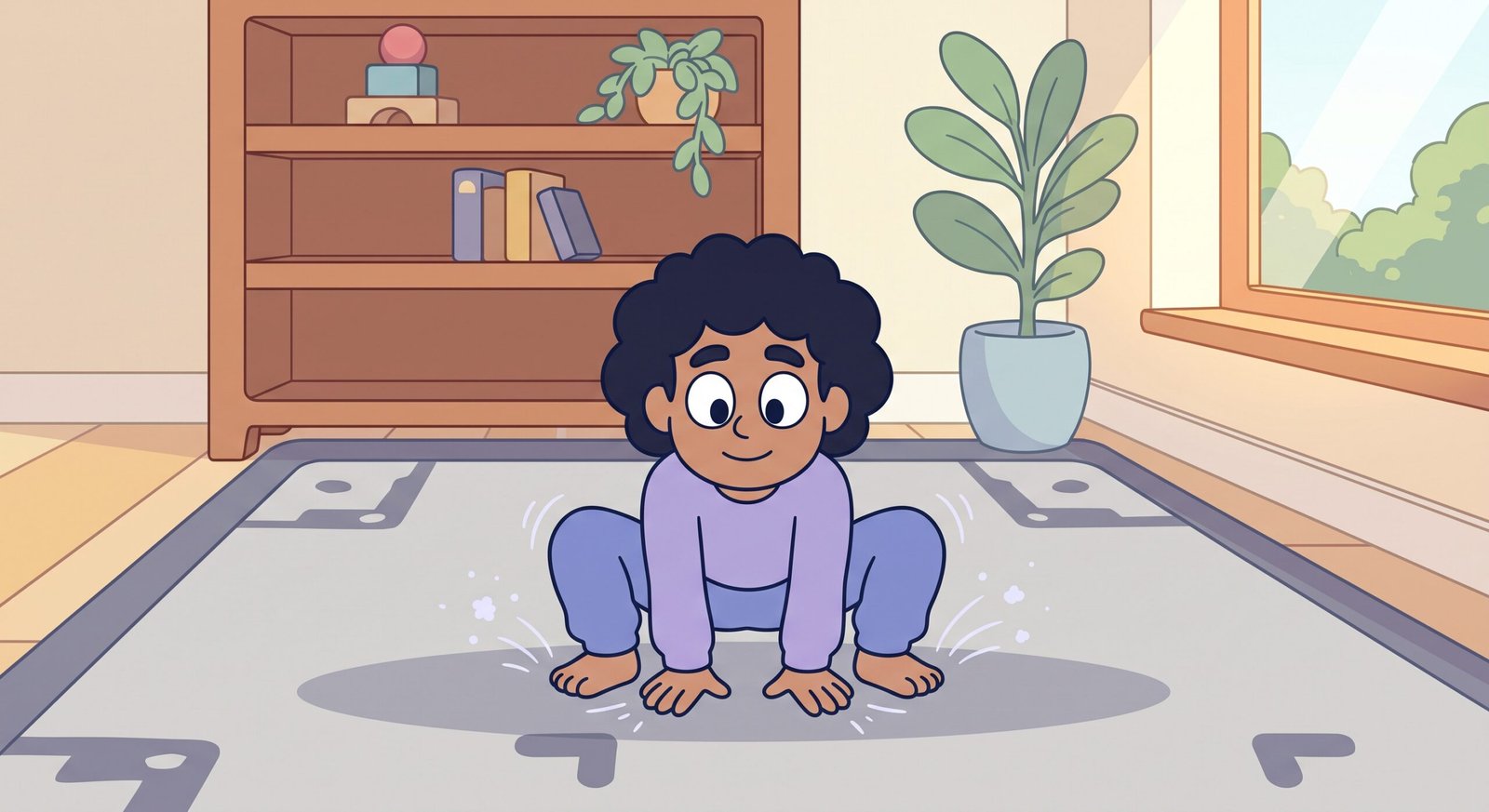
- The Physical Mechanics: The child drops down into a deep squat, feet slightly wider than shoulder-width, with both hands resting flat on the floor between their feet. They push off the floor explosively using their quadriceps and calves, leaping upward and forward. Crucially, they must land back down in the exact same deep squat position, with hands touching the floor to absorb the landing force quietly.
- Why It Regulates: The developmental value of the frog jump lies entirely in the deceleration. Anyone can leap wildly into the air; absorbing the impact of a landing requires immense eccentric muscle control and balance calibration. When a child must land softly in a deep squat without tipping over, their brain must recruit inhibitory control to stop forward momentum.
- How to Cue It: “Frogs jump high, but they land silently on a lily pad. Show me how you can leap across the pond, but when you land, keep your hands on the ground so you don’t splash the water.”
4. Minimal Variations: Snake, Penguin, and Starfish
While the Bear, Crab, and Frog form your primary regulatory toolkit, these three gentle variations offer alternative sensory textures when your child needs a different rhythm:
- The Snake Slither: The child lies flat on their stomach and pulls themselves along the carpet using only their forearms and chest, keeping their legs trailing behind. This provides deep tactile compression across the entire front of the body.
- The Penguin Waddle: The child stands upright, arms pinned against their ribs with palms flexed outward, walking with stiff knees on their heels. Walking exclusively on the heels delivers strong proprioceptive feedback through the long bones of the legs.
- The Starfish Stretch: The child lies on their back, spreading arms and legs wide like a star, then curls tightly into a ball holding their knees to their chest for five seconds. Alternating between full expansion and deep flexion helps children consciously notice the difference between muscle tension and relaxation.
What Children Are Actually Developing Inside the Body Bilateral coordination, core strength, and executive inhibitory control
When you ask a four-year-old to crab walk down the hallway, it can look like simple physical play. But underneath the fun animal persona, their nervous system is mastering foundational developmental architecture.
| Animal Movement Pattern | The Underlying Neurological Mechanism | Long-Term Developmental Benefit |
|---|---|---|
| Bear crawl across the living room rug | Reciprocal bilateral coordination and shoulder weight-bearing. | Hemispheric brain communication, handwriting endurance, and stability. |
| Reverse tabletop crab walk | Posterior chain co-contraction and spatial mapping. | Core stability, postural control at desks, and spatial awareness. |
| Deep squat frog jump and soft landing | Eccentric muscular control and kinetic force modulation. | Inhibitory impulse control, motor planning, and joint protection. |
| Prone snake slither on carpet | Full-body tactile compression and prone extension. | Autonomic down-regulation, physical body mapping, and calming. |
Just like the purposeful setups we build in our guide to an indoor obstacle course for preschoolers, animal walks turn unchanneled momentum into targeted physical problem-solving.
Crawling like a bear requires the left arm to move forward as the right leg steps, followed by the right arm and left leg. This cross-pattern movement requires the left and right hemispheres of the brain to communicate across the corpus callosum. Strengthening these cross-lateral neural connections directly supports future cognitive tasks, including tracking words across a page from left to right and writing with one hand while the other stabilises the page.
Research from the Raising Children Network (Australia) confirms that structured active play provides young children with a safe, positive outlet to discharge emotional stress, master bodily control, and build healthy self-esteem.
What Happened on My Own Kitchen Tiles From racing disasters to the power of a quiet green tape line
I have spent years studying early childhood education and child development. I understand the clinical theories behind sensory motor regulation. Yet when I was at home trying to parent my own daughter, whose buzzing ADHD traits constantly intersected with my own adult ADHD burnout, theory did not always translate into instant peace.
In our early days of indoor cabin fever, I made classic mistakes with animal walks.
One rainy morning when she was bouncing off the walls, I thought I would be clever: “Let’s see who can bear crawl down the hallway the fastest! Ready, set, go!”
It was a complete disaster.
She didn’t bear crawl. She bolted forward, tripped over her own hands, skidded on the floorboards, and smashed her knee into the skirting board. The sudden velocity spiked her adrenaline, and within twenty seconds she was screaming in pain and fury. Turning an animal walk into a speed contest defeated the entire regulatory purpose. Speed eliminates precision and joint compression, replacing it with frantic, uncoordinated momentum.
Another afternoon, trying to be the “fun educator parent,” I pulled out a deck of thirty animal cards: “Now be a flamingo! Now be an elephant! Now be a cheetah!” Within five minutes, she was wildly overstimulated, galloping around the room making loud screeching noises and completely unable to listen. The rapid novelty had overloaded her working memory.
The real breakthrough came when I treated animal walks gross motor preschool sessions as deliberate, quiet rituals rather than high-energy games.
One afternoon, when she was in that frantic, unfocused space right before dinner, I set two green painter’s tape lines across the living room rug, about three metres apart.
I knelt down and whispered: “The floor is made of quiet swamp moss. You have to travel from this green line to that green line. First, cross like a heavy, silent bear. When your paws touch the second line, turn around and scuttle back like a crab.”
She bear-crawled across. Her hands pressed firmly into the wool rug. She turned, sat down, lifted her bottom into a crab walk, and moved backward, her face tight with concentrated effort. She did that loop four times.
By the fourth lap, her frantic bouncing had completely vanished. Her breathing was deep, rhythmic, and slow. When she reached the green tape line the final time, she sat cross-legged on the rug, rested her hands in her lap, and quietly asked if she could have an apple.
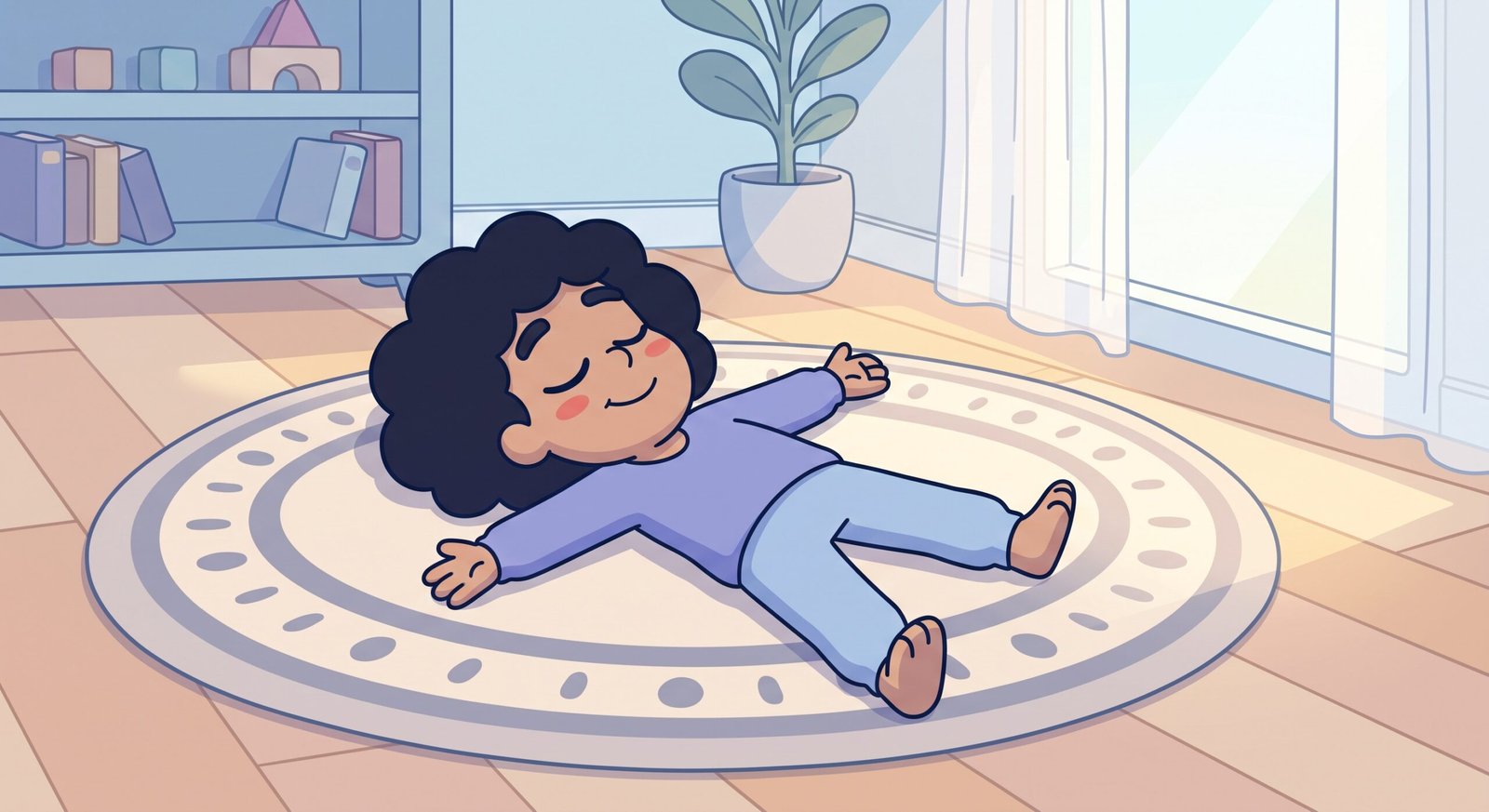
It wasn’t magic. It was simple, targeted sensory resistance giving her body the feedback it desperately needed.
“High-energy preschoolers are not trying to push our buttons when they crash into the room. Their bodies are simply calling out for heavy physical resistance. When we give them intentional, quiet ways to feel their own strength, chaos turns into deep, grounded peace.”
Dewi Griffith, PhD, Founder
What Does Not Work: Traps That Add More Chaos Mistakes to avoid when using animal movements indoors
If you have tried animal walks before and it left your house feeling louder, wilder, and more chaotic than when you started, you likely fell into one of these common traps:
- Turning It Into a High-Speed Race: Never encourage children to perform animal walks as fast as possible. Velocity activates the sympathetic nervous system, spiking heart rate and adrenaline. Always cue for weight, stealth, and control: “Move like an enormous bear waking up from winter,” or “Land like a frog that doesn’t want to make a sound.”
- Cycling Through Ten Animals in Five Minutes: Rapid novelty overloads an already struggling working memory. Pick two or three animals and repeat the same circuit several times. Repetition is what regulates the brain.
- Neglecting Physical Boundaries: If you tell a child to “bear crawl around the house,” they will quickly veer into running, crashing into walls, and tumbling over furniture. Always establish a clear starting mark and a defined finish line: from the living room rug to the hallway runner, or between two cushions placed three metres apart.
- Expecting an Instant Personality Transformation: Animal walks are not a magical switch that turns an active child into a silent statue. What they provide is a constructive physical container for that energy, transforming chaotic crashing into focused motor effort and preventing an escalation into a full meltdown.
How to Use Animal Walks in Real-Life Routines Strategic transition windows that prevent daily friction
You do not need to schedule an elaborate thirty-minute physical education lesson. The true power of animal walks gross motor preschool techniques is that they can be woven seamlessly into everyday transition points throughout your home:
- The Pre-Dinner Unravel Window (4:30 PM): The late afternoon is a classic danger zone for young children. Fatigue from preschool meets low blood sugar, and sensory regulation frays. Before setting the table, invite your child to do three bear crawl laps across the lounge room rug, followed immediately by a heavy work task like carrying a basket of napkins to the table.
- Transitioning to Seated Table Tasks: If your child struggles to sit for lunch, drawing, or quiet play, their postural muscles are often seeking sensory input. Have them crab walk from the sofa to their dining chair. Once they climb onto the chair, their joint receptors are loaded with calming feedback, making seated focus significantly easier. Much like the self-directed play habits we explore in our guide on how to encourage independent play in preschoolers, physical regulation must precede quiet focus.
- De-escalating Sudden Crashing: The second you notice your child climbing the back of the couch or diving into floorboards, intervene before the crash happens: “I see your body is asking for heavy work. The couch is closed, but the swamp path is open. Show me five giant frog jumps on the rug.”
Keeping the Movement Structured, Not Chaotic A repeatable 5-minute calming protocol for busy afternoons
To guarantee that your animal walk sessions result in a calm child rather than an overstimulated room, follow this simple, repeatable three-part formula:
- The Heavy Challenge (2–3 Minutes): Bear crawl down the hallway runner, turn around, and crab walk back. Repeat three times. Focus on heavy palms, high hips, and slow stealth.
- The Braking Exercise (1 Minute): Three slow, quiet frog jumps across the rug. The child must freeze in a deep squat for three seconds after each landing without tipping over.
- The Settling Rest (1 Minute): Starfish stretch on the rug. Have the child lie flat on their back, curl tightly into a ball holding their knees to their chest for five seconds, and release into a wide star with deep belly breaths before moving to the next activity.
Expanding Your Grounded Home Play Toolkit Practical sensory and fine motor guides across your home
Once you understand how to use purposeful movement to regulate your child’s nervous system, you can layer these strategies into other daily routines without adding extra clutter:
- When your child needs a complete living room movement circuit, explore our step-by-step guide to building an indoor obstacle course for preschoolers using cushions and painter’s tape.
- For quiet, contained sensory exploration that soothes busy hands on your living room rug, try our favourite low mess sensory bins for preschoolers.
- Channel physical energy into real-world household competence with practical ideas from our practical life activities for preschool at home.
- When rainy weather traps everyone inside for multiple days, turn to our restorative collection of rainy day activities for preschoolers at home.
- Discover how to step back from being your child’s constant entertainment engine with our complete guide on how to encourage independent play in preschoolers.
Looking for Grounding, Low-Mess Activities for Restless Days?
When you need quiet, table-based activities that soothe busy minds and build fine motor precision without living room mess, our Montessori-inspired story tracing printables offer a peaceful, structured transition.
Explore Calm Story Tracing BundlesReferences & Research Foundations Credible developmental, paediatric, and sensory motor research
- American Academy of Pediatrics (AAP). (2018). The Power of Play: A Pediatric Role in Enhancing Development in Young Children. Clinical Report. aap.org
- Center on the Developing Child at Harvard University. (2014). Enhancing and Practicing Executive Function Skills with Children from Infancy to Adolescence. Harvard University. developingchild.harvard.edu
- National Association for the Education of Young Children (NAEYC). (2020). Developmentally Appropriate Practice in Early Childhood Programs Serving Children from Birth Through Age 8. naeyc.org
- Ayres, A. J. (2005). Sensory Integration and the Child: Understanding Hidden Sensory Challenges. Western Psychological Services.
- Raising Children Network (Australia). (2024). Physical activity and active play for preschoolers. Australian Government Department of Social Services. raisingchildren.net.au
This article reflects personal family experience parenting in a neurodivergent household alongside professional early childhood education research. It is shared for supportive and educational purposes only and does not constitute formal paediatric, clinical, or occupational therapy advice. Every child develops at their own unique pace, with distinct physical capabilities and sensory thresholds. If you have ongoing concerns about your child’s balance, coordination, or sensory processing, please seek individual guidance from your GP, a paediatrician, or an accredited paediatric occupational therapist.