
Coregulation Strategies Early Childhood: 4 Powerful Somatic Actions for Calmer Rooms
Mastering coregulation strategies early childhood educators and caregivers can rely on requires treating emotional balance as an interpersonal biological dance rather than an intellectual negotiation.
In neurodivergent pedagogy, coregulation strategies early childhood practitioners employ are adult-mediated physiological interventions. Through intentional vocal prosody, grounded spatial proximity, and somatic calming cues, an adult provides an external nervous system scaffold that helps a young child re-enter their autonomic window of tolerance.
- Interpersonal Neurobiology: How Nervous Systems Converse
- 4 Powerful Somatic Actions Adults Take in the Moment
- Practical Scripts: What to Say When Language Fails
- Classroom vs. Home: Navigating System Differences
- The Adult Capacity Anchor: Co-Regulating Without Depletion
- Connected Guides in the Regulation Cluster
- Academic References & Empirical Frameworks
Interpersonal Neurobiology: How Nervous Systems Converse
Before a child can self-regulate, they must experience thousands of hours of reliable co-regulation. Self-regulation is not an innate skill that magically appears at age four; it is a neurological milestone constructed through repeated interpersonal connection.
Developmental research from Harvard’s Center on the Developing Child proves that brain architecture is formed through “serve and return” relational interactions. In situations of acute emotional dysregulation, this bio-behavioural synchrony takes priority over all cognitive instruction.
Through mirror neuron networks and continuous neuroception, a child’s subconscious brain reads the adult’s somatic state.[1] If an adult approaches an escalating child with raised shoulders, shallow breathing, clenched hands, or an elevated vocal pitch, the child’s autonomic nervous system detects acute danger. Even if the adult’s spoken words are outwardly polite (“Please calm down sweetheart”), the child’s lower brain detects physiological tension and mobilises further into fight, flight, or freeze.
Under Australia’s national early education framework administered by ACECQA, secure relational attachments form the foundation of children’s learning and wellbeing. When educators understand that dysregulation is a bid for nervous system support rather than defiance, daily friction drops dramatically.
4 Powerful Somatic Actions Adults Take in the Moment
When an early childhood environment tips into chaos, cognitive interventions fail. True coregulation strategies early childhood professionals use rely on four non-verbal, somatic adjustments:
1. Drop Vertical Stature and Angle the Body at 45 Degrees
Standing over a dysregulated child activates an instinctive predatory threat signal in their subcortical brain. Looming over a child—even with kind intentions—triggers autonomic avoidance or aggression.
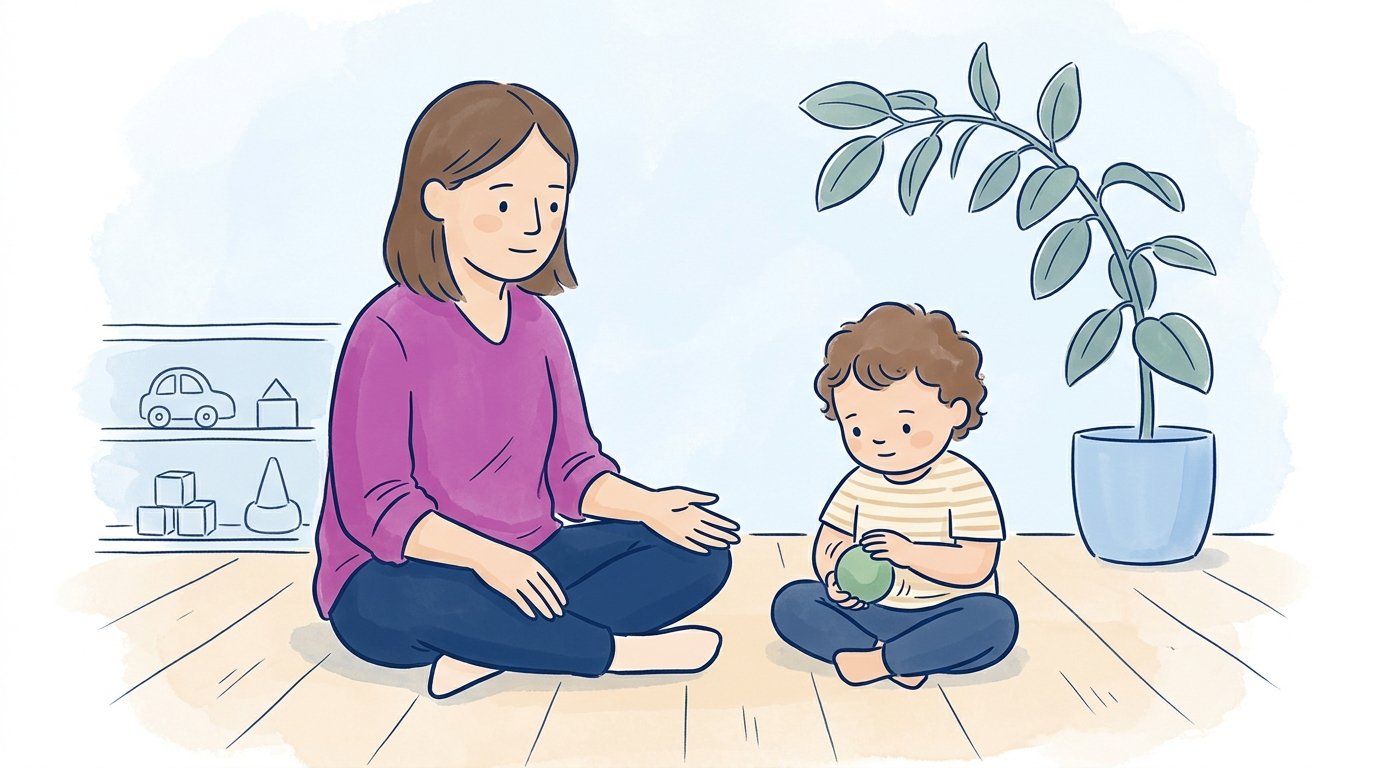
- Immediate Physical Move: Drop to the floor immediately. Sit cross-legged or kneel so your eye level is slightly below the child’s horizontal gaze.
- The 45-Degree Angle: Never position your torso squared directly facing the child. A head-on stance is universally read by the human nervous system as confrontational. Sit at a 45-degree angle, facing the room alongside them. This signals alignment and shared observation rather than opposition.
- Hands in Lap: Keep your hands open and resting loosely in your lap. Open palms are a biological symbol of non-violence.
2. Lower Vocal Pitch and Adopt a Rhythmic, Monotone Prosody
When adrenaline surges, adult vocal cords naturally tighten, shifting pitch upward into higher, sharper frequencies. Dysregulated neurodivergent ears interpret high pitches as alarm signals.
- Vocal Tone Calibration: Drop your voice an octave into a low, warm chest register.
- Tempo Deceleration: Speak at half your normal conversational speed. Elongate your vowels slightly.
- The Power of Silence: The most effective verbal tool in coregulation strategies early childhood settings is strategic silence. Deliver a single grounding phrase, then remain completely silent for 45 to 60 seconds to allow the child’s auditory cortex time to decode the environment.
3. Use Exaggerated, Audible Diaphragmatic Exhalations
Children naturally match their respiration to the breathing rhythms of grounded adults nearby through a biological process known as physiological entrainment.[2]
- The Physiological Sigh: Take two short inhales through your nose, followed by a long, slow, audible exhale through your mouth.
- No Verbal Coaching: Do not tell the child to “take a deep breath.” Telling an overwhelmed child to breathe feels like a demand, which often causes hyperventilation or defensive yelling. Model the breath in your own ribcage. Let their mirror neuron system absorb the biological pace naturally.
4. Introduce Low-Friction Grounding Objects
During sympathetic mobilization, high-level motor planning disappears. Providing heavy, grounding sensory input restores body schema awareness without requiring spoken language.
- The Indirect Offer: Place a weighted lap pad, a heavy beanbag, or a cold water bottle on the carpet between you and the child. Do not force it into their hands.
- Parallel Movement: Roll a tactile ball smoothly back and forth between your own palms. The rhythmic, repetitive physical motion provides an external visual and auditory anchor that calms autonomic arousal.
Practical Scripts: What to Say When Language Fails
Language is a dangerous tool during nervous system distress. Extensive neuroimaging confirms that Broca’s area (the brain’s expressive language hub) goes offline under acute sympathetic or dorsal stress.[3] Lengthy explanations, moral questions, or multi-step choices simply overwhelm the child’s processing limits.
Effective coregulation strategies early childhood scripts rely on minimal, predictable verbal anchors. Keep statements under five words:
“Hands down. Floor is safe.”
“I am right here with you.”
“No big jobs right now.”
“Sit here together.”
“You do not need to talk.”
“We can sit quietly.”
| Common Instinctive Adult Phrasing | Neurological Problem | Neuro-Affirming Co-Regulation Script |
|---|---|---|
| “Use your words, why did you do that?” | Demands verbal synthesis from an offline prefrontal cortex. | “Your body feels big. I am right here.” |
| “If you don’t pack away now, you lose playground time.” | Triggers temporal panic and activates rejection sensitive dysphoria. | “We can put the red blocks in together.” |
| “Look at me when I am talking to you!” | Eye contact during acute threat registers biologically as predator dominance. | “I am looking at the carpet with you.” |
Classroom vs. Home: Navigating System Differences
A common hurdle in implementing coregulation strategies early childhood models is adapting techniques to vastly different physical environments. What functions smoothly in an early childhood classroom with a 1:4 or 1:11 educator ratio must be modified within a noisy home living room.
| Operational Dimension | Early Learning Classroom Setting | Domestic Family Home Setting |
|---|---|---|
| Environmental Containment | Quietly redirect the rest of the peer group to a separate play zone or outdoor verandah to protect privacy and clear space. | Turn off background screens, washing machines, and television. Create an immediate sensory buffer in the family room. |
| Staff and Sibling Dynamics | Use subtle non-verbal hand signals between educators: one educator steps into low-demand proximity while the other maintains group safety. | Separate siblings into an adjacent room with a low-demand activity (audiobook, sensory bin) before beginning co-regulation. |
| Time Pressures & Routines | Flexible curriculum routines allow an educator to sit quietly for fifteen minutes without compromising group compliance. | High transition friction (getting out the door for school). Adult must consciously drop non-essential steps (e.g. skip socks; put shoes on in car). |
| Adult Emotional Reserves | Educators can tap out and swap roles with an assistant or co-educator when their own nervous system reaches capacity. | Parents often have no backup. Requires self-compassion and immediate physical demand reduction to survive the moment. |
The Adult Capacity Anchor: Co-Regulating Without Depletion
We cannot discuss coregulation strategies early childhood without acknowledging the biological cost to the adult. Mirroring calmness in the face of violent outbursts, piercing screams, or unresponsive shutdown requires significant neurological stamina.
Educator and parent burnout does not happen because caregivers lack compassion; it happens because adults attempt to co-regulate from an empty battery. When an adult is carrying chronic stress, unmanaged sensory sensitivities, or neurodivergence of their own, co-regulation feels like swimming upstream against an emotional torrent.
Protecting Your Own Internal Battery:
• The 10-Second Physical Grounding Check: Before stepping toward an escalating child, press both feet firmly into the floorboards, soften your jaw, and let your shoulders drop. Anchor your own biology first.
• Lower the Bar to Safety Only: When adult energy is running on empty, drop all secondary expectations. Learning, tidying, and social etiquette do not matter in a crisis. The only goal is restoring physiological safety.
• The Shared Tag-Team Protocol: In educational settings, establish an explicit agreement among staff: any educator can tap another on the shoulder and say, “I’m swapping with you,” without shame, guilt, or explanation.
To understand how adult and child capacities fluctuate unevenly throughout the week, review our operational framework in the Spiky Profiles & Capacity Cluster →
Furthermore, pairing these relational strategies with intentional classroom acoustic buffers prevents nervous system overload from developing in the first place. Explore practical layouts in our Sensory Environment Cluster →
• Learn our tactical 3-step de-escalation protocol in Child Meltdown Co-Regulation: 3 Powerful Steps →
• Discover why sticker charts damage autonomic self-regulation in ADHD Behaviour Strategies: Why Behaviour Charts Fail →
• Decode fight, flight, and freeze somatic warning signals in Fight, Flight, and Freeze in Children Decoded →
• Return to our cluster foundation for broader models on Regulation and Behaviour in Early Childhood →
Academic References & Empirical Frameworks
- Siegel, D. J. (2012). The Developing Mind: How Relationships and the Brain Interact to Shape Who We Are (2nd ed.). Guilford Press. [Interpersonal neurobiology, mirror neuron systems, and bio-behavioral attunement].
- Porges, S. W. (2017). The Pocket Guide to the Polyvagal Theory: The Transformative Power of Feeling Safe. W. W. Norton & Company. [Autonomic entrainment, social engagement vocal frequencies, and neuroception].
- van der Kolk, B. A. (2014). The Body Keeps the Score: Brain, Mind, and Body in the Healing of Trauma. Penguin Books. [Demonstrating Broca’s area deactivation during acute sympathetic threat].
- Shanker, S. (2016). Self-Reg: How to Help Your Child (and You) Break the Stress Cycle and Successfully Engage with Life. Penguin Random House.
- Delahooke, M. (2019). Beyond Behaviors: Using Brain Science and Compassion to Understand and Solve Children’s Behavioral Challenges. PESI Publishing.