
ADHD Skills Inconsistency Explained: The Real Truth Behind Uneven School Days
Few things feel heavier than sitting at a small timber table during parent-teacher interviews while a teacher slides an uneven workbook across the table, furrowing their brow as they ask why your clever child seems to switch their ability on and off like a desk lamp.
If you have walked out of those school meetings with your stomach tied in knots, you are not alone. When educators see our children write an expressive story on Tuesday morning and then stare blankly at a simple worksheet on Thursday, the conclusion they jump to is almost always behavioural. People assume the child is daydreaming, lacking motivation, or deliberately digging their heels in.
Having ADHD skills inconsistency explained properly changes everything. It moves us away from blaming our children and gives us the vocabulary to advocate for them. Sitting on both sides of that table, as an early childhood educator who completed doctoral studies through Deakin University, and as an ADHD mum raising a spirited six-year-old daughter here in Victoria, I have lived every single bit of this friction.
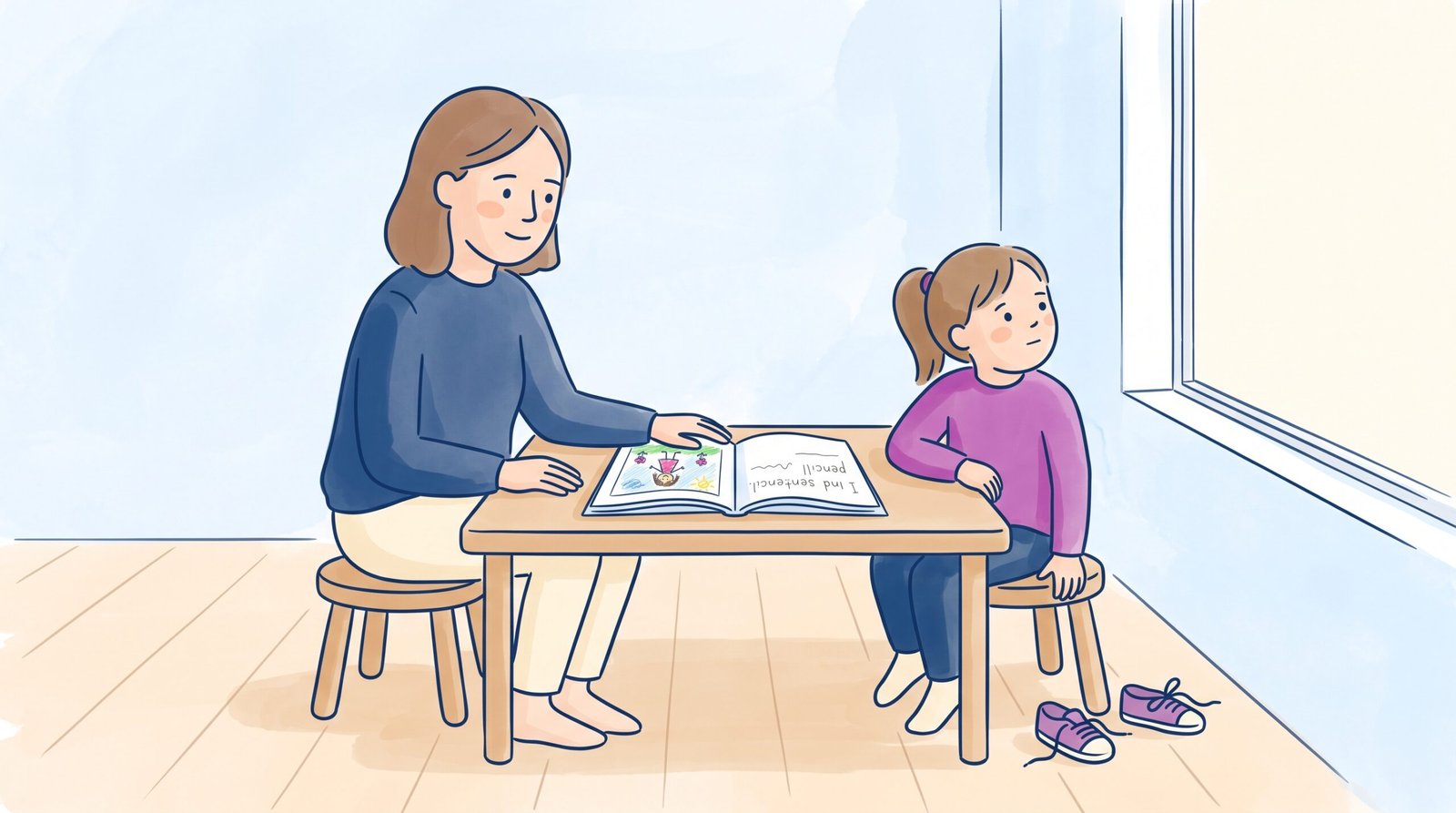
The Writing Book That Confused the Classroom
To understand how ADHD skills inconsistency explained through real life looks, let me take you back to a rainy Wednesday afternoon in Term Two. My daughter had brought home her preparatory writing folio.
On page fourteen, dated a Tuesday morning, she had drawn a detailed echidna with dozens of fine pencil spikes. Beneath it, she had written three neat sentences about how echidnas use their long snouts to dig for ants in the bush. Her pencil grip was steady, the letters sat neatly along the dotted thirds, and her punctuation was spot on. Her teacher had placed a proud little star at the top of the page.
On page fifteen, dated forty-eight hours later, there was a single wobbly word: the. The pencil line was pressed so hard into the page that the paper had torn. The rest of the page was completely blank, save for a few dark scribbles in the bottom corner where my daughter had clearly pushed her lead until it snapped.
Beside that wobbly word, the teacher had written in red pen: Refused to write today. Chose to look out the window instead. Needs to show more effort.
Reading that note made my chest ache. That brief red comment captured the entire misunderstanding our children face in mainstream school environments. The teacher saw a moral refusal. They thought my daughter woke up on Thursday and decided to be difficult.
What the teacher could not see was that Thursday morning had begun with a noisy fire drill right before reading groups. The classroom was warm and sticky from rain on the windows. The fluorescent tubes overhead had an irritating hum that set my daughter’s teeth on edge, and her best friend was home sick with the flu. Her nervous system had spent every drop of dopamine and working memory just staying seated on the mat. By the time the writing book was placed in front of her, she did not have the physical fuel left to hold a lead pencil.
Why Executive Function Swings Look Like Defiance
The hardest part about school misunderstandings is that neurotypical adults expect executive function to be stable. People assume that if you can plan, organise, focus, and initiate a task today, those same cognitive levers will respond identically tomorrow.
In neurodivergent development, executive function is not a permanent muscle. It is a fluctuating resource that rises and falls with physiological energy, sensory load, and chemical regulation in the brain.
When we look at ADHD skills inconsistency explained through neurological science, we see that the prefrontal cortex relies heavily on dopamine and noradrenaline to transmit messages across neural synapses. Clinical research by Russell Barkley highlights that individuals with ADHD do not have a deficit of knowledge; they have an issue with the timing and transmission of that knowledge at the exact point of performance.[2]
| The Classroom Observation | The Common School Misunderstanding | What ADHD Skills Inconsistency Explained Really Means |
|---|---|---|
| Writes Beautifully on Monday, Paralysed on Thursday Completing a page of neat sentences, then staring at a blank sheet two days later unable to write their name. |
The child is being oppositional, lazy, or trying to avoid doing work. | Working Memory and Motor Planning Collapse: Coordinating fine motor muscles while holding sentence ideas in short-term memory burns massive glucose. When the battery runs low, task initiation stalls. |
| Listens Attentively to Stories, Bolts During Maths Sitting enraptured during a picture book reading, but rolling around on the carpet during numeracy lessons. |
They only listen when it suits them and lack basic respect for class structure. | Dopaminergic Interest Gating: High interest literature generates its own neurochemical fuel. Abstract numeracy drills require heavy cognitive willpower that has already been spent. |
| Independent at Locker at Nine, Tears Over Bag at Three Unpacking lunch and drink bottles smoothly in the morning, weeping helplessly over their zipper in the afternoon. |
They are putting on a show for parents at pickup time to get out of carrying their belongings. | Sensory and Masking Saturation: Six hours of holding their body still, filtering room echoes, and navigating playground politics has left their nervous system completely dysregulated. |
As developmental findings published by Harvard’s Center on the Developing Child show, the biological circuits underpinning executive function are directly compromised by toxic environmental and emotional stress. Expecting a child to demonstrate identical executive skills when their stress hormones are elevated is biologically impossible.
Emotional Load Versus Skill Ability: The Invisible Tug of War
One of the most important concepts when having ADHD skills inconsistency explained is the difference between skill ability and the emotional load required to use that ability.
Think of skill ability as an appliance, and emotional load as the electrical current in an old weatherboard house. A child might have a top-of-the-line blender sitting on the bench. It has sharp blades, a powerful motor, and can puree soup in thirty seconds. That is their intelligence, their vocabulary, and their conceptual understanding.
However, if the house already has an electric heater running, the washing machine spinning, and the oven baking, turning on that blender will blow the circuit breaker. The blender is not broken. It does not need to be sent back to the manufacturer for repairs. The electrical grid simply cannot carry another demand.
When a six-year-old child walks into an Australian classroom, their internal electrical grid is often already running at maximum capacity:
Sensory Demands: Polished vinyl floors bounce every dropped ruler like an echo chamber. Fluorescent ballasts buzz at fifty Hertz. Woollen uniform jumpers itch against sensitive skin. As occupational therapy pioneer Winnie Dunn has shown, children with sensitive processing thresholds burn substantial energy just trying to filter out this ambient chaos.[3]
Social Hypervigilance: Many children with ADHD live with rejection sensitive dysphoria. They are acutely aware that they move faster, talk louder, and get corrected far more frequently than other kids. That background worry creates a persistent low-level state of panic that siphons energy away from learning.
Cognitive Transitions: Shifting attention from an unfinished drawing to a maths worksheet requires flexible set-shifting. For an ADHD brain, slamming the brakes on one task to accelerate into another feels like grinding gears in a manual car without pressing the clutch.
When an educator looks at a child who cannot pick up their pencil, they are only looking at the tip of the iceberg. They see a simple five-minute writing task. What they do not see is the twenty-four other tasks the child has already navigated since eight o’clock that morning just to keep their body sitting in that plastic chair.
Why ADHD Skills Inconsistency Explained Demands Better School Advocacy
Because mainstream school systems are designed around standardised assessment and predictable progress, children with uneven profiles frequently get labelled as enigmatic, inconsistent, or unmotivated.
Under Australia’s early learning guidelines overseen by ACECQA, educational programs must be responsive to each child’s individual strengths, interests, and developmental rhythms. Yet on the ground, children with fluctuating executive function are routinely penalised when their performance dips.
When we sit down with teachers, we need to bridge this gap with practical, respectful language. Here is how we translate ADHD skills inconsistency explained into practical classroom accommodations:
1. Separate the Brain’s Ideas From Fine Motor Output
When a child has brilliant oral storytelling but freezes when handed a pencil, do not force them to spend all their energy on handwriting. Allow an educator or learning support assistant to scribe their words, or let the child record their thoughts using speech-to-text tools on an iPad. Let their mind shine without demanding that their tired fine-motor muscles carry the entire cognitive weight.
2. Introduce Flexible Point-of-Performance Scaffolding
Do not assume that because a child unpacked their bag independently on Monday, they will not need a reminder on Thursday. Place a simple visual sequence on their locker with clear photographs. When their working memory drops, the visual prompt quietly guides them without any adult having to raise their voice.
3. Provide Proactive Regulation Breaks Before Demands Peak
Waiting for a child to melt down or stare blankly out the window before offering a break is an ambulance at the bottom of the cliff. Schedule short movement breaks or heavy work tasks before high-friction lessons:
Have the child carry the library tub to the office, push against a solid wall, or roll a heavy weighted ball between their hands. Proprioceptive input grounds the central nervous system and restores dopamine far better than a scolding ever will.
How We Protect Our Children at Home After Hard Days
When school misunderstands our children, home must be their sanctuary. When my daughter walks out of the school gate with her shoulders slumped, clutching a crumpled workbook that she could not finish, I do not ask her why she did not try harder.
I take her heavy school backpack off her shoulders. I hand her an apple with peanut butter and a cold drink of water in the car. When we get through our front door, I let her kick off her shoes, pull on her softest cotton leggings, and curl up with our cat on the rug without any adult demanding words or explanations.
We cannot force our children’s nervous systems to perform with flat, predictable consistency. We can, however, wrap them in understanding. When we have ADHD skills inconsistency explained through love and biological truth, we stop expecting our children to be machines and start helping them flourish as the wonderfully uneven, brilliant human beings they are.
- Read why daily energy tanks rise and fall in Why Child Can Do It Some Days Not Others →
- Why standard age developmental checklists fail uneven profiles in Why Milestones Don’t Fit Neurodivergent Children →
- How to look after yourself when caregiver exhaustion hits in Parent and Teacher Burnout in Neurodivergent Care →
- Return to our main cluster guide on Spiky Profiles and Capacity in Neurodivergent Children Hub →
References
- Silverman, L. K. (2002). Upside-Down Brilliance: The Visual-Spatial Learner. DeLeon Publishing. [Examining asynchronous development and uneven learning profiles in children].
- Barkley, R. A. (2012). Executive Functions: What They Are, How They Work, and Why They Evolved. Guilford Press. [The neurology of dopamine regulation, task initiation, and variable performance in ADHD].
- Dunn, W. (2014). Sensory Profile 2: User’s Manual. Pearson. [How environmental noise and sensory thresholds drain nervous system reserves].
- Greene, R. W. (2014). Lost at School: Why Our Kids with Behavioral Challenges Are Falling Through the Cracks and How We Can Help Them. Scribner. [The foundational principle that children do well when they have the capacity to do so].
- Shanker, S. (2016). Self-Reg: How to Help Your Child (and You) Break the Stress Cycle and Successfully Engage with Life. Penguin Random House. [Understanding the hidden stressors that undermine daily regulation].