
Daily Routine for Neurodivergent Children: 4 Powerful Grounding Stages That Actually Work
Creating an effective daily routine for neurodivergent children requires abandoning clock-based timetables. Autistic and ADHD nervous systems operate on physiological arousal states rather than hours. A 4-stage biological grounding rhythm supports nervous system stability, reducing meltdowns and resistance without demanding rigid compliance.
Designing a realistic daily routine for neurodivergent children begins with accepting a harsh truth: when your child is dysregulated under the kitchen table at 7:42 am, no laminated chart will save your morning.
My eldest daughter was six, her bare back pressed hard against the cold skirting board, kicking the underside of the timber tabletop until the salt shaker walked itself over the edge. Her four-and-a-half-year-old sister (born in 2005) was sitting on the rug nearby clutching a half-eaten piece of toast, watching the tension mount. Socks were somewhere in the hallway. School shoes were missing. The visual schedule we laminated last Sunday was stuck to the fridge at eye level, pristine and cheerful, insisting that 7:30 to 7:45 was “Get Dressed and Pack Bag”.
I stood there with a lukewarm mug of instant coffee in one hand, watching her kick. Back then, I had two little girls aged six and four and a half, and I was right at the beginning of an early childhood PhD at Deakin University that wouldn’t be finished until my eldest was thirteen. I was juggling research chapters alongside fifteen years of working with little kids in long daycare and preschools. I also had my own ADHD brain buzzing with pending deadlines, and an ADHD daughter telling the universe that she could not put those socks on.
If I leaned on my academic training, I might have thought about executive dysfunction, task initiation deficits, or tactile defensiveness. If I leaned on standard parenting advice, I was supposed to point to the laminated picture of the socks, drop my voice to a calm, firm register, and say, “First socks, then shoes.”
Neither worked. Enforcing that clock-bound strip of velcro cards in that moment would have triggered a complete nervous system collapse for her and derailed the morning for both girls. We have been sold a lie about what structure means. It is time to throw out the timetable and build a daily routine for neurodivergent children that actually works with their biology.
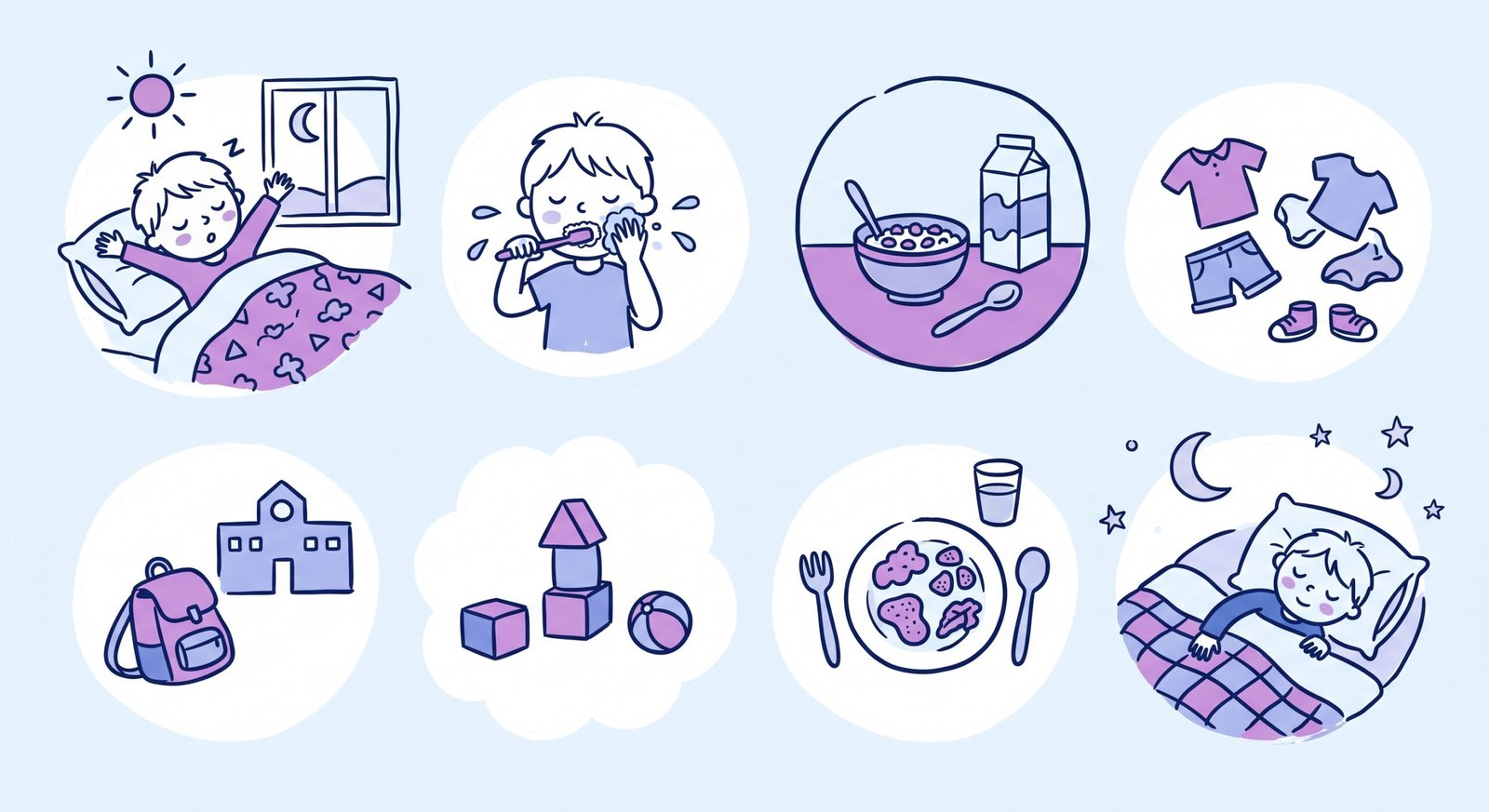
Why Standard Routines Fail Neurodivergent Children
Walk into almost any early learning centre, clinic, or neurodiversity webinar across Australia, and you will see the same tool recommended: the visual timetable.
In theory, visual schedules reduce anxiety by creating predictability. In practice, for an ADHD or autistic brain, a rigid timetable creates an unbearable amount of ambient pressure. Standard schedules are built on clock time. Human nervous systems do not operate on clock time.
A neurotypical adult might look at a watch, register that it is 8:15 am, and summon the cognitive fuel required to switch from drinking tea to typing an email. For an ADHD or autistic child, that cognitive switch is not a simple toggle. Research highlighted by the Center on the Developing Child at Harvard University underscores that executive function and emotional regulation are deeply tied to physiological stress states. When we demand a transition simply because a hand on a clock moved, we ignore their biological capacity.
Standard routines fail because they treat a child’s brain like an appliance drawing steady voltage from a wall socket. When internal capacity does not match an arbitrary clock demand, the nervous system interprets that demand as a survival threat, plunging the child into fight, flight, or shutdown.
Standard timetables collapse because they rely on three faulty premises:
- They Assume Consistent Daily Capacity They assume a task mastered on Tuesday can be executed with equal ease on Thursday, ignoring sensory exhaustion, illness, and autonomic depletion.
- They Prioritise Compliance Over Regulation They measure success by whether a child followed an order, rather than whether their nervous system had the physiological stability to do so.
- They Treat Transitions as Cognitive Instructions Instead of Somatic Shifts Telling a child “pack up your blocks, it is time for lunch” assumes a lack of knowledge, ignoring the physical chasm their brain must cross to disengage from flow state.
The Shift: A State-Based Daily Routine for Neurodivergent Children
If we stop looking at our day as a series of time slots to survive, what is left? A rhythm.
A rhythm is fundamentally different from a routine. A routine says: At 8:00 we do this, at 8:30 we do that. A rhythm says: After this kind of physical exertion, our bodies need that kind of grounding.
Children with ADHD and autistic children experience huge fluctuations in arousal throughout the day. They swing from under-stimulated (sluggish, hunting for dopamine, bumping into walls) to hyper-aroused (racing, dysregulated, loud) in minutes. When you layer a traditional schedule on top of those swings, you create friction.
In a biological daily routine for neurodivergent children, we manage arousal states rather than tasks. Instead of asking “What should we be doing right now?”, we ask:
Where is their nervous system sitting right now, and what kind of physical state do they need to land in next?
This is not an absence of structure. It is a much sturdier biological support system than a visual timetable because it does not snap when real life gets messy.
Stage 1: Heavy Work (The Morning Anchor)
Heavy Proprioceptive Movement in a Daily Routine for Neurodivergent Children
Proprioception is the body’s internal GPS: the feedback our muscles and joints send to the brain telling us where our limbs are in space. Neurodivergent children often wake with an under-aroused cortex seeking dopamine, or sensory disorientation from waking daylight. As recommended by the American Occupational Therapy Association (AOTA), proprioceptive heavy work grounds that system immediately.
- Real-Life Anchor: Carrying the big dog kibble bag from the pantry, pushing a loaded laundry basket with their bare feet down the hallway, or wall pushes to “see if the wall moves two centimetres”.
- What NOT to Do: Avoid frantic cardio or unstructured backyard trampoline bouncing. Unstructured bouncing revs the motor higher without providing stabilizing joint compression.
- Why it Works: Joint compression sends inhibitory signals to the brainstem and vestibular system, dampening cortisol and providing a clear internal sensory map.
Stage 2: Low-Demand Parallel Flow
Parallel Flow Without Relational Pressure
Once physical anchors are set, dropping a barrage of executive commands (“eat your toast, brush your teeth, pack your bag”) instantly triggers demand avoidance. Stage 2 provides an intentional low-demand buffer where parent and child share proximity without pressure.
- Real-Life Anchor: The child builds with magnetic tiles on the rug while you fold laundry nearby. Direct eye contact and verbal questions are minimal; breakfast is served deconstructed on a low board.
- What NOT to Do: Do not use this quiet space for interrogation about the school day, and do not abandon the room completely. Parallel presence provides co-regulatory stability.
- Why it Works: Operating alongside an adult with low demand protects ventral vagal safety, allowing working memory to charge before real-world tasks begin.[1]
Stage 3: Pre-Transition Discharge and Reset
Active Somatic Discharge
Verbal warnings (“five minutes left, two minutes left”) do not ease transitions in a daily routine for neurodivergent children; they escalate anticipatory dread. Shifting focus requires burning off an adrenaline spike before cognitive flexibility can engage.
- Real-Life Anchor: The Crash Reset: stacking three large cushions at the doorway for full-body crash dives before leaving, or wheelbarrow-walking down the hallway to the shoe rack.
- What NOT to Do: Do not rely exclusively on ringing digital timers without pairing them with a physical somatic action. Timers feel abstract and punitive to a hyper-focused brain.
- Why it Works: Muscle contraction metabolises sudden stress hormones released during dopamine interruption, breaking hyper-focus inertia without an emotional rupture.
Stage 4: Regulation Space (Sanctuary, Not Isolation)
Parasympathetic Sanctuary
After holding it together across six hours of loud school environments, children return home with a drained sensory bucket. Stage 4 is not forced “time-out”; it is dedicated nervous system restoration.
- Real-Life Anchor: An enclosed floor nest behind the couch with a weighted blanket, noise-dampening headphones playing brown noise, and cold smoothies through a narrow straw.
- What NOT to Do: Never use this restorative sanctuary as a punitive time-out space, and avoid demanding an immediate verbal debrief of their day.
- Why it Works: Removing visual flutter, conversational load, and demands activates parasympathetic recovery, lowering heart rate and stopping post-school restraint collapse.[4]
The 4 Grounding Stages at a Glance
| Grounding Stage | Biological Purpose | Real-Life Activity | What to Avoid |
|---|---|---|---|
| 1. Heavy Work Morning anchor |
Stabilises the vestibular system and maps body awareness in space. | Pushing laundry baskets, rolling in a heavy doona, carrying grocery bottles, wall pushes. | Frantic unstructured jumping, or framing movement as an obligatory clinical chore. |
| 2. Parallel Flow Midday buffer |
Protects ventral vagal safety; preserves finite executive functioning. | Magnetic tiles on the rug, parent folding washing nearby, deconstructed breakfast. | Interrogating with questions, direct eye contact demands, or leaving the room completely. |
| 3. Transition Reset Pre-shift bridge |
Discharges adrenaline spikes; breaks task inertia safely. | Cushion crash dives at the doorway, wheelbarrow walking, firm compression hugs. | Relying solely on loud timers, shouting countdowns, or rushing through physical resets. |
| 4. Regulation Space Afternoon sanctuary |
Engages parasympathetic restoration; ends sensory masking strain. | Pop-up tent, weighted blankets, brown noise, cold thick smoothie through a narrow straw. | Asking about school, using the space as a punishment, or bright fluorescent lighting. |
A Real Lived Scenario: The 8:10 AM Hallway Stalemate
To understand how this shifts the day, consider the classic morning flashpoint in any family routine: putting on shoes at the front door.
The Compliance Trap (The Old Way):
It is 8:10 am. Work starts soon. You say: “Put your shoes on, we need to leave in two minutes.” Your daughter is staring at a Lego wheel on the bedroom carpet and does not move. You repeat louder: “Look at me. Shoes on. Now.” She flops onto the floor, turns her limbs into liquid, and cries that her socks feel pointy. You try to slide the shoe on; she kicks out, wedges herself behind the wardrobe, and sobs uncontrollably while her little sister watches wide-eyed. Everyone leaves the house in adrenaline overdrive.
The Rhythm Way (State-Based Support):
Same morning. 8:05 am. You see your daughter is in parallel flow (Stage 2). You know an abrupt demand will trigger an autonomic crash. You sit on the floor beside her, pick up a stray Lego block, and say quietly: “I need some muscle to help move the big door open today.” You pick up her school bag by the straps like a kettlebell: “Cushion crash pad is ready at the front door if you want a landing.”
She drops the Lego, crawls fast across the floor, and dives stomach-first into the floor cushion (Stage 3: Transition Reset). Deep proprioceptive impact hits her joints. She exhales. Her shoes are beside the cushion. You sit beside her without hovering. “Firm squeeze or loose today?” you ask. “Firm,” she mumbles. You slide the shoe on, compress her foot with a steady squeeze, and stand up. You are out the door in four minutes without an argument.
Practical Actions: What to Do vs What NOT to Do
| Supportive Rhythm Actions (What to Do) | Compliance Pressure Pitfalls (What NOT to Do) |
|---|---|
| Observe the body, not the clock: When you see pacing, chewing shirts, or bouncing, introduce heavy joint resistance before giving verbal tasks. | Debating during dysregulation: When a child is in fight-or-flight, the prefrontal cortex is offline. Explaining schedules during an autonomic surge is useless. |
| Lower vocal register and cadence: Slow speech and low vocal pitch signal neurological safety; high-pitched urgency signals predator threat. | Using sticker charts as transition leverage: Rewards assume lack of motivation. When the brain lacks executive fuel, reward bribes produce shame. |
| Maintain physical anchors across locations: Carry a familiar compression hug or heavy backpack routine into the school car park. | Treating altered plans as parental failure: If a morning rhythm fractures and they go to school in gumboots, the day is not lost. Regulate and reset. |
Navigating “Spiky Capacity” Days
A typical developmental chart assumes steady, linear progress. A child learns to put their shoes on, and the assumption is that they can do it every morning thereafter.
Neurodivergent development does not work that way. It is spiky.
On Wednesday, your child may dress herself, eat breakfast independently, and chat happily. Her nervous system battery is charged. On Thursday, that same child may wake up, look at a sock, and weep as if it were coated in broken glass.
On spiky capacity days, our rhythm adapts:
- Stage 1 (Heavy Work) becomes passive: placing a weighted lap pad over their legs rather than asking them to carry items.
- Stage 2 (Parallel Flow) expands: non-essential morning tasks are cut; breakfast is eaten under a blanket.
- Stage 3 (Transition Reset) shifts to co-regulation: you physically hold their hand with grounding downward pressure as you walk to the car.
- Stage 4 (Sanctuary) begins the moment school finishes with zero questions asked.
Printable Daily Routine for Neurodivergent Children
A low-demand, landscape A4 sheet designed for tired brains. No clock hours, no tick-boxes: just four gentle zones to note whatever simple anchors fit your day.
Daily Grounding Rhythm
This is not a schedule. It’s a rhythm.
Move first
push, carry, jump, climb
Let it flow
play beside, no pressure
Reset before moving on
pause, shake it out, slow down
Wind down
quiet space, low light, soft activity
I still have that laminated visual schedule somewhere. It is tucked into the bottom drawer of the sideboard underneath some old school reports. Every now and then I see it, and I remember the exhaustion of trying to cram my family’s sensitive brains into those tiny little boxes.
We do not live by the boxes anymore. Tonight, my daughter will drop her backpack, crawl behind the armchair with her weighted blanket, and chew quietly on crackers while her sister reads on the rug. I will fold washing nearby. We will not be on schedule. But we will be steady. And steady is everything.
- Discover room sound buffering in Classroom Noise Sensory Overload: 4 Powerful Ways Sound Triggers Meltdowns →
- Learn how lighting frequencies affect attention in Lighting Fluorescent Flicker ADHD: 4 Powerful Ways Light Drains Focus →
- Build an opt-in recovery sanctuary from scratch in Calm Corner Design in Early Childhood: Step-by-Step Setup →
- Return to our overarching cluster foundation on the Sensory Environment in Early Childhood Hub →
References
- Porges, S. W. (2011). The Polyvagal Theory: Neurophysiological Foundations of Emotions, Attachment, Communication, and Self-Regulation. W. W. Norton & Company. [Autonomic reactivity, ventral vagal engagement, and physiological states underpinning social communication].
- Dunn, W. (2014). Sensory Profile 2: User’s Manual. Pearson. [Sensory processing models, proprioceptive input thresholds, and environmental regulation strategies].
- Barkley, R. A. (2015). Attention-Deficit Hyperactivity Disorder: A Handbook for Diagnosis and Treatment. Guilford Press. [Executive dysfunction, task initiation deficits, and time blindness mechanisms in ADHD].
- Shanker, S. (2016). Self-Reg: How to Help Your Child (and You) Break the Stress Cycle and Successfully Engage with Life. Penguin Random House. [Energy restoration, sensory stressors, and down-regulation sanctuaries].