
At 47, I’m Starting to Understand My Busy Mind Differently
This is one adult asking a real question about her own life: which parts of my busy mind come from how I am made, and which come from how much I have taken on? I do not have a tidy answer, and I am writing before I do.
At 47, I have a lot going on. I have two adult daughters, two jobs and two websites. Understanding my busy mind has become an everyday journey of working out what is natural focus and what is simply overload.
One site is EarlyChildhoodEduNet. The other is GriffithProMarketing, a separate site about SEO and online marketing that I am still building.
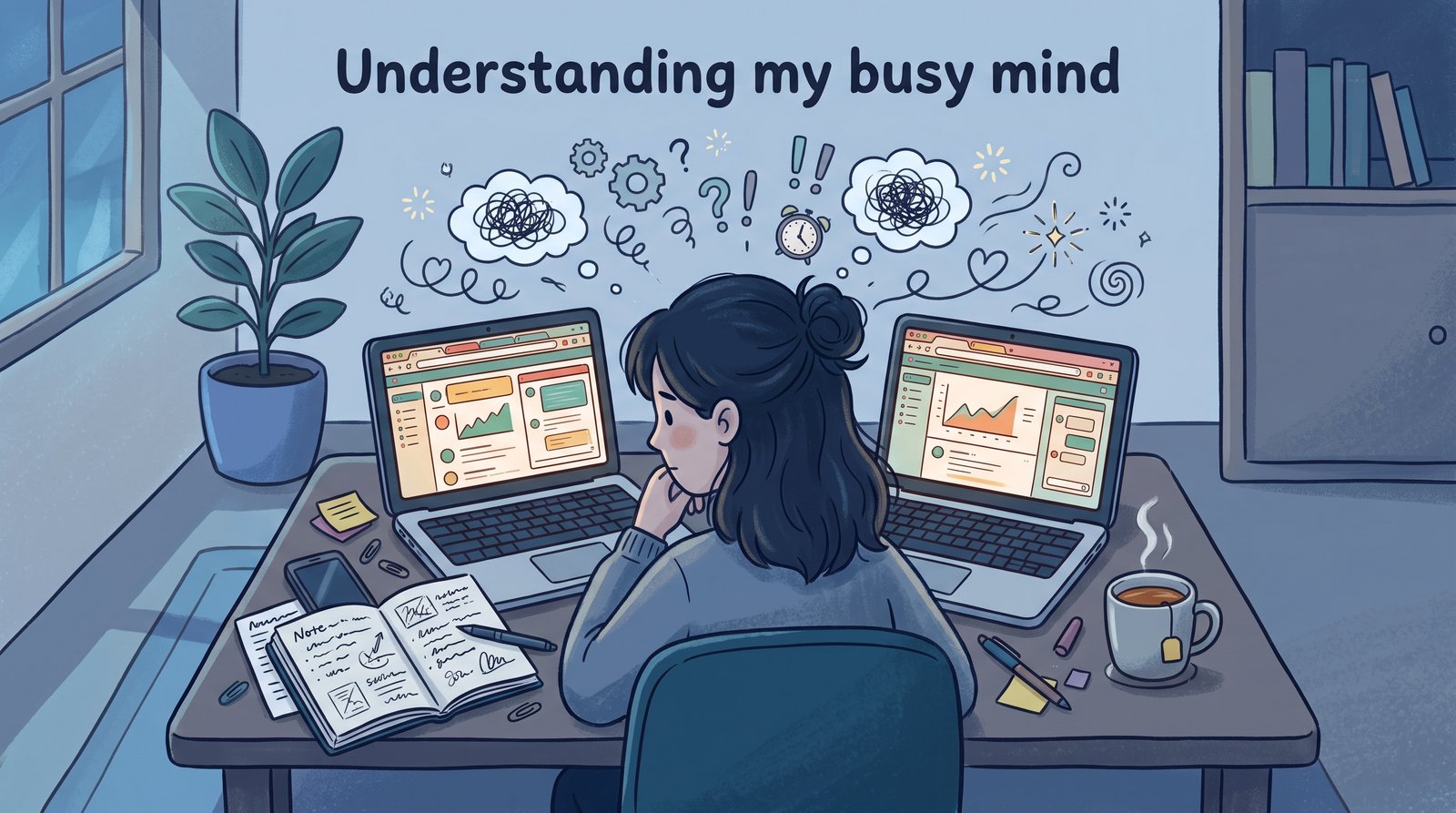
Most of the time I like it this way. I enjoy having different challenges and interests, and I find variety interesting. I also notice that keeping several things moving can tip into overwhelm, and sometimes into plain frustration.
I have an ADHD diagnosis. I mention it early so you know where I am writing from, and then I want to leave it in the background. This post is about a narrower question. Which of my working patterns come from how my mind works, and which come from having more on my plate than one person can carry well?
In this reflection:
Understanding My Busy Mind: When Having Many Interests Gets Complicated
Having many interests and managing many active commitments are different things. An interest costs nothing to keep. A commitment costs time, attention and the energy to switch between tasks.
For me the two have started to blur. I finish some things and leave others open. My motivation varies depending on the day. I have written about how a child’s capacity can change from day to day, and my own motivation varies in a similar way. I enjoy the variety, and it can also frustrate me.
A diagnosis does not explain all of that, and I do not want it to. Two jobs and two websites is a lot for anyone. Tiredness, stress, unclear priorities and a full life can all produce the same pile of half-finished work. If I put everything down to ADHD, I would stop looking at the parts I can actually change.
Starting, Finishing and Everything in Between
A project has stages, and I have found it useful to separate them. There is having the idea. There is starting. There is the long middle, where the necessary tasks get done. And there is deciding when something is finished enough to stop improving.
Website work shows these stages clearly. Having an idea for a new page is quick. Writing and checking it takes much longer, and deciding whether it is ready can take longer still. With two sites, those stages multiply. When I write about helping a child begin a task, one idea is to start together on the first step. Adults rarely have anyone to start with, which is part of why a written next action matters.
Unfinished tasks and shifting interests have many possible explanations. Unclear priorities, too many open projects, perfectionism, tiredness and a full life can all produce them. Some people with ADHD describe similar patterns, but the pattern alone does not tell you the cause. The useful question for me is a practical one. What is the next step, and what does finished look like?
When My Body Rests but My Mind Keeps Planning
This is the part I keep returning to. There are times when my body is resting and my mind carries on planning. The projects and responsibilities keep going while I am physically still. I have written about caregiver burnout for parents and teachers, which is a different situation, though the overload will sound familiar to some readers.
If it keeps getting in the way of sleep, wellbeing, relationships or work over a long period, that deserves attention.
Having a diagnosis does not make other explanations drop away. The Australian ADHD guideline notes that ADHD can be diagnosed alongside other conditions, and that sleep disorders, thyroid disease, anaemia and hearing or vision problems can produce ADHD-like symptoms.[1] A mind that will not switch off is a reason to look at sleep, stress and general health as well as ADHD, ideally with a doctor.
Why an Online ADHD Test Is Only a Starting Point
Many people look for an online ADHD test when they start wondering about their own minds. It can be hard to tell who made a given test, how it scores, or whether it has been checked against clinical assessments, so a score on its own is hard to interpret.
A screening result is not an assessment. The Australian guideline advises against screening whole populations because current tools are not accurate enough, and says that a positive screen should be followed by further assessment.[2] For adults, the main self-report questionnaires have had mixed accuracy.[2]
What an Assessment of ADHD in Adults Involves
If you are wondering about your own mind, it helps to know what a proper assessment looks like. I am not a clinician, and my autism training through PESI Australia is still in progress. So I am relying on the guideline and public health information here.
A proper assessment is much more than a questionnaire. The Australian guideline describes a detailed clinical interview that may take two to three hours, sometimes across several sessions. It looks at developmental, family, health and educational history, at symptoms and their effect in different settings, and at medical causes and other conditions that could explain what is happening.[3]
Adult ADHD assessment considers whether symptoms began in childhood, how they have affected everyday functioning, and whether other conditions or circumstances could explain the difficulties. A clinician considers the person’s history and functioning across different areas of life rather than relying on a questionnaire alone.[4] For adults, clinicians can use information from people who knew the person as a child.[3] A busy or stretched life in midlife does not meet that bar on its own.
What about women, and about midlife? Healthdirect says ADHD is under-diagnosed in girls and adults.[4] The people behind the Australian guideline have said there is a large gap in what is known about how ADHD presents in girls and women.[5] A 2025 review of 11 studies found suggestive links between ADHD symptoms and hormonal changes across puberty, the menstrual cycle and pregnancy, but it did not cover perimenopause, and the authors listed menopause as a gap for future research.[6]
So I have not found solid evidence that I could verify about ADHD at my stage of life. I would rather say that than guess.
What I Can Change, Whatever Is Behind It
A diagnosis tells me something, and it does not tell me how to run two websites. Some practical changes seem sensible whatever the cause. These are general organisation ideas, not a treatment for ADHD, and they do not replace advice from the people who support your health. They are suggestions, not tested findings.
The first is to keep one main website project as the current priority, and to give the second site a smaller, planned maintenance session. Second, when a new idea arrives, I can record it instead of acting on it straight away. Third, I can define what done looks like for each project before I start, so that I know when to stop.
Fourth, before ending a work session, I can write down the next action, so that the next session starts with a step and not a decision. Last, I can make room for rest, and stop treating every available hour as time that must be productive.
None of this is a system that will suit everyone. Some of it may not suit me.
If you do not have a diagnosis and you recognise some of these patterns, and they keep affecting your sleep, mood, work or relationships, a GP is a reasonable first step.[4] It may help to jot down when the patterns began and how they show up in different parts of your life. If you do have a diagnosis and things still feel unmanageable, it is worth telling whoever supports you.
Understanding My Busy Mind Is an Ongoing Process
A diagnosis answers some questions and leaves others open. Working out which habits, commitments and working arrangements help me function well is a separate task, and it is worth doing whatever the label says.
For now I am holding one question open: how much of my busy mind is how I am made, and how much is how I have arranged my life?
If you recognise some of this, which part is costing you the most at the moment: the number of projects, the lack of rest, or something else?
- Read about the other side of this story in A Parent With ADHD: 4 Shifts That Autism Training Brought Home →
- Read about tiredness and overload in Parent Teacher Burnout in Neurodivergent Care: 4 Ways to Lighten the Load →
- Read about getting started in ADHD Start Together Task Trick: 4 Ways to Help Your Child Begin →
- Read about uneven days in Why a Child Can Do It Some Days and Not Others →
Research: the Australian ADHD guideline (on co-occurring conditions, screening and diagnosis); healthdirect on adult ADHD; a Monash University news article on the guideline; and a 2025 systematic review of ADHD and sex hormones in females.
Experience: everything written in the first person, the five organising ideas, and the question at the end are my own reflections and have not been tested. The training I mention is one I am still working through. Last reviewed: 20 October 2026.
References
- Australasian ADHD Professionals Association. (2022). Australian evidence-based clinical practice guideline for ADHD: Co-occurring conditions. https://adhdguideline.aadpa.com.au/cooccurring-conditions/
- Australasian ADHD Professionals Association. (2022). Australian evidence-based clinical practice guideline for ADHD: Screening and identification. https://adhdguideline.aadpa.com.au/identification/screening-and-identification/
- Australasian ADHD Professionals Association. (2022). Australian evidence-based clinical practice guideline for ADHD: Diagnosis. https://adhdguideline.aadpa.com.au/adhd-diagnosis/
- healthdirect. (2024). Adult ADHD. https://www.healthdirect.gov.au/adult-adhd
- Monash University. (2022, October 13). Landmark new Australian ADHD guideline sets the benchmark for diagnosis and treatment. https://www.monash.edu/medicine/news/latest/2022-articles/landmark-new-australian-adhd-guideline-sets-the-benchmark-for-diagnosis-and-treatment
- Osianlis, E., Thomas, N., Jenkins, A., & Gurvich, C. (2025). ADHD and sex hormones in females: A systematic review. Journal of Attention Disorders, 29(9), 706–723. https://doi.org/10.1177/10870547251332319