
ADHD and Deadlines: 3 Things I Learned About Working Under Pressure
This reflection shares what I have noticed about my own working rhythms, time pressure, and focus. It is personal experience and educational content, not clinical guidance.
I have been thinking a lot about ADHD and deadlines lately, mostly because I keep noticing the same pattern in my own life. A date on the calendar seems to do something for me that good intentions rarely manage on their own.
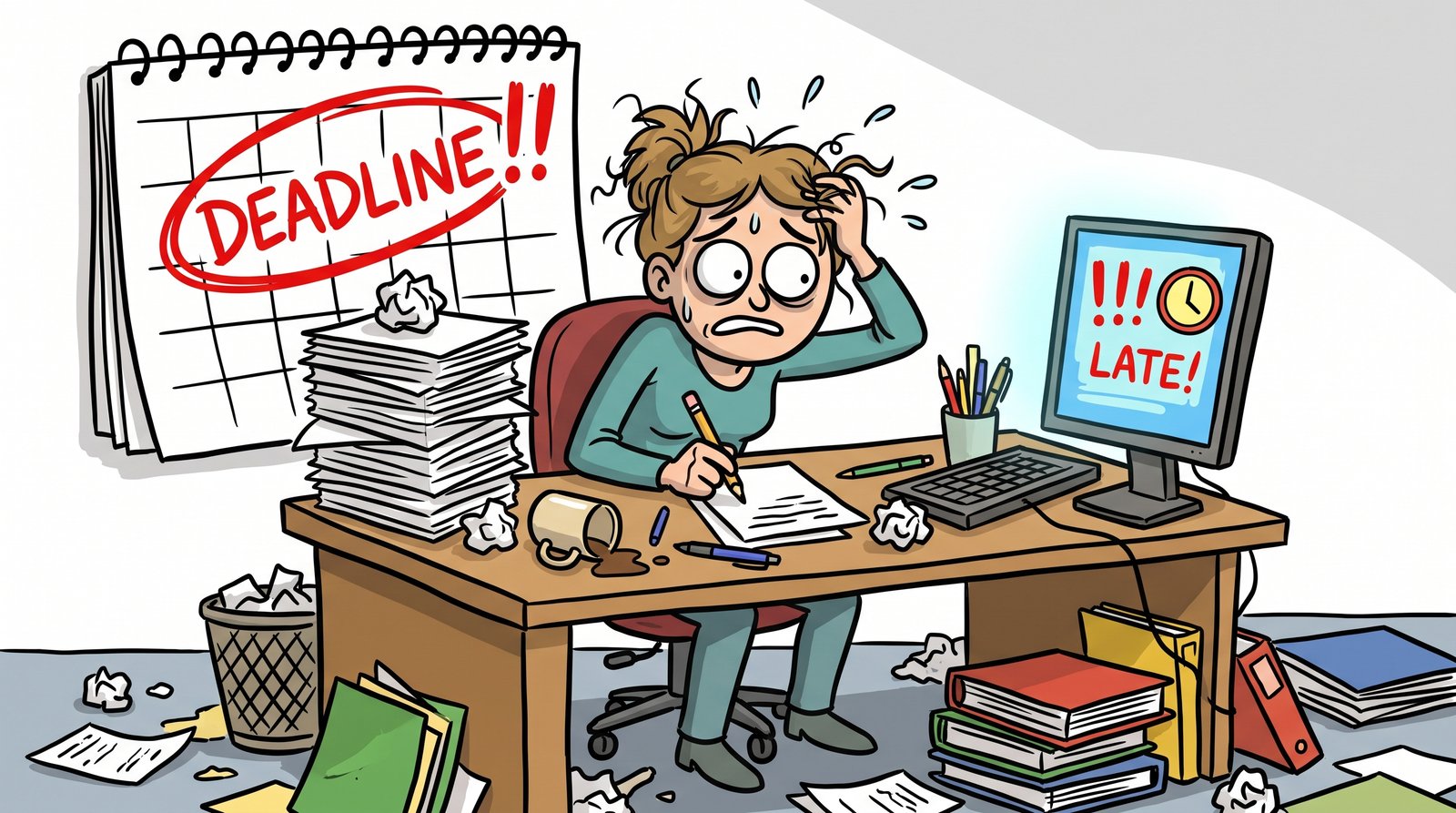
At 47, I work two jobs, look after two websites and still take part in life with my two adult daughters. I like it that way. I enjoy variety and I like a challenge, and juggling several things at once has never frightened me.
What I am only now starting to look at honestly is what the juggling costs, and how much of it ran on pressure.
I received my ADHD diagnosis in my forties, well after I finished my PhD. When I look back on how I worked during those years, I am using knowledge I did not have at the time. Back then I just thought it was how I worked, and some of it embarrassed me.
These are three things I have learned about working under pressure, from someone who got a lot done that way and is now asking whether it was the best way. If you leave things until the last minute and then wonder why you can suddenly focus, some of this may sound familiar.
In this reflection:
Looking Back at My PhD: I Finished, and the Stress Was Through the Roof
I started my PhD in 2010, when my daughters were four and six. I was also doing part-time teaching work, and for that first year I was managing it all on my own. I have written about doing much of my PhD from bed. This piece is about a different part of those years: the time pressure.
My days had very little slack. I would drop the girls at school, get to the university, and try to fit a full day of thinking into one tight morning. Then it was pick-up, dinner, baths and bedtime. A lot of that period ran on adrenaline, and by the evening I often felt completely empty.
And I finished. The thesis was submitted, examined and passed. This is not a story about failing. I could keep research, paid work and two small children moving at once, and when something had to be done by a certain date, it got done.
But my stress level during those years was through the roof. A doctorate is hard for anyone, and doing one while parenting and working would stretch most people. I am not putting all of that down to ADHD.
What I can say now, with hindsight and a diagnosis I did not have then, is that some of the ways I worked make more sense to me. Looking back, three lessons stand out.
Lesson 1: Getting Started Is Not the Same as Being Able to Do the Work
During my PhD, I usually knew exactly what the next task was. I knew which chapter needed work and which articles I had to read. The problem was the gap between knowing and starting. At the university desk, I could stare at a blinking cursor for an hour. At home, propped up in bed, I could sometimes write two thousand words in an afternoon. Same person, same knowledge, very different start.
I see it now with the autism training I am working through. Some weeks the laptop never leaves the bag. Then one evening something catches my interest and I get through several modules at once. My understanding of the material does not change between those weeks. Whether I can get going does.
I used to read that gap as a character flaw. It took me years to recognise it in my eldest daughter, who would freeze at the start of tasks she could easily do, and longer to see the grown-up version in myself. I wrote about her side of it in What to Do When an ADHD Child Won’t Start Tasks.
I am not unusual in this. Healthdirect lists putting off tasks that need sustained effort, and difficulty organising time, among the inattentive symptoms of ADHD.[1] One study of adults found that those with ADHD reported problems meeting deadlines, finishing tasks and keeping track of time more often than adults without a diagnosis or with other clinical conditions.[2] Those are findings about groups, not about me, and plenty of people without ADHD struggle to start things too.
What this does to mental clarity
An unstarted task does not sit quietly in a drawer. For me, it sits in my head, adding to the noise of a mind that keeps planning even when my body is resting. Knowing the work and not beginning it is tiring before a single word is written.
So when I can’t start, it usually doesn’t mean I can’t do the work. It means the start needs help, and the better question is: what would make the first step smaller?
Lesson 2: Urgency Changes How a Task Feels
A close deadline does not just add pressure. It changes how the task feels.
My clearest example is sewing. I have a bag of half-finished projects I find hard to return to, but when I need a costume for an Indonesian traditional dance performance, it gets made. I wrote about that in my post on having plenty of ideas and finding them hard to finish. The PhD worked the same way. When something was due on a certain date, it got done, even after slow weeks.
Why can I focus when a deadline is close?
I can only describe it from the inside. When a deadline is weeks away, the task feels vague, one of many things I should do at some point. When it is tomorrow, it becomes the only thing. The question of what to do first disappears.
Research has explored how people with ADHD respond to waiting for rewards, including a large study in which children and teenagers with ADHD chose smaller, sooner rewards over larger, later ones more often than their peers.[3] That is a different question from why I sometimes find it easier to work when a deadline is close. I can’t use that research to explain my own experience, although it has made me curious about the wider relationship between waiting, motivation and getting started.
Why urgency can work, for me
Urgency seems to help me in a few specific ways. It turns a vague task into a concrete one and removes the decision about what to work on. When someone else is waiting, like a dance group or a supervisor, it adds a reason beyond me. And it gives open-ended work an end point.
Not everyone with ADHD works this way. Many people without ADHD do their best work near a deadline, and some people freeze under pressure instead. My point is only that, for me, urgency changes something worth understanding.
Lesson 3: Finishing Under Pressure Does Not Mean the Pressure Is Harmless
This is the lesson I resisted longest. I finished the PhD, and the costumes were ready for the stage. If pressure gets the work done, why change anything? Because getting it done and paying nothing for it are not the same thing.
What pressure did to my thinking
Looking back, the stress during my PhD did not only make me tired. It seemed to make clear thinking harder at exactly the moments I needed it most. That is my own reflection, not something I can prove.
What helped me make sense of it was reading about stress and the brain. The kind of thinking a thesis needs, such as holding several ideas in mind and choosing between them, relies heavily on the prefrontal cortex. Neuroscientist Amy Arnsten’s review describes how even fairly mild stress that feels out of our control can quickly weaken abilities like working memory and directing attention.[4] Much of that research was done in animals and laboratories, and it is not about ADHD. It does not explain what happened to me. It simply gave me some background for a trade-off I had felt for years: the urgency that gets me started can come with stress that makes the thinking itself harder.
Why last-minute productivity works, and where it stops working
Working to the wire seems to work best for me on tasks that are short, clear and familiar, like sewing a costume I know how to make or finishing a page I have already planned.
It works much less well for long, complex work. A thesis or a website strategy needs time to step back, notice mistakes and change direction. A last-minute push leaves no room for that, or for a sick child, a computer problem or a bad night’s sleep.
Some costs don’t show in the finished product at all, like the evenings I spent completely empty. The people around us often live alongside the stress too, something I have written about in how overload builds up for parents and carers.
The cost that worries me most is the habit itself. If urgency is the only thing that reliably gets me started, I can end up waiting for a crisis before I act, and every success under pressure makes the next rush feel justified.
What I’m Trying Now: Borrowing Urgency Without the Crisis
I have not solved this. I still work two jobs and look after two websites, and plenty of my weeks still end with a push.
The idea behind everything below is the same. If urgency helps because it makes a task concrete, close and shared with someone else, maybe I can create some of that on purpose, earlier and in smaller doses. None of this is a treatment for ADHD, and none of it has been tested beyond my own life.
| What urgency gives me | A gentler way to borrow it |
|---|---|
| A date that feels real | Set a date with another person, not just in my diary |
| One clear task | Break a big deadline into smaller ones that are only days away |
| No decision about where to start | Write down the next action before I stop working |
| A reason outside myself | Tell someone what I will show them, and when |
| An end point | Decide what “done” looks like before I begin |
Other ideas I am testing include making the first step almost too small to resist, like opening the file or threading the machine, which is the adult version of the start together idea I use with children. I also want to build in a buffer day before anything that matters, and plan some rest after a big deadline instead of rolling straight into the next one.
I am trying one change at a time. Changing everything at once would just become another unfinished project.
When It’s Worth Talking to Someone
Leaving things until the last minute is very common, and on its own it does not mean someone has ADHD. What matters is how long it has lasted and what it costs. Healthdirect explains that with ADHD the difficulties are persistent and get in the way of work, study or relationships, and that the first step, if you are concerned, is to see a doctor. It also notes that things like poor sleep or health problems can cause similar symptoms.[1]
If you already have a diagnosis and deadlines still feel unmanageable, raise it with whoever supports you. Healthdirect lists cognitive behavioural therapy among the options that may help.[1] And if constant pressure is wearing you down, with or without ADHD, that alone is a good reason to see your GP. In Australia, the healthdirect helpline is 1800 022 222 (NURSE-ON-CALL in Victoria).[1]
What I’d Tell My PhD Self about ADHD and deadlines
If I could sit beside the woman rushing from school drop-off to the fourth floor in 2010, I would not tell her to stop. She finished something hard, and I am proud of her.
I would tell her three things instead. Not being able to start does not mean she can’t do the work. The deadline helps for real reasons, and she does not need to feel ashamed of that. And the stress is not proof that she is trying hard enough. It is a cost, and some of it could be lowered.
I did not know about my ADHD then. I know now, and that knowledge does not rewrite those years. It just lets me look at them more kindly, and make slightly different choices with the deadlines in front of me today.
Deadlines will probably always help me. I would just like them to help me without taking quite so much in return.
If you recognise yourself in some of this, here is a question to take away. Think of one deadline coming up. What is one small thing you could do this week, while it still feels far away, so the last few days are a little less of a crisis?
- Personal reflections: At 47, I’m Starting to Understand My Busy Mind Differently →
- On project initiation: I Have Plenty of Ideas. Why Is Finishing Them So Hard? →
- Doctoral study: I Did My PhD in Bed: What I Understand Differently After My ADHD Diagnosis →
- Supporting kids with starting: What to Do When an ADHD Child Won’t Start Tasks →
- Managing capacity: Parent Teacher Burnout Neurodivergent Care: 4 Ways to Lighten the Load →
Research: healthdirect on adult ADHD; a study of how adults with ADHD describe their symptoms; a study of delay and reward choice in young people with ADHD; and a review of how stress affects the prefrontal cortex. Experience: everything written in the first person, and the ideas in the table, are my own reflections. Last reviewed: October 2026.
References
- healthdirect. (2024). Attention deficit hyperactivity disorder (ADHD). Australian Government. https://www.healthdirect.gov.au/adult-adhd
- Riccio, C. A., Wolfe, M., Davis, B., Romine, C., George, C., & Lee, D. (2005). Attention deficit hyperactivity disorder: Manifestation in adulthood. Archives of Clinical Neuropsychology, 20(2), 249–269. https://doi.org/10.1016/j.acn.2004.07.005
- Marco, R., Miranda, A., Schlotz, W., et al. (2009). Delay and reward choice in ADHD: An experimental test of the role of delay aversion. Neuropsychology, 23(3), 367–380. https://doi.org/10.1037/a0014914 [A study of 6 to 17 year olds; mentioned as a related question, not as an explanation of adult deadlines].
- Arnsten, A. F. T. (2009). Stress signalling pathways that impair prefrontal cortex structure and function. Nature Reviews Neuroscience, 10(6), 410–422. https://doi.org/10.1038/nrn2648 [Mostly animal and laboratory research; not specific to ADHD].