
Emotional Regulation in Literacy: The Complete Guide for ADHD & Neurodivergent Families
It was one of those mornings when the air felt heavy before the day had even started. My daughter sat at the kitchen table, cereal bowl in front of her, spoon tapping against the ceramic side in a rapid, dysregulated rhythm.
I slid a decodable reader across the laminate surface, hoping we could review just five lines before the school van arrived. She looked at the cover, glanced at me, and within seconds, her body shifted into fight or flight: her shoulders stiffened, her pupils dilated, and she pushed her chair back violently.
That immediate resistance was not laziness, defiance, or a lack of interest in stories. It was executive function fatigue, sensory overload, and emotional dysregulation colliding in real time.
Fostering emotional regulation in literacy requires recognising a fundamental neurodevelopmental truth: A dysregulated brain cannot decode text.
When a child’s autonomic nervous system perceives threat or overwhelm, higher-order cognitive tasks—such as phoneme manipulation, visual tracking, and working memory retention—instantly shut down.
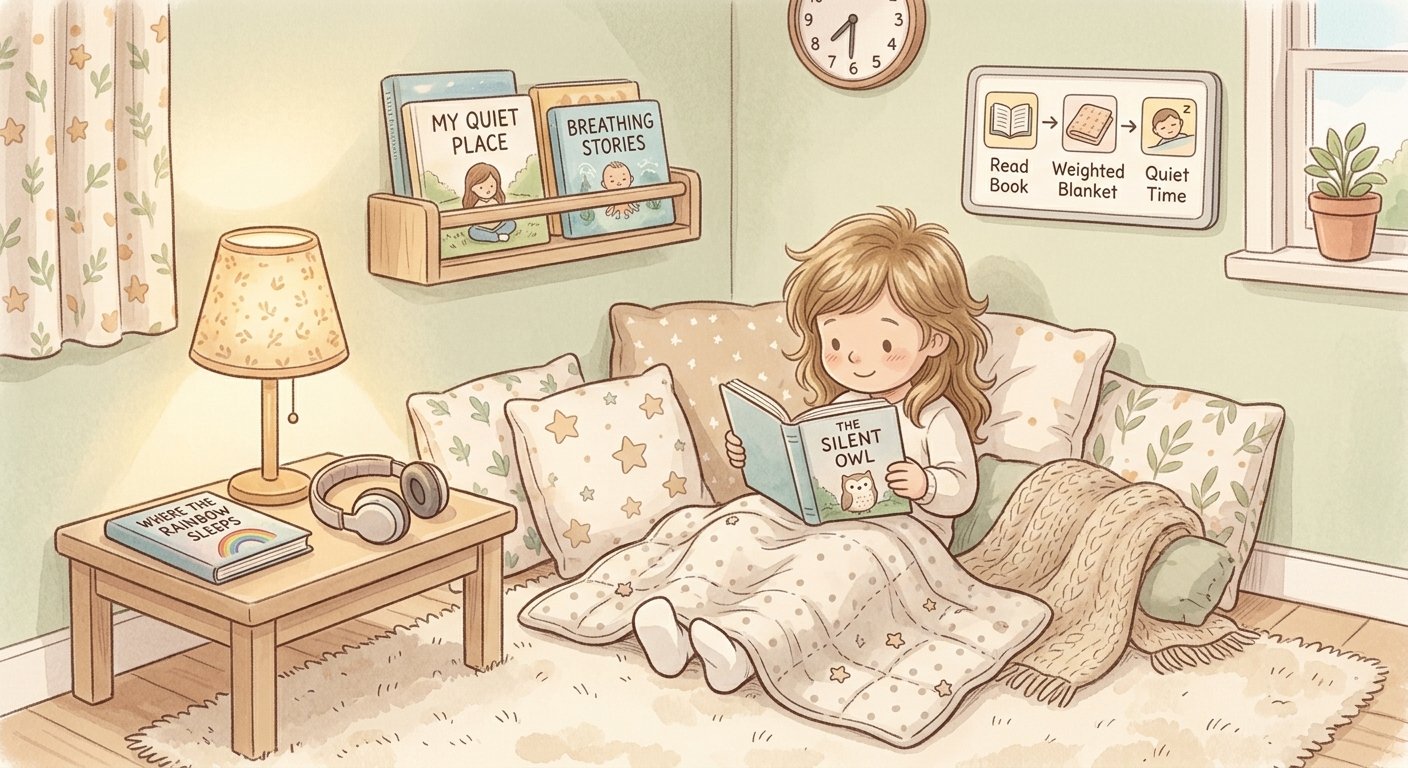
Section 1: The Neurobiology of Emotional Regulation in Literacy
To understand why traditional reading routines fail neurodivergent children, we must look at the neurological demands of reading through the lens of polyvagal theory and brain-based learning.
Integrating emotional regulation in literacy strategies addresses the reality that visual decoding requires the coordination of complex neural networks across the occipital, temporal, and frontal lobes.
1. The Executive Function Stack in Reading
When a child sits down to read a single sentence, their brain must perform an extraordinary cascade of executive functions simultaneously:
- Working Memory: Holding sound-symbol correspondences in mind while retrieving vocabulary context.
- Inhibitory Control: Filtering out background sounds, internal anxiety, physiological discomfort, and visual distractions on the page.
- Cognitive Flexibility: Switching fluidly between sounding out unknown words, interpreting syntax, and updating narrative comprehension.
In children with ADHD, Dyslexia, or Sensory Processing Differences, executive reserves drain quickly.
Emphasising emotional regulation in literacy practices protects children from cognitive overload before the amygdala triggers task avoidance.
2. The Polyvagal Hierarchy in the Learning Environment
According to Polyvagal Theory (Porges, 2011), human engagement exists along a physiological hierarchy that dictates how emotional regulation in literacy manifests:
- Ventral Vagal State (Social Engagement & Safety): Heart rate is stable, breathing is deep, and the brain is capable of curiosity, problem-solving, and reading acquisition.
- Sympathetic State (Mobilisation/Fight or Flight): Heart rate increases, muscles tense, and attention narrows. The child may fidget, argue, tear pages, or bolt from the table.
- Dorsal Vagal State (Immobilisation/Shutdown): The system collapses under excessive load. The child becomes non-responsive, slumps over, hums repetitively, or exhibits extreme task avoidance.
When educators or parents insist on completing reading logs while a child is in a Sympathetic or Dorsal state, learning stalls.
Prioritising emotional regulation in literacy means pausing the academic agenda to return the child’s body to a Ventral Vagal state of felt safety.
To help establish basic foundations before introducing complex texts, explore our School Readiness Printable Pack for structured, low-stress early learning tasks.
Section 2: Why Traditional Reading Models Ignore Emotional Regulation in Literacy
For decades, conventional reading instruction has relied on behaviourist strategies: sticker charts, timed reading logs, privilege removal, or performance praise.
Because these methods ignore emotional regulation in literacy, they frequently cause severe anxiety and task avoidance in neurodivergent households.
| Traditional Reading Intervention | Impact on ADHD/Neurodivergent Brain | Emotional Regulation in Literacy Alternative |
|---|---|---|
| Timed Reading (15 min countdown) | Creates time-scarcity anxiety; shifts focus from story joy to clock-watching. | Volume-Neutral Rhythm: Focus on 1 to 2 high-quality pages or shared turn-taking without clocks. |
| Sticker Charts & Extrinsic Rewards | Increases rejection sensitivity; turns reading into a transactional hurdle. | Intrinsic Co-Regulation: Pair reading with physical closeness, sensory comfort, and shared humour. |
| Forced Oral Decoding (“Sound it out!”) | Overloads working memory; induces public performance anxiety and shame. | Low-Demand Scaffolding: Dual reading, echo reading, or humming sentence rhythms. |
| Rigid Seating (Chair at Desk) | Deprives the vestibular system of movement needed for alertness and focus. | Flexible Ergonomics: Floor laying, wobble cushions, lying upside down, or pacing with audio. |
Research confirms that focusing on co-regulation and emotional stability yields far superior long-term reading comprehension and school engagement (Nilfyr & Ewe, 2025).
When we embed emotional regulation in literacy routines, we remove the psychological barriers that prevent children from approaching text with confidence.
Section 3: The 3 Core Calm Moments for Emotional Regulation in Literacy
Transforming home literacy from a battleground into a calm, restorative routine requires low-demand adaptations.
Below are three detailed frameworks built specifically around emotional regulation in literacy principles.
Moment 1: The Low-Demand Vocal Anchor (Humming Over Decoding)
When a child experiences emotional dysregulation, high-stress responses temporarily inhibit the prefrontal networks responsible for expressive language production.
Integrating emotional regulation in literacy means substituting oral decoding with low-demand vocalisations.
Implementation Steps:
- Step 1: Offer the Vocal Alternative. Say: “You don’t have to speak the words right now. Can you hum the rhythm of this line while I read it?”
- Step 2: Model Rhythm Vocalisation. Read aloud with exaggerated cadence while making low-frequency hums for each word.
- Step 3: Transition to Tactile Tracking. Invite your child to drag their finger across the text while humming, matching physical movement to auditory pacing.
“I see your body is feeling tired today. We don’t need to read out loud. I’ll read the words, and you can hum the cadence to keep our emotional regulation in literacy routine feeling calm and easy.”
Why it Works Neurologically:
Low-frequency humming stimulates the vagus nerve, lowering heart rate and activating the parasympathetic nervous system.
This supports emotional regulation in literacy tasks without forcing verbal output.
Moment 2: Sensory Pre-Grounding & Tactile Tracing
Expecting an ADHD child to shift instantly from active play into seated reading creates severe executive friction.
Sensory pre-grounding establishes emotional regulation in literacy transitions before opening the book.
Implementation Steps:
- Step 1: Proprioceptive Reset (Heavy Work). Spend 2 to 3 minutes engaging in heavy work activities (wall pushes, tight blanket squeezes) before touching a book.
- Step 2: Tactile Letter Exploration. Spend 60 seconds tracing textured letters in sand or on sandpaper before engaging with printed sentences. You can practice this using our high-contrast Space Adventure Alphabet Tracing Worksheets.
- Step 3: Multi-Sensory Text Engagement. Allow the child to hold a weighted lap pad or knead therapy putty while listening to or reading text.
Evidence from sensory processing interventions demonstrates that combining tactile inputs and heavy work tools directly supports emotional regulation in literacy activities (American Occupational Therapy Association, 2023).
Moment 3: Picture-Led “Visual Literacy” Entry Points
Dense text can feel like visual noise to an exhausted reader.
Visual entry points prioritise emotional regulation in literacy by building narrative momentum through illustrations.
Implementation Steps:
- Step 1: Picture Walk First. Open the book and explore the artwork exclusively for the first 3 minutes.
- Step 2: Co-Create the Narrative. Ask open-ended questions about character expressions, colours, and visual clues.
- Step 3: Selective Reading Anchors. Read only the specific dialogue bubbles or target words your child chooses to point out.
“We’re doing a visual walk today. You’re the story detective, show me what you see in the artwork before we focus on any words.”
Section 4: Conducting a Home Sensory Audit for Emotional Regulation in Literacy
A child’s reading resistance often stems from environmental triggers.
Performing a sensory audit ensures your home environment supports emotional regulation in literacy practices.
Home Environment Sensory Checklist
Work through these factors to optimise your space for emotional regulation in literacy routines:
For additional strategies on establishing inclusive learning spaces, visit our guide on Designing Sensory-Friendly Calm Reading Spaces or review the external Child Mind Institute Executive Functioning Guide.
Section 5: Troubleshooting Emotional Regulation in Literacy Questions
Q1: What if my child refuses to look at a book entirely?
Refusal is an expression of self-protection against perceived failure.
Step away from physical print and rely on audiobooks or oral storytelling to maintain emotional regulation in literacy development without inducing stress.
Q2: Do audiobooks support emotional regulation in literacy?
Yes. Audiobooks activate the same narrative processing and vocabulary networks as print reading while removing decoding fatigue.
The International Dyslexia Association notes that assistive audio tools play a vital role in preserving reading motivation and comprehension.
Q3: How long should daily reading sessions last?
Prioritise short, co-regulated micro-sessions (3 to 5 minutes) over long, forced reading blocks.
Short periods of calm engagement build stronger neural connections than long, anxious sessions.
Q4: How do I handle school reading logs?
Inform your child’s teacher that you are using targeted emotional regulation in literacy strategies at home.
Count audiobooks, picture discussions, and shared family reading toward required daily reading minutes.
Section 6: Sustainable Action Plan for Families
Follow this four-week roadmap to build lasting emotional regulation in literacy habits at home:
- Week 1: Lower the Pressure. Eliminate reading timers and optimise your reading environment using the sensory audit.
- Week 2: Introduce Sensory Grounding. Practice heavy work and tactile tracing before opening books.
- Week 3: Adopt Low-Demand Options. Introduce humming, picture walks, and dual reading routines using low-pressure tools like our Space Number Tracing 1–20 Pack.
- Week 4: Protect Boundaries. Consistently choose nervous system calm and emotional stability over rigid academic targets.
By centering emotional regulation in literacy practice, reading transitions from a source of conflict into an empowering, lifelong home habit.
References
American Occupational Therapy Association. (2023). Sensory integration and processing in early childhood development. AOTA Guidelines. https://www.aota.org/about/for-the-media/about-occupational-therapy/sensory-integration
International Dyslexia Association. (2022). Accommodations for students with dyslexia and reading challenges. IDA Fact Sheets. https://www.dyslexiaida.org/
Nilfyr, K., & Ewe, L. P. (2025). Thriving children’s emotional self-regulation in preschool: A systematic review discussed from an interactionist perspective. Education Sciences, 15(2), 137. https://doi.org/10.3390/educsci15020137
Porges, S. W. (2011). The Polyvagal Theory: Neurophysiological foundations of emotions, attachment, communication, and self-regulation. W. W. Norton & Company. https://www.ncbi.nlm.nih.gov/pmc/articles/PMC3108032/
Clinical Disclaimer: This guide is provided for educational purposes and synthesises early childhood research with lived parenting experience. It does not replace clinical evaluation. For specialised support, consult a paediatric specialist or credentialed therapist.