
Child Development Milestones by Age: A Neuro-Inclusive Guide
I’ve spent far too many hours sitting across from exhausted parents who are clutching a crumpled piece of paper covered in milestone checkboxes, looking like they’ve just been handed a failing grade on their parenting.
You know the charts I mean. The ones that say a child must do X by month twenty-four, or else.
Let’s be honest for a second. Human growth doesn’t actually run on a neat, factory-line schedule. Yet we’ve built this massive cultural anxiety around ticking boxes by specific dates. When a toddler isn’t stringing sentences together right at the arbitrary line, or an ADHD kid refuses to sit still during story circle, the panic sets in. We start wondering what we broke.
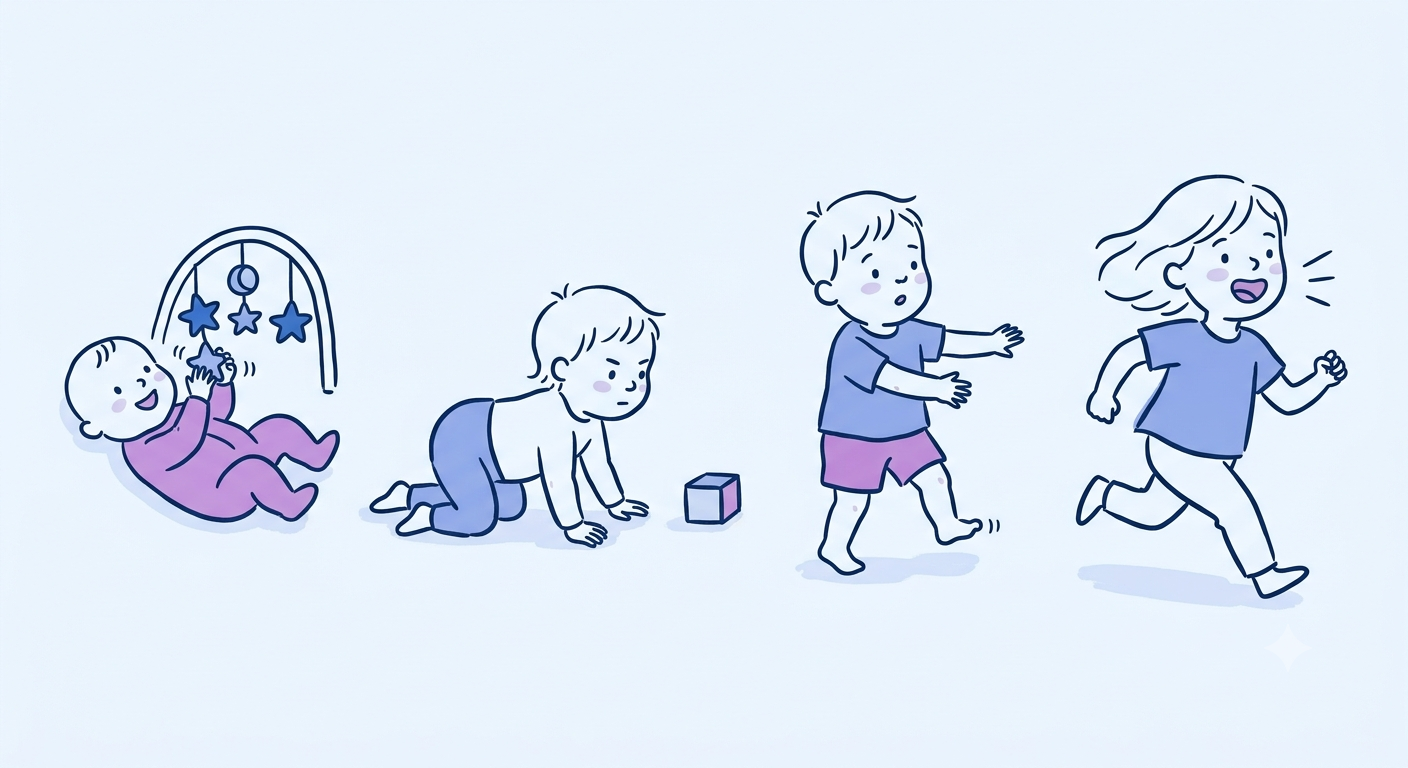
Most of the time? We haven’t broken anything.
Development is messy. It loops back on itself. Sometimes a child drops language temporarily because their brain is suddenly obsessively wiring up gross motor pathways for climbing every piece of furniture in the house. Progress isn’t linear. If you’ve spent any real time around young kids, or raised a few of your own, you realise that every single child comes equipped with their own internal clock.
To make sense of this without losing our minds, we need a way to look at growth that respects the individual. That’s what we’re going to unpack across the major stages of early childhood, examining key child development milestones not as a strict grading rubric, but as a map of the territory.
The Messy Reality of How Development Actually Works
Before breaking down ages and stages, we have to clear out a common misconception. Development does not happen in isolated silos. When a child is working on fine motor control, they aren’t just moving fingers; they are exercising cognitive planning, emotional regulation, and expressive language all at once.
If we look at children through rigid filters, we miss the interconnected web of how they process their world. Let’s look at the core domains through a more grounded lens:
- Gross Motor Play: This isn’t just about burning off toddler energy. Large-muscle movement, like running, balancing, and climbing, builds the spatial awareness and bilateral coordination that later dictates how a child’s eyes track print across a book page.
- Fine Motor and Pre-Writing: Long before a child holds a pencil, they are building hand strength by tearing up junk mail, squishing stubborn playdough, or figuring out how buttons work on a stiff winter coat. If you want to dive deeper into this foundation, take a look at how we approach fine motor skills without resorting to endless drills. Pushing formal handwriting too early creates physical discomfort and resistance.
- Communication: Receptive language, meaning what they understand, almost always outpaces expressive language, meaning what they say. For multilingual kids or late talkers, communication often relies heavily on gestures and visual storytelling long before spoken English dominates. You can explore more about nurturing these roots in our guide to early literacy skills.
- Executive Function: These are the brain’s air traffic control systems, covering working memory, mental flexibility, and impulse control. They don’t appear magically, as they are built slowly through co-regulation with calm adults.
Age Two to Three: The Great Autonomy Shift
The third year of life is a period of monumental transformation. Toddlers are moving away from purely sensory-motor exploration into symbolic thinking, expanding vocabulary, and a fierce, sometimes exhausting desire for autonomy.
If you are living with a two-year-old right now, you already know the word no has become their favourite linguistic tool.
What Communication Often Looks Like
- Vocabulary Growth: Many kids are using anywhere from 50 to 200+ words, starting to jam two or three words together into rough phrases like more milk, go outside, or daddy car.
- Receptive Understanding: They can usually follow basic two-step instructions, provided they aren’t completely dysregulated, such as picking up a cup and putting it on the table.
- The Reality Check: Strangers might only understand about half of what they say. That is completely normal. Articulation takes time.
Motor and Cognitive Shifts
- Gross Motor: Running gets a bit less clumsy. They can kick a large ball forward, begin climbing stairs with alternating feet while holding a hand or railing, and jump with both feet leaving the floor.
- Fine Motor: They can build a tower of six or more blocks, turn thick board-book pages one at a time, and scribble spontaneously.
- Play Styles: Symbolic play creeps in. They might feed a stuffed animal or pretend a block is a phone. However, social play is still mostly parallel play, meaning playing side-by-side with other kids rather than actually sharing or cooperating.
A quick note on neurodiversity: Children with ADHD or sensory processing differences may experience extreme difficulty during simple transitions at this age, resulting in emotional flooding. This is an executive function hurdle, not willful disobedience or bad parenting.
Age Three to Four: The Expansion of Imagination
By age three, children cross a subtle developmental threshold. Their world opens up to social peers, elaborate storytelling, and much bigger emotional landscapes. They start asking why about everything, often cycling through a dozen questions before breakfast.
Language and Social Reality
- Sentence Structure: Sentences expand to four or five words or longer. They can recount simple events from earlier in the day.
- Speech Clarity: Familiar people understand almost everything, while strangers can usually catch about 75% of it. Minor articulation mix-ups on tricky sounds like th, s, or r are totally fine to leave alone for now.
- Social Play: The shift from parallel play to true cooperative play begins. They start negotiating simple rules with friends, though sharing is still a massive work in progress.
Physical and Cognitive Milestones
- Gross Motor: Hopping on one foot, standing on one foot for a few seconds, throwing a ball overhead, and climbing playground structures with actual intention rather than accidental scrambling.
- Fine Motor: Holding a crayon or pencil with a transitional grip, drawing a circle, copying cross shapes, and cutting paper along a rough line with safety scissors.
- Cognitive Concepts: Basic time concepts like soon, later, or tomorrow start hovering at the edges of their understanding, even if they don’t fully grasp chronological time yet.
Age Four to Five: Foundations for School and Beyond
Four-year-olds are natural investigators. They are building the stamina, focus, and physical control required for formal schooling, while refining their emotional independence.
Communication and Narrative
- Advanced Storytelling: They speak in complex sentences, tell detailed stories with a clear beginning, middle, and end, and use past and future tenses.
- Phonological Awareness: They start catching rhymes, identifying words that start with the same sound, and clapping out syllables in familiar words.
- Clarity: Speech is almost entirely intelligible to both family members and strangers.
Motor Control and Independence
- Gross Motor: Skipping, galloping, rides a tricycle or training-wheel bicycle, catching a bounced ball reliably with both hands, and walking a straight line heel-to-toe.
- Fine Motor: Moving toward a mature tripod pencil grasp, cutting complex shapes with scissors, printing some capital letters, and drawing people with distinct body parts.
- Attention Span: They can sustain focus on a self-chosen activity or structured task for 15 minutes or longer, provided the task actually interests them. If it doesn’t, attention wanders rapidly, which is entirely age-appropriate.
Where the Standard Charts Fail: Neurodiversity and Human Variation
One of the most critical responsibilities of modern early childhood educators and parents is recognizing a simple truth: different is not deficit. Human neurobiology varies widely, and traditional milestone charts were historically built on narrow sample groups.
When evaluating child development milestones, we have to account for real neuro-inclusive nuances:
- The Autistic Profile: Many autistic children develop language through gestalt language processing, which involves memorising whole chunks of scripts from books or shows and using them as massive blocks of meaning before ever breaking them down into single, isolated label words. Their social engagement may look different, with parallel play lasting much longer or unique stimming behaviours used for emotional regulation.
- The ADHD and Executive Function Profile: Task initiation, working memory, and emotional regulation often mature on a different timeline for ADHD learners. An ADHD child who cannot sit through a 10-minute story circle may possess advanced spatial reasoning or hyper-focused problem-solving skills elsewhere.
- Multilingual and EAL Learners: Children acquiring two or more languages simultaneously often exhibit a silent period when entering a new language environment. Their total vocabulary is split across languages. This is dual-pathway brain building, not a language delay.
Red Flags Versus Individual Variations: When to Trust Your Gut
Let’s clear something up right away. Just because development is a messy, beautiful spectrum doesn’t mean we ignore red flags. There is a massive difference between a kid who runs on their own eccentric timeline and a child who genuinely needs a professional evaluation.
The trouble is that parents are often told to “wait and see” by well-meaning relatives, even when their internal alarm bells are ringing. If you are standing at that crossroads, you don’t need platitudes. You need a clear, grounded way to look at when a variation crosses the line into something that needs expert eyes.
We look closer, and partner with a pediatrician or developmental specialist when differences are persistent, universal across settings, or involve regression. Keep an eye out for these specific markers:
- Communication and Social Connection: If a child completely stops responding to their name, loses language or social skills they previously had at any age, or shows a total absence of shared enjoyment and reciprocal interaction by age three, don’t wait. That isn’t just taking the scenic route; that’s a signal to seek a professional evaluation.
- Motor and Physical Patterns: Persistent, rigid toe-walking well past toddlerhood that throws off a child’s balance, or a complete inability to hold a crayon or manage basic hand movements by age four, deserves a look. We aren’t looking for perfection here, but rather functional ease. If gross or fine motor hurdles cause daily distress or physical pain, physical or occupational therapy can unlock immense relief.
- Sensory and Emotional Regulation: Every child melts down. But if minor environmental adjustments, like background noise or clothing textures, trigger extreme, prolonged sensory flooding that standard co-regulation cannot touch, an occupational therapist specializing in sensory processing can help translate what your child’s nervous system is screaming for.
Trust your observations. You spend more hours watching your child navigate the living room floor than a specialist ever will in a twenty-minute clinical observation. If your gut tells you something feels fundamentally difficult for them, reaching out for support is never an overreaction.
Practical Ways to Support Growth Without Turning Your Home Into a School
You do not need flashcards, rigorous workbooks, or expensive educational toys to support a young child’s child development milestones. In fact, research overwhelmingly shows that children learn best through play, natural exploration, and warm human connection. You can find plenty of hands-on concepts to try by exploring our complete hub of play-based learning resources.
To bring this down to earth:
- Prioritize Play-Based Learning: Play is the primary work of early childhood. Building blocks, sensory bins, playground climbing, and imaginative dress-up naturally practice gross motor balance, fine motor pincer strength, mathematical reasoning, and social negotiation. For a head start on foundational mathematical reasoning through play, check out our guide on early math skills.
- Embrace Co-Regulation: Before a child can self-regulate their emotions or attention, they must be co-regulated by a calm adult. When an ADHD or autistic child experiences task-avoidance or emotional flooding, lowering your voice, sitting beside them, and offering a calm physical presence by suggesting you start a puzzle together unlocks executive function faster than any reprimand or punishment.
- Build Literacy and Numeracy into Daily Life: Point out print on street signs, count out loud when setting the dinner table, sing rhyming songs in the car, and encourage your child to write shopping lists using scribbles or invented spelling. Keeping literacy low-pressure protects a child’s intrinsic love of learning.
A Final Thought Over a Cuppa
Reviewing key child development milestones is intended to serve as a compass, not a cage. Every child has their own internal clock, shaped by their genetics, sensory profile, environment, and lived experience.
If you’re reading through these age brackets trying to grade your kid’s progress, take a breath. Ditch the clipboard. Watch how they play when they think no one’s looking. Listen to the weird stories they invent. Most of the time, they’re telling us exactly where they’re at, provided we are willing to drop our anxiety long enough to watch. By meeting children where they are with patience, observation, and developmentally appropriate play, we foster not only essential skills, but unshakeable confidence that lasts a lifetime.
Authoritative Sources and Clinical References
- Centers for Disease Control and Prevention. Learn the Signs Act Early Milestone Trackers. CDC Act Early Guidelines
- American Academy of Pediatrics. Developmental Surveillance and Screening Guidelines. HealthyChildren.org
- Piaget, Jean. The Origins of Intelligence in Children. International Universities Press, 1952.
- Vygotsky, Lev. Mind in Society: The Development of Higher Psychological Processes. Harvard University Press, 1978.
- National Association for the Education of Young Children. Developmentally Appropriate Practice in Early Childhood Programs.