
I Have Plenty of Ideas. Why Is Finishing Them So Hard?
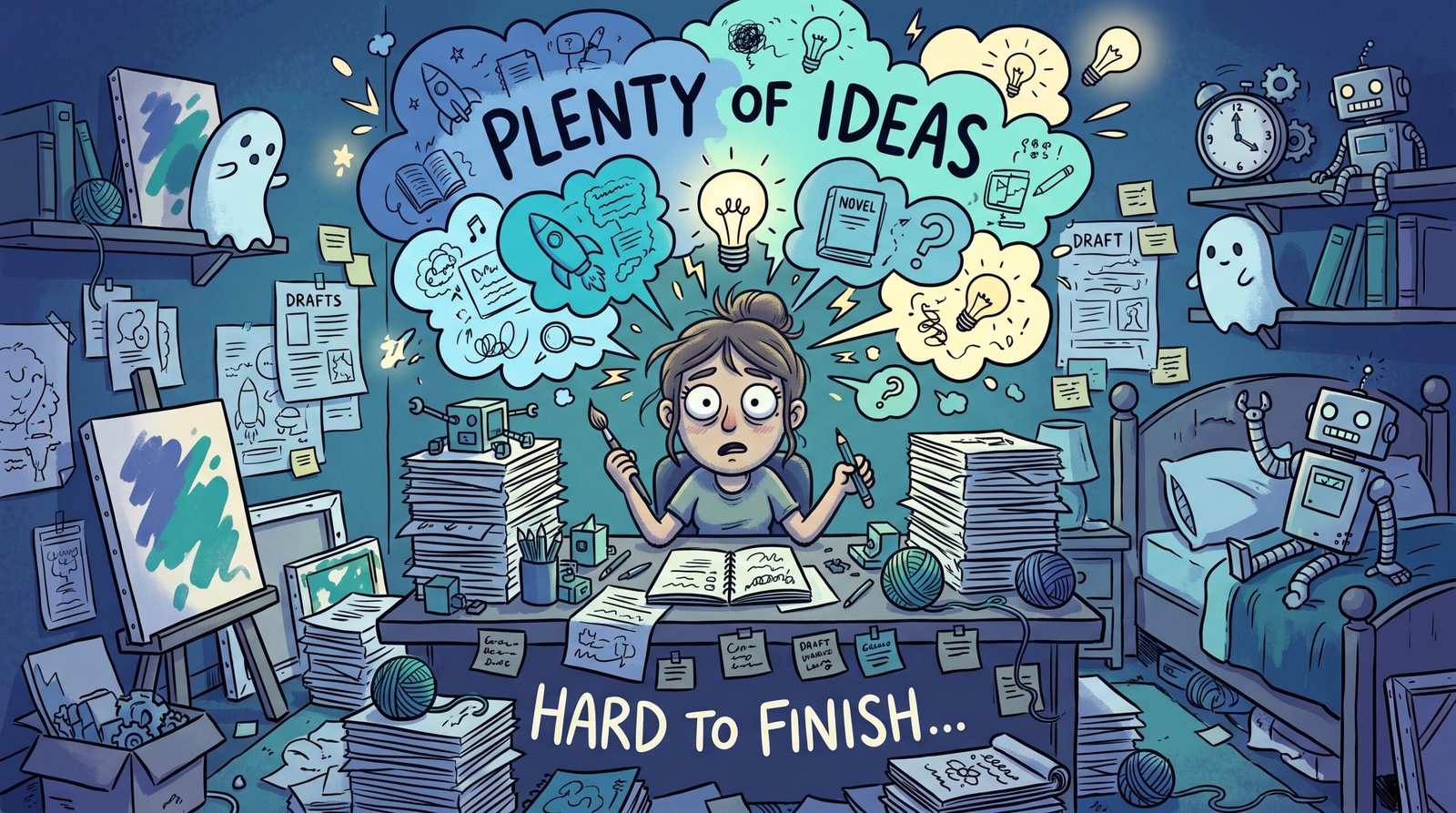
This is my own account of having plenty of ideas and finding it hard to finish them. It is one person’s experience, and I cannot say how much of it comes from ADHD.
When you have plenty of ideas hard to finish, the challenge is rarely a lack of creative energy; it is knowing how to bridge the gap between initial excitement and the long, quiet middle of a project.
I have never had a shortage of inspiration. The harder part is deciding which one deserves my attention today, then staying with it long enough to complete it. That is true of my sewing, my websites, and most of the projects I have started. I enjoy having different challenges, and variety keeps life engaging. The friction only begins when a concept has to turn into a finished deliverable.
I have an ADHD diagnosis, and I cannot tell you how much of this comes from neurodivergence alone. What I can do is describe what happens, including the parts that seem to contradict each other. This reflection is about one of those contradictions: how someone can finish a PhD and still have a bag of half-sewn work that she dreads returning to.
In this reflection:
Having Ideas Is Easy: Finishing Is a Different Job
It took me a long time to realise that having an idea and finishing a project are two completely different kinds of work. They use different parts of a day, and they ask different things from my mind.
I wrote about this in my post about understanding my busy mind. There is having the idea. There is starting. There is the long middle, where the repetitive steps happen. And there is deciding when something is finished enough to step back.
It is easy to treat those stages as a single, uniform process. A project that begins with genuine excitement is expected to carry that energy all the way to the end. When that energy drops, the natural assumption is that something is wrong with our willpower.
Managing websites shows these phases clearly. Coming up with an idea for a new page is quick and satisfying. Writing, formatting, and checking the links takes much longer. Deciding whether it is ready to publish can take longer still.
Sewing shows this pattern even more plainly, and it is the example where I can describe the friction best.
My Sewing Bag: Plenty of Ideas, Not Enough Finished Projects
I love sewing. Every length of fabric suggests a cut or a pattern I would be excited to make. If you asked me whether I have ideas for things to sew, I could easily give you a long list.
Preparing the pattern: where the excitement lives
The first phase is where my energy is highest. Choosing the fabric, imagining how it will look, and laying out the pattern pieces are the parts I look forward to. In that initial stage, everything feels possible, and sitting down to work is effortless.
Cutting and sewing: where time runs out
Then the work shifts into the cutting and stitching. These steps usually take more than a single sitting, and the realities of a busy day mean I rarely finish a piece in one go. So I stop.
Stopping is completely reasonable. Nobody finishes every piece in an afternoon, nor should they have to. The friction is in what happens next.
Coming back to finish: the hard part
Coming back to an unfinished piece can feel deeply unappealing. The excitement belonged to the first phase, and by the time I return, that novelty is gone. What remains is the slow, methodical assembly, and that part does not generate its own motivation.
So the unfinished piece goes into a bag, joining the other projects waiting for attention.
What the bag shows
The bag is an honest picture of how things get left behind. None of those projects represents a failure; each was started with genuine interest. But together they make a pile that is far easier to add to than to empty.
I would rather describe this openly than invent a neat explanation for it. If you have your own version of this bag, you will know the feeling.
Plenty of Ideas Hard to Finish: Why Starting Is Easier Than Returning
Having plenty of ideas hard to finish often comes down to how our attention interacts with momentum. While I do not have a tidy formula for why returning to a project is so difficult, there are several ordinary reasons worth considering.
The novelty has worn off, because fabric that is already cut is no longer an open possibility. The planning is done, meaning the most engaging part is behind me. I might not remember exactly where I left off or what the next construction step was. My energy on the day I return might not suit fine, detail-heavy work. Or my interest may have simply shifted to another idea in the meantime.
Looking at those possibilities turns a vague sense of self-criticism into practical questions I can actually answer. Did I leave clear notes? Do I still want this item? Is today the right kind of day for this specific step?
Sometimes the honest answer to that last question is no, and the sensible choice is to leave it for another day. That is not avoidance as long as there is an intention to return when conditions suit better.
What Actually Works: A Genuine Deadline
There is one thing that reliably gets my sewing finished, and that is a meaningful deadline.
When I need a garment ready for an Indonesian traditional dance performance with a fixed date, the work gets done. I have made several performance costumes this way without the usual delays.
That does not prove that I simply lacked discipline before. It shows that an external date attached to a real event changes the psychological weight of the work. The performance date will not shift just because I do not feel like sitting at the machine.
Dance is also something I do on weekends to recharge, as I wrote in A Parent With ADHD. The deadline is connected to an activity I care about deeply, which makes following through much easier.
If you find your plenty of ideas hard to finish, look for deadlines tied to an external commitment. A date written quietly in a private diary can be adjusted without consequence, but a date someone else is relying on creates genuine momentum.
Many day-to-day projects do not come with an automatic performance date, so the ongoing challenge is finding an equivalent form of accountability for them.
Choosing Between Ideas: Which One Deserves Today?
The other half of the problem is selection. With work, parenting, family life, websites, and creative hobbies all competing for attention, the issue is rarely whether I have ideas. It is deciding which one should get today’s energy.
My focus varies from day to day. A task that feels manageable on Tuesday can feel completely unapproachable by Thursday, which is why rigid schedules drawn up in advance often fall apart before the week is out.
Rather than relying on a rigid productivity system, these questions help clarify where to put your effort:
| Question | Why it helps |
|---|---|
| Which of these has a genuine external deadline? | A real date tied to another person or event naturally settles the priority. |
| Which project will still matter in three months? | It separates brief creative impulses from work that delivers lasting satisfaction. |
| Am I hesitating because the step is hard, or because the idea has run its course? | A difficult step needs to be broken down. An idea that no longer matters can simply be set aside. |
| What is the smallest physical action I can take right now? | It turns an intimidating project into a five-minute task you can start immediately. |
These questions are not meant to generate a single perfect answer every time. Their purpose is simply to clear away the mental fog so a choice can be made deliberately.
Interesting Work, Novelty, and Everything Else
My mind tends to engage in contrasts. When something captures my interest, I can concentrate on it for hours without noticing the time. But when a task feels repetitive and disconnected from any immediate purpose, getting started can feel remarkably difficult.
That difference explains why some projects get finished quickly while others remain untouched. Every project, no matter how exciting at the start, eventually involves administrative, repetitive, or fiddly steps that do not supply their own motivation.
A practical example is the professional development course I mentioned in A Parent With ADHD. There are periods where the laptop stays packed away for weeks. Then an interesting topic catches my attention, and I will complete three modules in an evening while my tea goes cold beside me.
That is the exact same pattern as the sewing bag. Progress does not happen in a steady, predictable trickle. It arrives in bursts, and what happens during those bursts depends heavily on whether the next step feels engaging or purely administrative.
Simple Strategies Worth Trying
If you constantly face plenty of ideas hard to finish, these practical adjustments have proved helpful in our home. They are sensible ways to reduce friction rather than rigid rules:
| The Friction Point | A Practical Adjustment |
|---|---|
| Wrapping up a work session | Write down the immediate next step before packing away, so your next session starts with an action rather than a decision. |
| Putting unfinished work into storage | Slip a brief note inside the bag stating what needs to happen next, rather than leaving the project without context. |
| Too many open projects at once | Choose one primary piece to focus on, and treat the others as secondary tasks for smaller time slots. |
| A new idea appears mid-project | Jot it down in a dedicated ideas notebook instead of acting on it straight away. |
| Uncertainty about whether a piece is done | Define what ‘good enough’ looks like before beginning, so you have a clear stopping point. |
| No natural deadline exists | Borrow one by agreeing to share your progress with a friend or colleague on a specific day. |
None of these suggestions relies on pushing through discomfort with sheer willpower. They are designed to make returning to the work less demanding. When starting again is the hardest part, leaving a clear path makes the next session far easier to approach.
A few small habits make a genuine difference. Keep all the tools, pattern pieces, and materials together in one container so you do not have to search for them later. Write down where you stopped, even if it seems obvious in the moment. And if possible, stop mid-step so that the entry point for your next session is already clear.
It is usually best to try only one small adjustment at a time. Trying to overhaul your whole way of working at once often turns into another unfinished project itself.
What I Am Not Claiming
I am not claiming that having unfinished projects is purely an ADHD symptom. Incomplete work can stem from a full schedule, fatigue, perfectionism, or unclear priorities. Resources like the national health platform healthdirect explain how executive function and adult attention patterns involve multi-layered factors across daily life. Attributing everything to neurodivergence overlooks the practical changes we can make in our daily routines.
Nor am I claiming that deadlines solve everything. A firm date helped me finish specific costumes, but that does not mean an artificial date will resolve every stalled project, or that my sewing bag will ever stay empty.
Most importantly, I am not suggesting I have all this sorted out. Having an ADHD diagnosis offers useful context, but it does not run two websites, balance work, and complete craft projects for you. That remains day-to-day practical work.
Not Every Idea Needs to Be Finished
There is another perspective that matters here: sometimes, leaving an idea unfinished is the right choice.
A thought that stays in a notebook for months before fading has served its purpose. A pattern that no longer appeals does not need to be seen through just to prove commitment.
The projects worth protecting are the ones that continue to matter once the initial burst of novelty passes. Completing my doctoral thesis (which I wrote about here) was one of those. The work mattered to me, so I stayed with it despite the friction of the process. In post-secondary contexts, academic guides from the Australian Disability Clearinghouse on Education and Training (ADCET) demonstrate how breaking down major milestones helps students reach the finish line.
A helpful question is not “Why can’t I finish this?” but “Do I still care about having this finished?” If the answer is no, you can put it aside without guilt. If the answer is yes, you can look at what is making the return difficult and find a practical way back in.
If Someone You Know Has Unfinished Projects
Many people live or work alongside someone who starts projects with great enthusiasm and leaves them half-done. It is easy to view that as disorganisation or a lack of care.
It helps to remember that the person is likely just as frustrated by the backlog as you are. Critical comments such as “You never see things through” rarely create motivation; more often, they make returning to the work feel even more loaded with tension.
A gentle, practical question is far more helpful: “What is the next little step on that?” or “Is there a date you need this ready by?” That frames the unfinished task as a practical problem to address rather than a personal flaw.
And if you are the one looking at your own unfinished projects, offer yourself that same patience. You would not speak harshly to a friend in that situation; you deserve the same consideration.
A Small Experiment for This Week
If you would like to test a different approach this week, pick one unfinished task that still matters to you. It might be a piece of sewing, a draft article, or a household cupboard you started sorting.
Write down a single sentence defining what ‘finished’ looks like for it, and identify the smallest next physical action.
Give it a realistic date tied to an actual reason, even if that simply means telling a friend you will show them the completed item by the weekend. When the day arrives, focus only on that single next step. If you stop, write down the subsequent action before putting the work away.
At the end of the week, simply notice what happened. Did the external date help? Did the note make picking up the work easier? You are not trying to overhaul your whole life; you are simply gathering useful information about what supports you.
One Question to Take Away
I started with the reality that having plenty of ideas hard to finish is a common pattern. I still do not have a tidy formula for it, and I prefer to be honest about that.
What I do know is that the enthusiasm naturally belongs to the start, returning to a stalled task takes deliberate scaffolding, and a genuine external reason helps. Most importantly, not every idea needs to reach the finish line.
Think of one project you started that still genuinely matters to you. What is the very next small step, and what does ‘done’ look like for today?
Research: references include public guidance from healthdirect and ADCET on executive function and learning accommodations.
Experience: reflections on unfinished work, sewing, and daily routines represent my own personal observations. Last reviewed: 20 October 2026.
References & External Resources
- healthdirect. (2024). Adult ADHD. Australian Government Department of Health and Aged Care. https://www.healthdirect.gov.au/adult-adhd
- Australian Disability Clearinghouse on Education and Training (ADCET). Reasonable adjustments: ADD/ADHD. https://www.adcet.edu.au/students-with-disability/reasonable-adjustments-disability-specific/Reasonable-Adjustments-ADD-ADHD