
Emergent Literacy in Preschoolers Aged 3 to 5 Years: 5 Powerful Secrets
Understanding emergent literacy in preschoolers aged 3 to 5 years begins when we notice how young children interact with language during quiet, spontaneous play at home.
Late in the afternoon, when the house usually settles into a calm rhythm, my four year old daughter lay on the living room rug surrounded by scattered coloured pencils. Nearby, I was folding laundry, half watching and half lost in thought. She picked up a bright yellow pencil, drew a sweeping, uneven circle across her paper, and then softly whispered the word “sun.”
It was not a structured reading session. There were no printed flashcards, no repetitive trace sheets, and no timed tasks on a kitchen timer. It was a completely spontaneous, low demand micro interaction embedded directly inside self directed play. For young children navigating early childhood, learning to read and write rarely starts at a rigid desk. It emerges quietly through daily play, environmental curiosity, oral storytelling, and casual mark making across everyday Australian home routines.
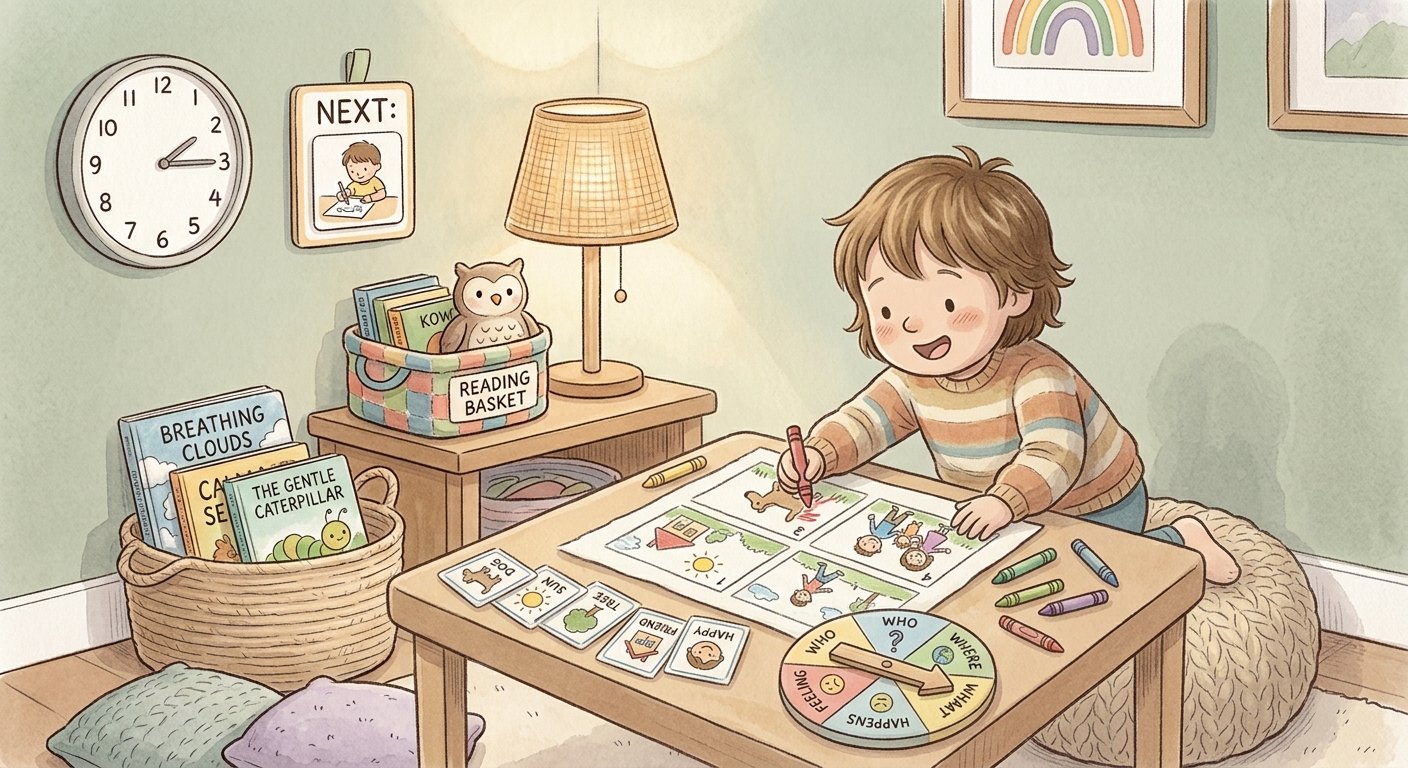
What Is Emergent Literacy in Preschoolers Aged 3 to 5 Years?
Emergent literacy in preschoolers aged 3 to 5 years refers to the gradual accumulation of foundational knowledge, oral language skills, print awareness, and phonological concepts that young children develop long before formal reading and writing instruction begins in primary school. Between 3 and 5 years of age, early brain development thrives on play based learning rather than rigid academic drill work.
When young children trace swooping patterns in window condensation, recognise familiar brand icons on cereal boxes during breakfast, or assign imaginative narratives to abstract crayon scribbles, they are constructing essential neural frameworks. Nurturing emergent literacy in preschoolers aged 3 to 5 years builds phonemic awareness, vocabulary strength, visual discrimination, and print knowledge in a stress free setting.
| Formal Instructional Expectation | Emergent Literacy in Preschoolers Aged 3 to 5 Years | Developmental and Brain Benefit |
|---|---|---|
| Formal Handwriting Drills | Mark making in sensory media like damp sand, flour, or paint | Builds fine motor control, hand strength, and spatial orientation |
| Decoding Written Sentences | Identifying environmental print like street signs and packaging labels | Establishes symbolic thinking and print awareness naturally |
| Rote Phonics Worksheets | Playful oral rhyming, silly singing, and whispering letter sounds | Strengthens auditory discrimination without executive fatigue |
| Mandatory Silent Reading | Interactive picture book dialogue and shared story exploration | Fosters comprehension, narrative vocabulary, and emotional bond |
The Science of Emergent Literacy in Preschoolers Aged 3 to 5 Years
To fully appreciate why low demand methods yield superior long term educational outcomes, we must examine the neurodevelopmental mechanisms behind emergent literacy in preschoolers aged 3 to 5 years. For a child aged 3 to 5 years, forced compliance and formal instructional pressure often activate the sympathetic nervous system, triggering anxiety, task avoidance, or executive freeze.
In contrast, incidental learning leverages spontaneous moments of natural curiosity. When learning occurs inside self chosen play, the brain releases dopamine, which enhances memory consolidation and neural plasticity. International early childhood research published in the Association for Psychological Science consistently demonstrates that rich home literacy environments combined with responsive adult interactions build stronger oral language foundations than early academic drills (Neuman and Roskos 2007; Whitehurst and Lonigan 1998).
The Australian Early Years Learning Framework, accessible via the official ACECQA EYLF V2.0 Framework, highlights communication and literacy as holistic practices. EYLF principles emphasize that young children learn best through play based experiences where adults act as co-investigators rather than rigid instructors. Supporting emergent literacy in preschoolers aged 3 to 5 years requires honoring the child’s natural play pace and validating their spontaneous attempts at communication.
5 Powerful Frameworks for Emergent Literacy in Preschoolers Aged 3 to 5 Years
Rather than turning every spontaneous moment into a pop quiz or an academic lesson, parents and early childhood educators can utilize the evidence informed Observe Affirm Expand framework to cultivate emergent literacy in preschoolers aged 3 to 5 years. This methodology preserves the joy of play while seamlessly introducing foundational language concepts.
1. OBSERVE: Spotting Spontaneous Triggers
Begin by observing your child during quiet independent play or daily transition times. Look out for these subtle entry points for emergent literacy in preschoolers aged 3 to 5 years:
- Sensory Mark Making: Swirling fingers through spilled water, sand pits, shaving cream, or flour on baking trays. Explore our hands on School Readiness Printable Pack for structured sensory practice ideas.
- Environmental Print Recognition: Pointing out familiar logos on milk cartons, supermarket signs, or traffic boards during car rides.
- Invented Narrative and Symbolism: Drawing zigzags on paper and proudly declaring, “I wrote a long letter to Nanna!”
- Phonemic Whispers: Repeating initial letter sounds softly while maneuvering toy trucks, animals, or building blocks.
2. AFFIRM: Validating Play Efforts Without Immediate Correction
Acknowledge your child’s micro interaction instantly without quizzing, testing, or correcting minor developmental errors.
Avoid Dismissing: “That is nice dear, now go clean up your drawing space.”
Avoid Over Instructing: “Good drawing! Now sit up straight and write the letters S U N underneath it.”
Affirmation Response: “You created a bright yellow sun! You used your pencil to share that idea.”
3. EXPAND: Introducing One Simple Linguistic Layer
Add a single low demand linguistic extension that expands their vocabulary or phonological awareness without overwhelming working memory.
Five Core Pillars of Emergent Literacy in Preschoolers Aged 3 to 5 Years
To build a comprehensive home environment supporting emergent literacy in preschoolers aged 3 to 5 years, parents can focus on five foundational pillars. These pillars integrate effortlessly into everyday Australian family life, whether you are preparing vegemite toast, visiting the local park, or riding public transport.
Pillar 1: Oral Language and Narrative Comprehension
Oral language is the bedrock of all future reading and writing success. Preschoolers who enter primary school with rich, expressive vocabularies and strong narrative comprehension transition into formal reading with far greater ease. You can build oral language during routine tasks by engaging in conversational turn taking, asking open ended questions, and describing daily activities with rich adjectives.
For example, while walking through the local neighborhood, instead of simply saying, “Look at the dog,” you might expand with, “Look at that energetic golden retriever bounding across the green grass.” This simple practice introduces specialized vocabulary and complex sentence structures in a natural context.
Pillar 2: Print Awareness and Concepts About Print
Print awareness is the understanding that written marks on a page represent spoken words and carry meaning. Before children can decode individual words, they must understand basic print conventions, such as reading from left to right, top to bottom, and recognizing that books have front and back covers.
Encourage print awareness by letting your child hold picture books, turn pages during bedtime stories, and follow along as you run your finger beneath large printed titles. Pointing out signs at the local library or grocery store further reinforces that print provides functional information in the real world.
Pillar 3: Phonological and Phonemic Awareness
Phonological awareness involves tuning into the sounds of spoken language, including rhymes, syllables, and initial word sounds. Phonemic awareness, a specific subset of phonological processing, is the ability to hear, identify, and manipulate individual sounds, known as phonemes, in spoken words.
Preschoolers aged 3 to 5 years do not need formal phonics worksheets to build these skills. Instead, engage in playful oral rhyming games, sing traditional nursery rhymes, break words into rhythmic clapping syllables during cooking, and play sound games like “I spy with my little eye something starting with the sound /b/.” Practice early sound and letter association with our Space Adventure Alphabet Tracing Worksheets.
Pillar 4: Alphabetic Principle and Letter Knowledge
The alphabetic principle is the understanding that systematic relationships exist between written letters and spoken sounds. For 3 to 5 year olds, acquiring letter knowledge should remain hands on, visual, and connected to personal meaning.
Start with the letters that carry the greatest emotional significance for your child, such as the initial letter of their own name or the names of family members and pets. Use tactile materials like wooden letter blocks, magnetic letters on the refrigerator, or drawing letters in outdoor sand pits to make letter shapes memorable and concrete.
Pillar 5: Fine Motor Control and Emergent Writing
Emergent writing begins long before a child can form perfect cursive or print legibly between ruled lines. It starts with gross motor shoulder stability, moves down to elbow and wrist control, and eventually refines into pincer grip strength required for holding writing utensils.
Provide diverse fine motor play opportunities, such as squeezing playdough, threading large wooden beads onto string, using tweezers to collect pom poms, and tearing scrap paper for art projects. Practice early number formation and motor control using our Space Number Tracing 1 to 20 Pack. When young children scribble, draw loops, or attempt invented spellings, celebrate these efforts as genuine written communication.
Activities for Emergent Literacy in Preschoolers Aged 3 to 5 Years
Integrating emergent literacy in preschoolers aged 3 to 5 years into daily schedules requires no expensive commercial software or formal curriculum kits. Below are six practical, low cost activities designed for Australian homes, early learning centres, and preschool classrooms.
Activity 1: The Kitchen Recipe Scavenger Hunt
While preparing lunch or baking snack muffins, involve your preschooler in reading the kitchen environment. Draw simple visual icons next to written ingredient labels on recipe cards, such as an egg icon beside the word “Egg” or a milk bottle beside “Milk.”
Ask your child to retrieve items from the pantry by matching the visual symbol and initial letter sound. This activity reinforces print functional utility, visual discrimination, and categorisation skills during a low pressure household routine.
Activity 2: Outdoor Nature Tracing and Mud Writing
Take early literacy learning outdoors into the backyard, local park, or bushland walking trail. Collect fallen gum leaves, twigs, smooth stones, and seed pods. Invite your child to arrange these natural objects into large letter shapes across the grass or soil.
Alternatively, provide a small container of water and a large paintbrush for your child to paint water letters on outdoor pavers or timber fencing. This gross motor play builds shoulder stability while connecting letter shapes to multi sensory physical movement.
Activity 3: Sensory Tray Mark Making
Fill a shallow wooden tray or baking dish with a thin layer of fine salt, rice, flour, or kinetic sand. Demonstrate how to trace swirling lines, zigzags, wavy ocean waves, and simple letter shapes using a single index finger, a wooden stick, or a soft feather.
Sensory mark making removes the frustration of pencil grip demands, allowing young children to focus entirely on spatial orientation, form reproduction, and tactile feedback in an easily resettable format.
Activity 4: Environmental Print Bingo during Community Walks
Transform daily walks around your neighborhood or trips to the local shopping precinct into an engaging print hunt. Create a simple cardboard card featuring common community logos and signs, such as a red STOP sign, a pedestrian crossing symbol, a post box icon, or a local supermarket logo.
As you walk together, invite your preschooler to spot these signs in the wild and mark them off their board. This practice reinforces that reading is a meaningful tool used to navigate our shared physical world.
Activity 5: Interactive Dialogic Picture Book Reading
Elevate standard bedtime story reading into an interactive conversation through dialogic reading techniques. Instead of reading the text passively from start to finish, pause on engaging pages to ask open ended prompts, make predictions, and discuss character emotions.
Ask questions like, “Why do you think the little wombat looks surprised on this page?” or “What do you imagine will happen when they open that mysterious wooden door?” Dialogic reading expands oral language, narrative comprehension, and inferential reasoning naturally. For further research on story reading strategies, visit the Reading Rockets Literacy Initiative.
Activity 6: The Post Office Imaginative Play Corner
Set up a simple home post office station using discarded envelopes, scrap paper, cardboard boxes, sticker stamps, and colourful pens. Invite your child to write secret messages, draw pictures, address envelopes with scribble names, and deliver letters to family members or soft toy animals.
Imaginative role play contextualizes writing as an authentic social action, motivating preschoolers to practice mark making and invented spelling with high enthusiasm and zero performance anxiety.
Addressing Parent Concerns About Emergent Literacy in Preschoolers Aged 3 to 5 Years
Navigating early childhood development often exposes parents to conflicting advice, social media comparison, and artificial academic pressure regarding emergent literacy in preschoolers aged 3 to 5 years. Below, we address four frequent concerns regarding early reading and writing acquisition.
Concern 1: “My 4 year old shows no interest in sitting down to trace letters.”
It is entirely developmentally appropriate for a 4 year old child to resist sitting at a table for structured handwriting worksheets. At this stage, physical growth prioritises gross motor development, spatial awareness, and sensory integration. Forcing seated table work often creates unnecessary power struggles and negative associations with learning.
Instead, focus on gross motor pre writing activities like painting on outdoor easels, swinging from monkey bars to build upper body strength, and tracing large letters in air or sand. Letter knowledge can be fostered through oral games and play based exploration without forcing fine motor pencil tasks before the hand muscles are ready.
Concern 2: “My child reads words backwards or writes letters reversed.”
Letter reversal, such as confusing b and d or writing numbers in mirror image, is completely normal and common in children aged 3 to 5 years. Young brains are still developing spatial orientation and visual processing systems, learning that object identity remains constant regardless of direction.
In early childhood, a chair is still a chair whether it faces left or right. Applying this concept to asymmetric letters takes time and practice. Gently model correct orientation without punishing or overly correcting errors. Mirror writing usually resolves naturally as visual processing matures in primary school.
Concern 3: “Is smartphone or tablet educational app reading beneficial for preschoolers?”
While some digital early literacy applications offer engaging graphics and interactive phonics games, research consistently shows that digital media cannot replace human turn taking and physical sensory exploration. Passive screen interaction often lacks the co-regulatory benefits, tactile feedback, and rich conversational context provided by real world shared reading.
If utilizing digital tools, treat them as a minor supplement rather than a replacement for physical picture books, oral storytelling, and hands on sensory play. Always engage alongside your child to facilitate active conversation about what appears on screen.
Concern 4: “Should I push my preschooler to read fluently before starting primary school?”
Early childhood research indicates that pushing early fluent reading before a child is developmentally ready offers no long term academic advantage by middle primary school. Children forced into early academic decoding often miss out on essential play experiences that build social emotional competence, creative problem solving, and executive function skills.
Focus your energy on fostering a deep love for stories, rich oral language comprehension, curiosity about print, and strong fine motor foundations. A child who enters primary school with high self confidence and a positive relationship with books will master formal decoding quickly when systematic instruction begins.
A Sustainable Plan for Emergent Literacy in Preschoolers Aged 3 to 5 Years
To establish a calm, low demand home environment supporting emergent literacy in preschoolers aged 3 to 5 years, implement this step by step four week transition strategy.
- Week 1: Remove Formal Instructional Pressure. Replace trace sheets and forced flashcard routines with daily shared picture book reading and open ended drawing spaces. Observe your child’s natural play interests without intervening.
- Week 2: Introduce the Observe Affirm Expand Framework. Begin spotting spontaneous literacy sparks during daily transitions. Practice validating your child’s mark making and adding one single oral sound or vocabulary layer.
- Week 3: Integrate Environmental Print and Community Walks. Point out real world signs, food packaging, and labels during shopping trips and neighborhood strolls. Involve your child in functional household reading tasks like kitchen baking.
- Week 4: Establish Rich Sensory and Imaginative Play Spaces. Set up accessible mark making trays, sensory sand bins, and a dedicated pretend play corner with paper, envelopes, and writing utensils to foster natural emergent writing.
Building foundational literacy skills during early childhood does not require rigid scheduling, expensive tools, or stressful drill sessions. By recognizing that play is the true work of early childhood, Australian parents and educators can protect the wonder of early learning while building a resilient, confident foundation for lifelong reading success.
References
Australian Government Department of Education. (2022). Belonging, Being and Becoming: The Early Years Learning Framework for Australia (V2.0). Australian Government Department of Education for the Ministerial Council.
Neuman, S. B., and Roskos, K. (2007). Nurturing knowledge: Building a foundation for school success by linking early literacy to math, science, and social studies. Scholastic.
Whitehurst, G. J., and Lonigan, C. J. (1998). Child development and emergent literacy. Psychological Bulletin, 124(1), 59–83. https://doi.org/10.1037/0033-2909.124.1.59
Educational Disclaimer: This guide is for informational and educational purposes only. It synthesizes early childhood educational research and lived parenting experience to support home and classroom learning strategies. It does not constitute medical, psychological, or clinical advice. For individual developmental concerns, please consult a licensed paediatric health professional.
© EarlyChildhoodEdu.net – For educational use.