
ADHD Reading Routines for Neurodivergent Families Who Prefer Flexible Days
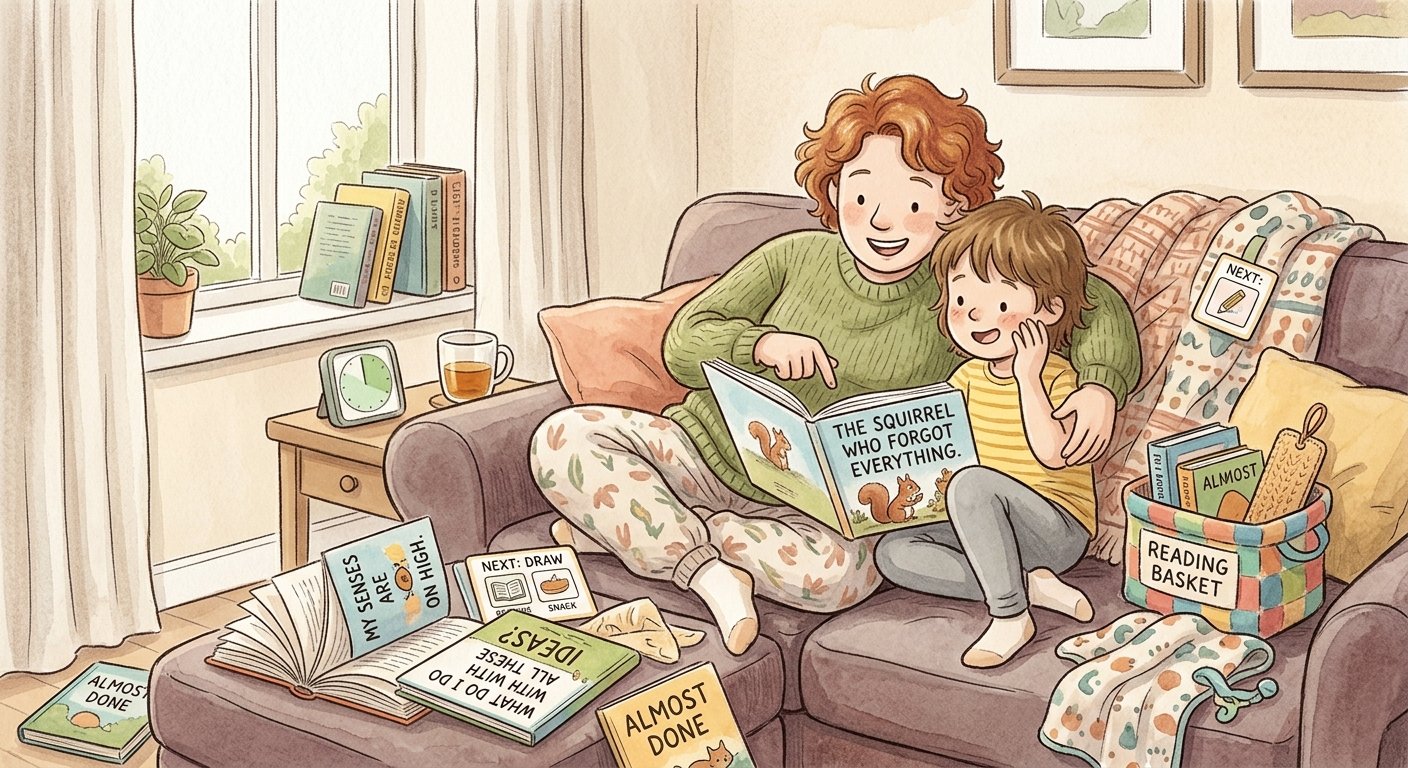
ADHD reading routines are something I learned to build slowly, gently, and with a lot of forgiveness. As a neurodivergent parent with ADHD myself, I used to imagine that reading with my child would look like the tidy routines I saw in parenting books. A set time. A perfect basket of books. A calm child. A calm parent. But our days never moved in straight lines. Some mornings felt organised. Some afternoons felt scattered. Some evenings felt unexpectedly calm. Reading did not fit into a schedule. It fit into moments.
The first time I realised this, my child was curled up on the couch with a snack, quietly flipping through a picture book. It was not “reading time.” It was not part of a routine. It was simply a moment when their nervous system felt settled enough to explore a story. That moment changed how I understood ADHD reading routines. They are not built from strict schedules. They are built from noticing calm, following curiosity, and creating gentle invitations.
Why ADHD Reading Routines Need Flexibility
ADHD reading routines need flexibility because ADHD is not a time-table condition. It is a way of experiencing attention, motivation, and energy. Many ADHD parents and children move through the day in waves. Focus arrives in bursts. Energy rises and falls. Transitions can feel heavy. When we try to force reading into rigid blocks, it often collapses.
Organisations such as Understood.org explain that ADHD affects executive function skills like planning, organising, and task initiation. These skills influence how easily a child can begin reading, how long they can stay engaged, and how smoothly they can transition into literacy moments. When we design reading routines that assume steady focus, we set ourselves up for frustration. When we design routines that respect ADHD rhythms, reading becomes possible.
As a parent, I learned that flexible routines do not mean “no routine.” They mean routines that bend. Routines that adapt. Routines that follow the child’s nervous system rather than the clock. This approach aligns with early childhood guidance from organisations like ACECQA, which emphasise responsive, relationship-based learning.
A Parent’s Story About Finding a Reading Rhythm
One evening, after a long day, my child climbed onto my lap with a book. It was not a book I had chosen. It was not part of a plan. They simply felt ready. Their body softened against mine. Their breath slowed. I opened the book and began reading. We only read two pages before they wandered off again. But those two pages mattered. They were part of our reading rhythm.
ADHD reading routines often look like this. Small moments. Short bursts. Gentle beginnings. When we stop measuring reading by the number of pages and start noticing the quality of connection, literacy becomes something that fits into real life.
Seven Calm ADHD Reading Routine Ideas for Flexible Days
Over time, I discovered seven ADHD reading routine ideas that worked well for our neurodivergent family. These ideas are not strict schedules. They are gentle patterns that can be picked up and put down as needed. They respect ADHD rhythms and early childhood realities.
1. The Couch Basket Routine
The couch basket routine began on a day when I realised that the hardest part of reading was simply getting up to find a book. ADHD makes transitions feel heavy. So I placed a small basket of picture books beside the couch. Not a big basket. Just three or four books.
When my child sat down, the books were already there. Reading became something we could do without moving. This reduced the executive function load of starting. It also made reading feel spontaneous rather than scheduled.
Early childhood organisations such as Early Childhood Australia highlight the importance of accessible materials in supporting literacy. The couch basket routine is a simple way to make literacy accessible at home.
2. The Snack and Story Moment
Snack time is one of the most predictable moments in an ADHD household. Children sit. They pause. They breathe. Their nervous system settles. This makes snack time a natural anchor for reading.
I began placing a book on the table during snack time. I did not aim to read the whole book. I simply read a page or two while my child ate. Over time, this became a gentle pattern. It was not a rule. It was an invitation.
This routine works because it does not require extra transitions. The child is already seated. The book simply joins the moment.
3. The “When We Notice Calm” Routine
ADHD reading routines often work best when they follow the child’s nervous system. Calm moments appear unexpectedly. When I noticed my child quietly playing or cuddling beside me, I would gently say, “This feels like a story moment. Would you like to read together?”
Sometimes they said yes. Sometimes they said no. Both were fine. Over time, these invitations became a pattern. Reading became something we did when calm arrived, not something we forced when calm was absent.
4. The Movement and Story Pairing
ADHD bodies often need movement before they can settle into reading. Jumping, stretching, or dancing can help regulate the nervous system. I began pairing movement with reading. “We will jump for one minute, then read for one minute.”
This pairing helped my child shift into reading mode. It also reduced conflict. Instead of asking them to sit still for a long time, I offered a rhythm that included both movement and rest.
5. The Interest-Based Reading Routine
ADHD reading routines become easier when they are built around genuine interests. My child loved trains. So we read train books. We labeled train pictures. We made up stories about trains. When literacy connected to their interests, reading felt natural.
Interest-based reading can also include non-traditional materials. Maps, menus, signs, and simple instructions all count as literacy. When we point to words in the environment and talk about them, we build reading routines that fit into daily life.
6. The “One Page Is Enough” Routine
ADHD reading routines benefit from low pressure. Instead of aiming to finish a whole book, I adopted a “one page is enough” mindset. We read one page. If my child wanted more, we continued. If they were done, we stopped.
This routine helped me let go of guilt. It also helped my child feel successful. Over time, these small moments added up. Reading became something we touched often, even if only briefly.
7. The Bedtime Drift Routine
Bedtime reading in an ADHD household rarely looks like a perfect routine. Some nights we read in bed. Some nights we read on the couch. Some nights we told stories aloud without a book. All of these counted.
The bedtime drift routine acknowledges that ADHD evenings can be unpredictable. Instead of forcing a rigid pattern, I held a gentle intention: “Stories are part of how we end the day.” This intention could be expressed in different ways depending on the energy of the evening.
ADHD Reading Routines for Neurodivergent Parents
ADHD reading routines must also consider the parent’s nervous system. If you have ADHD, you may find it hard to remember routines, locate books, or stay awake long enough to read. You may feel guilty about this. You may worry that you are not doing enough. It is important to remember that your presence and your relationship are already powerful literacy resources.
One practical support is to place books in multiple locations rather than in a single “perfect” spot. A book near the couch. A book near the bed. A book near the kitchen table. This increases the chances that you will pick one up.
Another support is to set a gentle reminder on your phone that says “Story moment?” without pressure. These small scaffolds help ADHD reading routines feel possible.
Helpful External Resources
Internal Linking Suggestions
- Supporting Literacy When You Are an ADHD Parent Too
- Sensory Friendly Literacy Moments for Children Who Feel Overwhelmed
- Co Regulation Before Reading and Why It Matters
- How to Notice Small Literacy Moments in Neurodivergent Learning
- Gentle Phonics for Children Who Learn Differently