
ADHD Behaviour Strategies: 4 Reasons Behaviour Charts Often Fall Short
Rethinking our ADHD behaviour strategies starts with an honest look at behaviour charts. For some children, star charts and point systems help. For others, especially when the reward is slow, the chart is public, or the skill is simply too hard that day, a chart can add pressure without adding skill.
Effective ADHD behaviour strategies usually pair clear expectations with support: changes to the environment, help to get started, and a calm adult. In my experience, behaviour is often less a question of willpower than of capacity, sensory load and executive function.
Rewards can still have a place when they are immediate, private and matched to something the child can do.
- The Sticker Chart Paradox: Why Good Intentions Backfire
- 4 Reasons Behaviour Charts Often Fall Short for Neurodivergent Children
- Motivation, Reward and Executive Function
- 4 Practical ADHD Behaviour Strategies to Try Alongside or Instead of Charts
- Real-World Application: The Morning Routine Shift
- Connected Guides in the Regulation Cluster
- Academic References & Scientific Sources
The Sticker Chart Paradox: Why Good Intentions Backfire
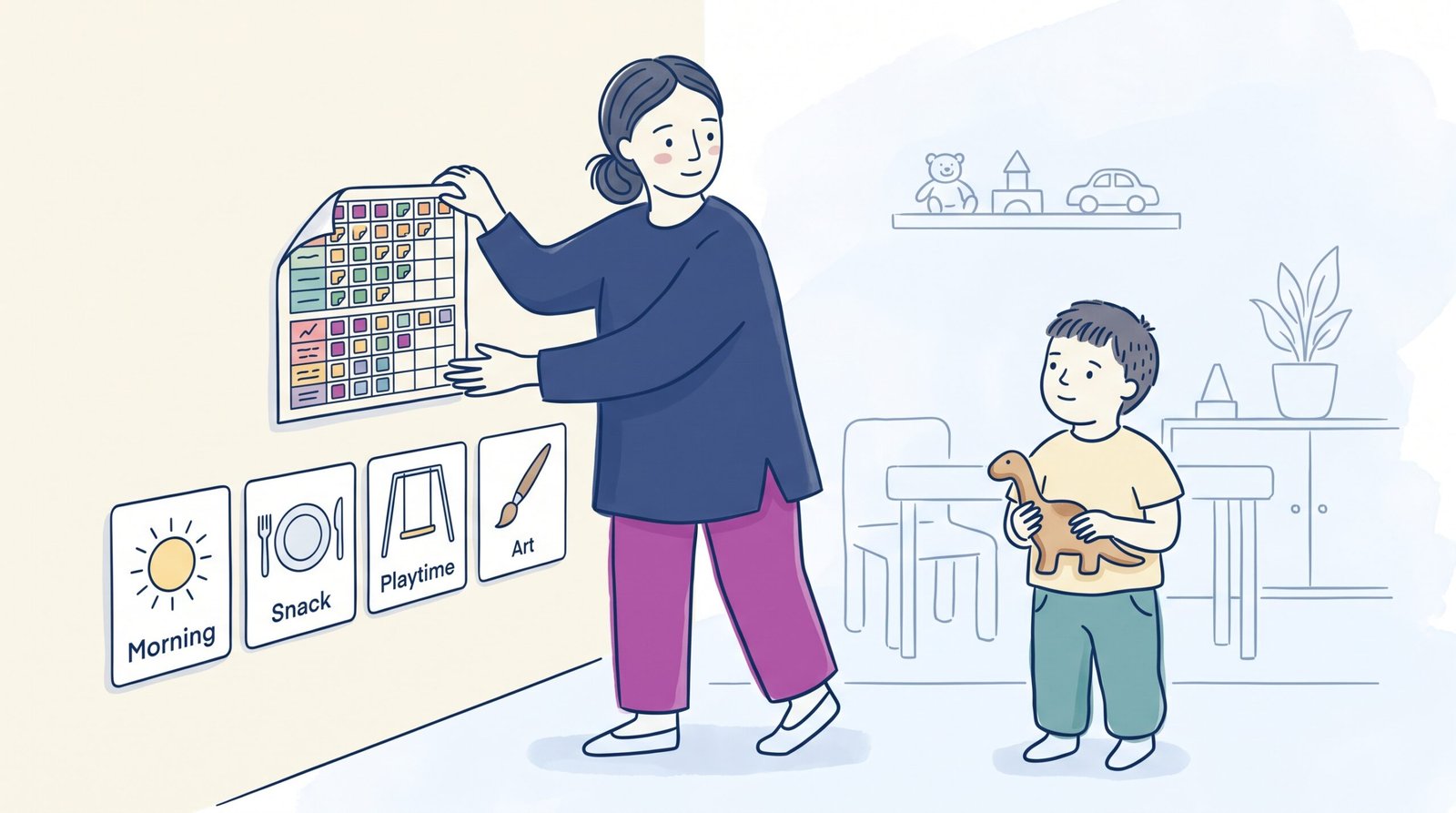
Walk into almost any early childhood room, preschool, or family home across Australia, and you are likely to see one: a brightly coloured laminated chart stuck to a wall or refrigerator door.
It has rows for Listening Ears, Gentle Hands, Sitting on the Mat, and Packing Away Toys. At the start of the week, clean grids promise gold stars, smiley face magnets, or Friday prize box tokens.
For many children, a chart works reasonably well as a visual reminder. For some children with Attention Deficit Hyperactivity Disorder (ADHD), autism, or sensory processing differences, I have watched charts lose their pull by midweek, often because the skills they ask for are the ones the child finds hardest.
When the child doesn’t earn their sticker, adults often double down. We assume the reward wasn’t exciting enough, the consequence wasn’t sharp enough, or the child was being stubborn. Sometimes the real problem is that the child can’t yet do what the chart is asking, at that moment.
The Early Years Learning Framework (EYLF) V2.0 names secure, respectful and reciprocal relationships as a core principle, and children’s wellbeing as one of its learning outcomes.[1] Modern ADHD behaviour strategies fit that emphasis.
When an ADHD child throws a pencil or bolts from the group mat, I try to ask what the behaviour is telling me about their capacity before I ask what consequence it needs.
What the research says about reward systems
I should be upfront: the research is kinder to reward systems than my own experience has been. A meta-analysis of behavioural treatments for ADHD found that they work, and a review of token systems in primary school classrooms found large effects, although it did not say which children had which diagnoses.[2][3]
So I no longer say that charts never work. What the research can’t tell us is how a chart will go for one particular four-year-old on one particular morning. The four reasons below are patterns I have seen in practice, not findings from those reviews.
There is also a separate, older debate about whether tangible rewards can reduce children’s interest in a task. A large meta-analysis found that they reduced later free-choice interest and self-reported interest, with stronger effects for children than for college students.[4] Alfie Kohn makes a related case for a general audience.[5]
That debate is not settled, and I haven’t found research testing it with children who have ADHD. I treat it as a reason for care, not a rule.
4 Reasons Behaviour Charts Often Fall Short for Neurodivergent Children
To use genuine, sustainable ADHD behaviour strategies, it helps to name the four patterns I see most often when charts fall short.
The table sets out my own reading and experience, not a summary of research findings.
| Design Assumption of Charts | What May Be Happening Instead | What I Have Seen Happen |
|---|---|---|
| 1. Temporal Consistency: Assumes a skill is as available at 11:30 am as it was at 9:00 am. | Capacity Can Vary: What a child can do often depends on fatigue, sensory load and hunger. | A child succeeds at 9:00 am and struggles at 11:30 am after a loud, busy morning. |
| 2. Delayed Gratification: Assumes a Friday token can motivate a Tuesday decision. | Delayed Rewards May Motivate Less: Research suggests a modest average tendency in ADHD to prefer smaller, sooner rewards (see Reason 2). | The child can’t draw on a distant prize in the moment of the decision. |
| 3. Public Accountability: Uses visible markers (green to yellow to red) to prompt self-correction. | Exposure Can Sting: Some children feel a public marker as a judgement, especially when they are already struggling. | Defensive anger, tears, running away, or going very quiet. |
| 4. Moral Choice Framing: Treats dysregulation as a choice between good and bad actions. | Skills Not Available Yet: Under strain, a child may not be able to use skills they have on calmer days. | Shame; some children conclude they are bad and stop trying. |
1. They Assume Skill Capacity Is Constant
Behaviour charts quietly assume that if a child can sit through storytime on Tuesday, they can on Thursday. When they can’t, adults can read it as wilful disobedience.
In my experience, capacity moves around. Many ADHD families describe the same child managing well one hour and struggling the next, depending on how tired, hungry or sensory loaded they are, and how much noise they have been filtering.
I picture it as an empty battery, which is an image, not a measurement. A chart then marks the child down for running low. I explore this variation in spiky profiles in neurodivergent children, and the effect of a loud room in classroom noise and sensory overload.
2. They Rely on Rewards That Arrive Too Late
Russell Barkley, a leading ADHD researcher, has argued that ADHD involves difficulty with time and with acting on future consequences.[6] His account is influential, though it is not the only one.
A related finding is that, on average, people with ADHD choose a smaller reward now over a bigger one later a little more often than others do. The effect is small to medium, and nobody is sure why.[7]
In practice, telling a four or five year old that packing away blocks now will earn a prize on Friday asks them to hold a long wait in mind. For many children that is a lot to ask.
In my experience, small rewards that come close to the moment are easier for young children to connect with what they did.
3. They Can Feel Like Public Exposure
Most behaviour charts are public. Whether hung in a kitchen or on a classroom whiteboard, everyone can see who has gold stars and who has empty squares or a clip on red.
Some parents and clinicians use the term rejection sensitive dysphoria (RSD) for intense emotional pain when a person feels rejected or criticised. It is worth knowing that RSD is not an official diagnosis, and that research on it is limited.[8] Many families still recognise the pattern.
With some children, I have seen a moved clip or a withheld star land as more than a small setback. The reaction can look like kicking, shouting, running away, or going very quiet. I haven’t found research that tests public charts directly, so please take this as what I have noticed.
4. They Confuse Won’t with Can’t
Ross Greene’s guiding idea is: “Kids do well if they can.”[9] If a child had the self-regulation, impulse control and working memory to do the expected thing in that exact place at that exact moment, they very likely would.
No child enjoys being the one whose clip is on red. When a chart is public, it can start to feel like a scoreboard of what the child finds hard. Over time, some children come to see it as proof that they are the “bad kid”. That is my observation, and I hold it loosely.
Motivation, Reward and Executive Function
To choose useful ADHD behaviour strategies, it helps to look beneath the behaviour at what we do and don’t know about motivation in ADHD.
Differences in how the brain responds to reward feature in many explanations of ADHD, and dopamine is often mentioned. The picture is still being worked out, and I don’t think anyone can yet say what is happening in an individual child.
What I can say from practice is that many children with ADHD find boring or hard tasks difficult to start, and do better with interest, novelty, urgency or a bit of company.
Executive function difficulties, such as holding information in mind, shifting between tasks and stopping an impulse, are common in ADHD. Researchers disagree about how central they are, and not every child with ADHD shows them.
The Center on the Developing Child at Harvard University describes executive function and self-regulation as skills that are still being built through the early years, and says that living with threatening situations for a long time can get in the way of that.[10] That is one reason I put support and a manageable load ahead of tracking.
4 Practical ADHD Behaviour Strategies to Try Alongside or Instead of Charts
If we take the chart down, or use it more lightly, what goes in its place?
Effective ADHD behaviour strategies do not abandon structure, clear expectations, or boundaries. They shift the focus from recording what went wrong to supporting what the child needs to succeed. These four come from my practice and from common ADHD guidance, not from trials I can point to, so try them and watch what happens with your child.
1. Point of Performance Visual Sequences
Instead of an abstract reward chart hung on the wall, place visual prompts where the action happens. If a child struggles to unpack their kindergarten bag, try three simple, laminated photo cards at their locker:
- Bag on hook.
- Water bottle in basket.
- Hat in pigeonhole.
This takes some load off working memory at the moment the child needs it, and can mean fewer verbal reminders.
2. The Start Together Body Doubling Technique
Starting a task is often one of the hardest parts for ADHD children. Being told to clean your room or pack up the construction blocks can feel enormous, and the first step is hard to see.
Try working alongside the child and making the first step small: “I will hold the basket; you find three blue blocks.” Once the movement begins, the rest often feels easier.
Body doubling is a practice many ADHD adults describe. I haven’t found trials with young children, so I offer it as something that has worked in my experience.
3. Heavy Work Transitions
Some of what gets labelled as disruptive behaviour in early childhood can reflect a need for movement or sensory input. Before asking a child to move into a sit down task, you can build in heavy work:
- Carrying a heavy basket of library books to the reading corner.
- Pushing firmly against a doorway or doing wall pushes.
- Crawling through an obstacle course or animal walking to the rug.
Educators and occupational therapists use heavy work widely, and many find it helps. The research on whether it settles children is limited, so I treat it as something to try and watch, not a guaranteed fix. If you are worried, an occupational therapist can assess your child.
4. Low Demand Connection
When a child begins escalating (shouting, knocking over chairs, or arguing), try pausing the behavioural warnings. Lower your body, sit side-on on the floor at a safe distance, and lower your voice.
Name what their body might be feeling before you address the boundary: “Your body feels really loud and fast right now. You are safe. I am right here.” Once their breathing has settled, quietly talk about what went wrong. This is close to the calm, connected approach in Stuart Shanker’s Self-Reg work.[11]
Real-World Application: The Morning Routine Shift
Here is an illustrative morning, built from patterns I have seen. It is a composite, not a case study, and real mornings are messier.
The Traditional Chart Approach (High Friction):
- Adult stands in the hallway repeating: “Put your shoes on! Remember, you won’t get your morning star if you don’t hurry up!”
- Child is distracted by a stray Lego brick; the clock means nothing to them.
- Adult raises voice: “That’s it, you’ve lost your star for today!”
- Child feels the loss sharply, kicks the shoe across the hall, and has a long meltdown.
- The family arrives at school late, worn out, and weighed down by guilt.
The Neurodivergent Learning Design Approach (Lower Friction):
• Reduce Choices: Shoes are always kept in the same open, labelled tub right next to the front door, not tucked away in a dark wardrobe.
• Body Doubling: The adult sits on the bottom stair next to the shoe tub putting on their own footwear: “Shoe time together. Left foot first.”
• Sensory Check: The adult checks whether the socks have irritating seams or the shoes feel too tight before assuming the child is refusing to cooperate.
• Outcome: On a good day, the shoes are on in a couple of minutes. No stars were awarded and no threats were made, and both arrive at school a little calmer.
None of this means a chart could never help in the same morning. A small, immediate sticker for “shoes on” might suit some children. The point is to start from what the child can do on that day.
• Learn our step by step physical de-escalation protocol in Child Meltdown Co-Regulation: 3 Powerful Steps →
• Decode subtle somatic warning signals before meltdowns occur in Fight, Flight, and Freeze in Children Decoded →
• See how skills vary from day to day in Spiky Profiles in Neurodivergent Children →
• Return to our cluster foundation for broader models on Regulation and Behaviour in Early Childhood →
Research: reviews of behavioural treatments for ADHD and of classroom token systems, a review of delayed-reward choice in ADHD, and Harvard’s working paper on executive function and stress. Guidance: the Early Years Learning Framework V2.0. Contested: whether tangible rewards reduce children’s interest, the status of rejection sensitive dysphoria, and how central executive function is to ADHD.
Experience: the four reasons, the four strategies and the morning example come from my own practice. Last reviewed: 18 October 2026.
Academic References & Scientific Sources
- Australian Government Department of Education. (2022). Belonging, Being and Becoming: The Early Years Learning Framework for Australia (V2.0).
- Fabiano, G. A., Pelham, W. E., Coles, E. K., Gnagy, E. M., Chronis-Tuscano, A., & O’Connor, B. C. (2009). A meta-analysis of behavioral treatments for attention-deficit/hyperactivity disorder. Clinical Psychology Review, 29(2), 129–140. https://pubmed.ncbi.nlm.nih.gov/19131150/
- Kim, J. Y., Fienup, D. M., Oh, A. E., & Wang, Y. (2022). Systematic review and meta-analysis of token economy practices in K–5 educational settings, 2000 to 2019. Behavior Modification, 46(6), 1460–1487. https://doi.org/10.1177/01454455211058077
- Deci, E. L., Koestner, R., & Ryan, R. M. (1999). A meta-analytic review of experiments examining the effects of extrinsic rewards on intrinsic motivation. Psychological Bulletin, 125(6), 627–668. https://doi.org/10.1037/0033-2909.125.6.627
- Kohn, A. (1993). Punished by rewards: The trouble with gold stars, incentive plans, A’s, praise, and other bribes. Houghton Mifflin.
- Barkley, R. A. (2012). Executive functions: What they are, how they work, and why they evolved. Guilford Press.
- Marx, I., Hacker, T., Yu, X., Cortese, S., & Sonuga-Barke, E. (2021). ADHD and the choice of small immediate over larger delayed rewards: A comparative meta-analysis of performance on simple choice-delay and temporal discounting paradigms. Journal of Attention Disorders, 25(2), 171–187. https://doi.org/10.1177/1087054718772138
- Understood. (n.d.). Rejection sensitive dysphoria: Why rejection can hit harder for people with ADHD. https://www.understood.org/en/articles/adhd-and-coping-with-rejection
- Greene, R. W. (2014). Lost at school: Why our kids with behavioral challenges are falling through the cracks and how we can help them (Rev. ed.). Scribner.
- National Scientific Council on the Developing Child. (2011). Building the brain’s “air traffic control” system: How early experiences shape the development of executive function (Working Paper No. 11). Center on the Developing Child at Harvard University. https://developingchild.harvard.edu/resources/building-the-brains-air-traffic-control-system/
- Shanker, S. (2016). Self-reg: How to help your child (and you) break the stress cycle and successfully engage with life. Penguin Random House.