
Free Number Recognition Worksheets for Preschool & Kindergarten
Free number recognition worksheets and games for the moment when a child can count out loud perfectly but still hesitates the second a numeral sits on the page by itself. Four printable packs, all starring Wobblin, a little glowing friend who keeps losing his numbers.
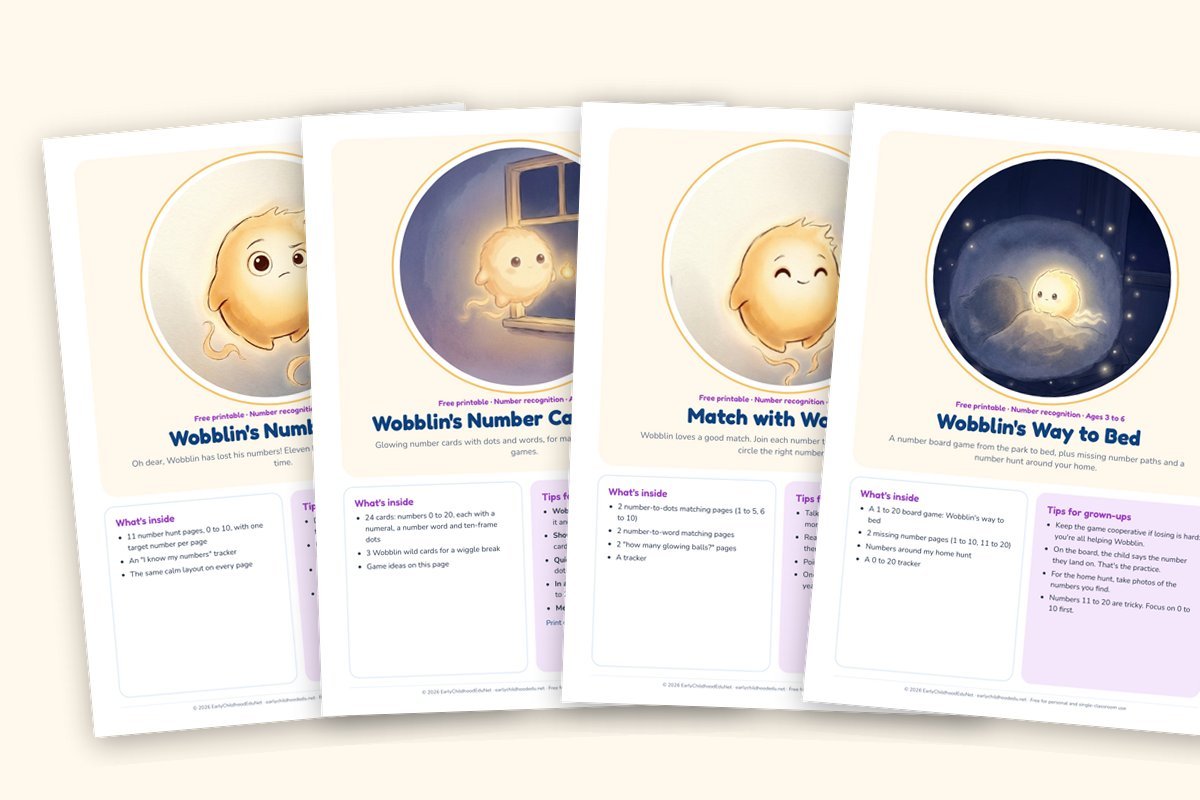
Four free number recognition packs
Number hunts, number cards 0 to 20, matching pages and a board game. Free, no email required.
Choose Your Free Pack ↓The Gap Between Counting and Recognising
Counting and number recognition feel like they should be the same skill, but they’re not. A child can recite “one, two, three, four, five” perfectly and still freeze when you point to a lone numeral 4 on a page and ask what it says.
Recognition is its own skill: matching a printed numeral to its name, and to the quantity it represents, without needing to count up to it first. It’s easy to assume this comes along for free once counting is solid, but it usually needs its own bit of direct, low-pressure practice.
These packs are built entirely around that gap, giving numerals space to become familiar on their own, not just as the last word in a counting sequence.
Four Free Number Recognition Packs, Starring Wobblin
Each pack opens with a guide for grown-ups and uses the same calm, predictable layouts throughout. Wobblin floats through every page with a speech bubble telling your child what to do. Start with whichever one suits your child, or work through all four.
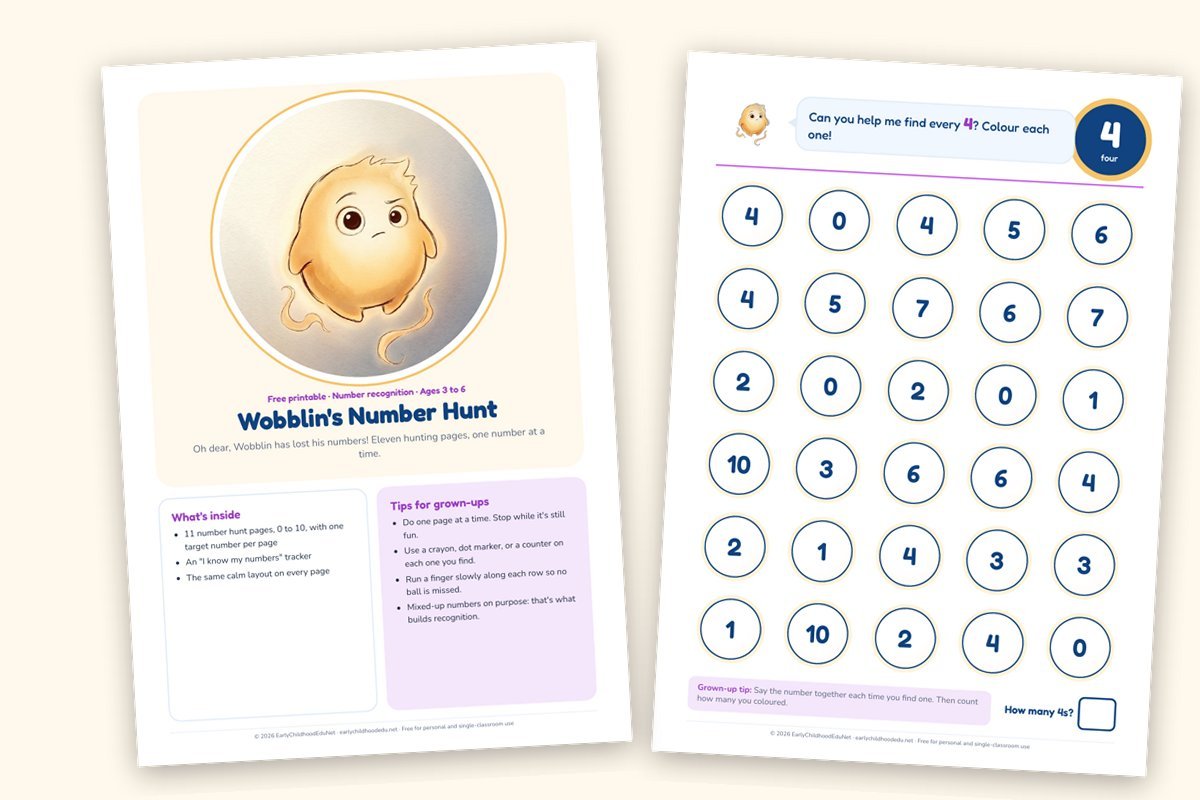
Wobblin’s Number Hunt
Eleven hunt pages, 0 to 10. One target number per page, hidden among mixed-up numbers in glowing balls. Find it, colour it, count how many.
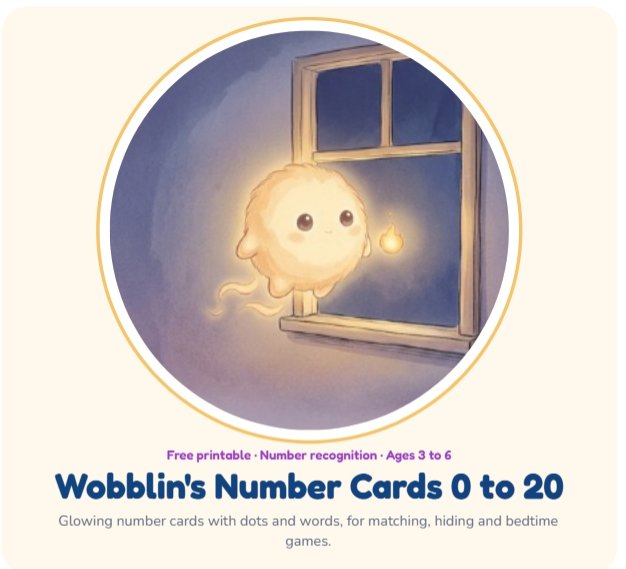
Wobblin’s Number Cards 0 to 20
Twenty-one number cards, each with the numeral, the number word and ten-frame dots, plus three Wobblin wiggle cards. Game ideas included.
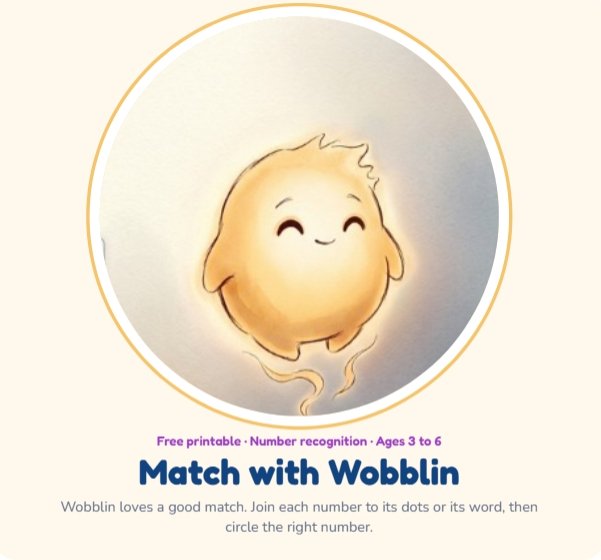
Match with Wobblin
Match numerals to ten-frame dots and to number words, then circle the right number for each group of glowing balls.
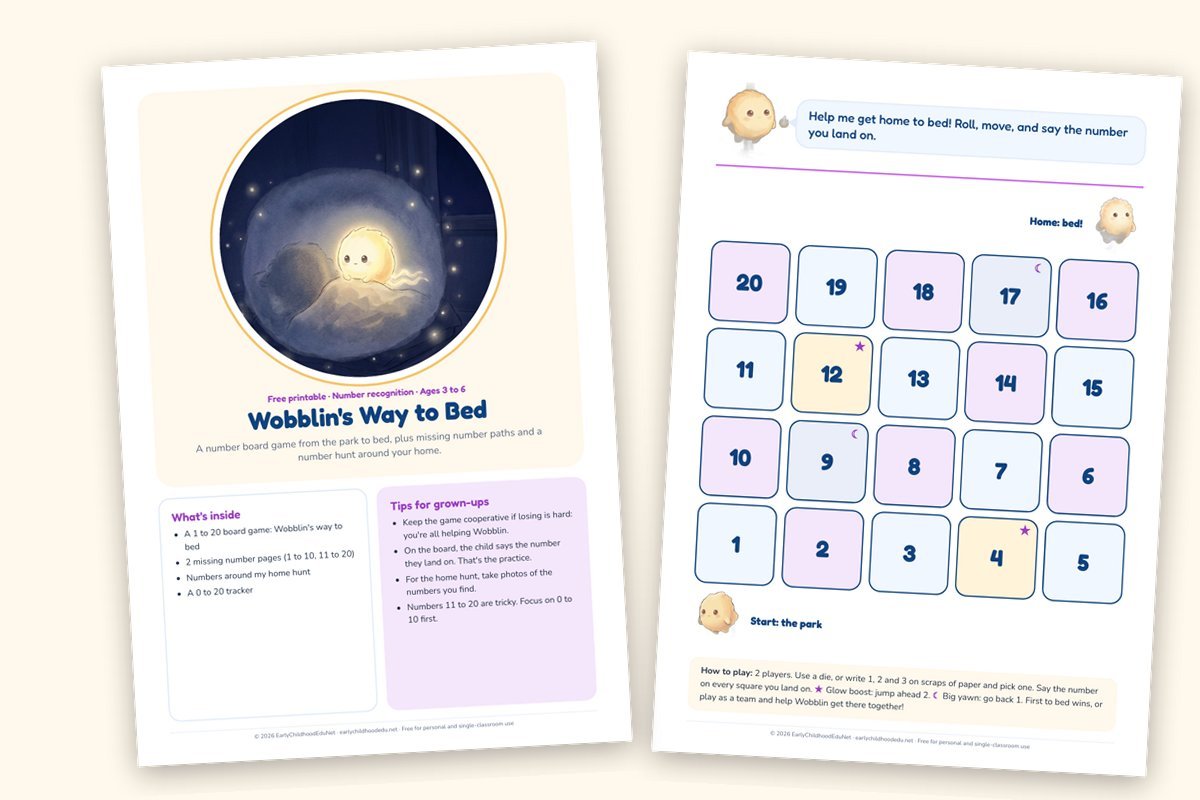
Wobblin’s Way to Bed
A 1 to 20 board game from the park to bed, missing number paths, a hunt for numbers around your home, and a 0 to 20 tracker.
Bonus: want to focus on one number at a time? Try the free Montessori number 4 worksheet set.
Who is Wobblin? Wobblin is a soft, glowing little character who appears across EarlyChildhoodEduNet printables. A friendly face asking for help (“Can you help me find every 4?”) can turn a worksheet into a small mission, which many children find easier to start than a plain instruction.
Why Number Recognition Deserves Its Own Practice
A child who only ever meets numerals inside a counting sequence always sees them in the same order and the same context. Recognition activities deliberately mix that order up. Numerals appear out of sequence, in different places and paired with different quantities, so a child learns to identify a numeral on its own rather than by what usually comes before or after it.
In the Australian Curriculum, the first year of school asks children to name, represent and order numbers including zero to at least 20 [1]. These packs cover exactly that: naming numerals (the hunts and cards), representing them with dots and words (the matching pages), and ordering them (the missing numbers and the board game).
Recognition sits alongside counting, not instead of it. If your child is still building one-to-one counting, start with my free counting activities for kids at home, and for the bigger picture see my guide to number sense activities.
How to Practise Number Recognition in Five Minutes a Day
- Start with 0 to 5. Get those feeling easy before adding 6 to 10. Numbers 11 to 20 come last.
- One page or one game. Five minutes of focused practice beats twenty minutes of struggle.
- Say it, see it, find it. Say the number, show the card, then ask your child to find it on the hunt page or around the room.
- Mix the order. Once your child knows a few numbers in order, show them out of order. That’s where real recognition starts.
- Link to quantity. After naming a numeral, ask “Can you show me that many?” with fingers, blocks or the ten-frame dots.
- Spot numbers in real life. Clocks, lifts, letterboxes, price tags. The Way to Bed pack has a home hunt checklist for this.
- Celebrate what they know. Colour in the tracker as numbers become easy, so your child can see their progress.
Number Recognition for Neurodivergent Kids
I have ADHD myself and I’m raising a daughter with ADHD, so these packs were designed with busy, sensitive and neurodivergent learners in mind. Every child is different, so take what helps and leave the rest.
- Same layout, every page. Each hunt page looks the same, so there’s nothing new to work out except the number.
- One target at a time. Each hunt page asks for just one number, which keeps the load on working memory low.
- Movement built in. The Wobblin wiggle cards and the board game get bodies moving. For more ideas, see my pocket heavy work cards.
- Many ways to answer. Pointing, placing a counter, stamping or colouring all count. Speech isn’t required.
- A friendly mission. Helping Wobblin can feel lower pressure than being tested. If starting is the hard part, try starting the task together.
- Co-operative games. If losing is hard, play the board game as a team helping Wobblin get to bed.
For more on how neurodivergent children build number understanding, see early maths and number sense for neurodivergent kids.
Common Number Mix-Ups and What Helps
| What you notice | What helps |
|---|---|
| Mixes up 6 and 9 | Very common. Talk about where the “ball” sits: at the bottom for 6, at the top for 9. Use the ten-frame dots on the cards to check. |
| Reads 12 as 21, or 15 as 51 | The teens are tricky because we say the second digit first (“four-teen”). Point to the 1 and say “ten”, then the other digit. |
| Writes numbers back to front | Very common in the early years. Focus on recognising first. Writing can come later. |
| Counts up from 1 to name a number | That’s a great strategy on the way to instant recognition. Keep practising mixed-up numbers and it usually fades. |
| Knows numbers on cards but not in real life | Use the home hunt page. Numbers on clocks and lifts look different, and that variety helps. |
Who These Packs Are For
- Parents whose child counts confidently but hesitates on standalone numerals
- Preschool and kindergarten teachers wanting quick, low-prep numeral recognition games
- Homeschooling families building a well-rounded early number routine
- Occupational therapists and tutors after simple, printable matching activities
Number Recognition FAQs
At what age do children recognise numbers?
Many children start recognising a few numerals, often their age and small numbers, around age 3 to 4. Most are working on 0 to 10 in preschool and kindergarten, and on numbers to 20 in their first year of school. Children vary widely, so follow your child.
What is the difference between counting and number recognition?
Counting is saying number words in order and matching them to objects. Number recognition is looking at a written numeral, like 7, and knowing its name and how many it means, without counting up to it first.
Are these number recognition worksheets free?
Yes. All four packs are free to download and print for your family or a single classroom, with no email sign-up required.
Do the worksheets print in black and white?
Yes. The pages are designed to work in black and white, and the numerals, dots and lines stay clear. Wobblin just looks a little more grey.
How can I help my child who keeps mixing up numbers?
Keep practice short, focus on a few numbers at a time, and mix the order once they know them in sequence. Mix-ups like 6 and 9, or 12 and 21, are very common and usually settle with time and playful practice.
More Ways to Build Number Skills
- Early maths activities hub
- Counting activities for kids at home
- Number activities for kids at home
- Number sense playdough mats 1 to 10
- Number line jumping game
- Math games for early learners
- Pattern activities for preschoolers
- Shape activities and early geometry
- Australian Curriculum, Assessment and Reporting Authority. (2022). Australian Curriculum: Mathematics, Version 9.0, Foundation (AC9MFN01). v9.australiancurriculum.edu.au