
Classroom Noise Sensory Overload: Four Ways to Soften a Loud Room
Classroom noise sensory overload is my phrase for what can happen when echo, sudden loud sounds and many voices at once make a room too hard to listen in. Some children, including some autistic children and children with ADHD, seem to find this especially tiring or distressing. It is a description, not a diagnosis.
I find it useful to ask about the room before I ask about a child’s behaviour.
When a four year old is hiding under the storage cubbies with their hands pressed against their ears, I find it helps to ask about the room before I ask about their behaviour.
- The School Hall Echo: What Happened to My Daughter at Six
- What the Research Says About Noise and Children
- Four Ways Noise Can Make a Room Harder
- A Note on Polyvagal Theory and the Ear
- Four Low Cost Ways to Soften a Loud Room
- Acoustic Buffers at a Glance
- Ear Defenders, Quiet Nooks and Gentler Signals
- Two Illustrations: A Wet Morning and a Wet Lunchtime
- Signs I Look For
- Printable A4 Acoustic Space Audit Sheet
- References
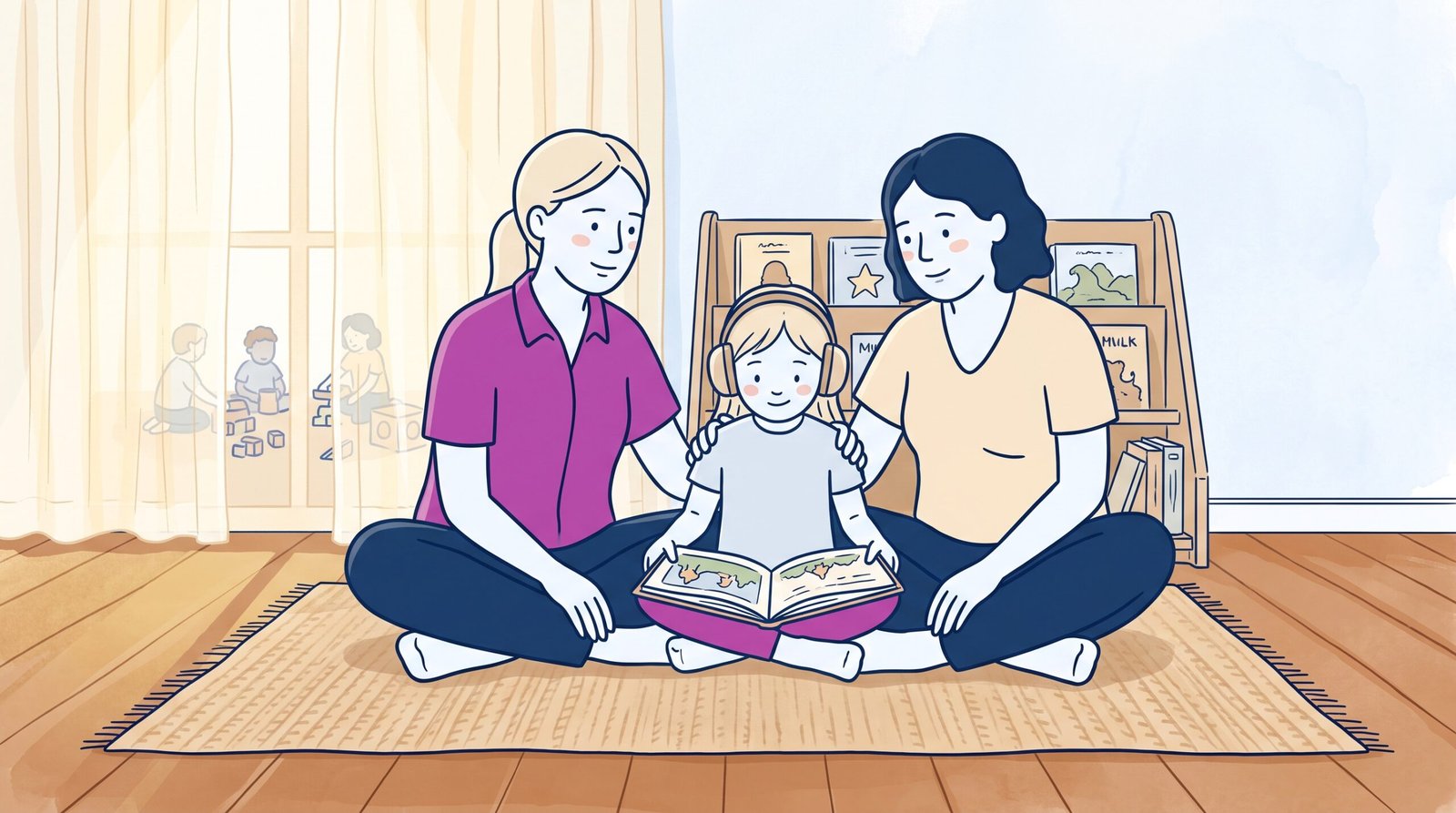
The School Hall Echo: What Happened to My Daughter at Six
When our family first moved to Melbourne, my eldest daughter was six and starting primary school, and her younger sister was four and a half and settling into kindergarten. As a young mother in a new city, I had no clinical vocabulary or community resources around neurodivergent development.
I did not know that my eldest and I were both living with undiagnosed ADHD.
On the open school grass, my six year old was joyful, cooperative and deeply engaged. She ran alongside other children, invented imaginative nature games and followed teacher prompts with ease.
But when her group moved inside to the multipurpose hall for wet weather lunch and indoor music, things unravelled. Within ten minutes she would press her back against the brick wall, slide down to the floor and shout at anyone who walked past.
When an educator approached her gently, she threw her shoes across the floorboards and curled into a tight ball, completely unreachable.
The first assumption was that she disliked group routines or struggled with transitions. When I visited the hall and sat on the floorboards myself, the room hit me straight away. High ceilings, polished timber floors and bare brick walls made the sound ring.
Dropped cutlery clattered, the overhead fluorescent lights hummed, and twenty four children singing and shuffling in runners merged into what felt like a roaring train tunnel.
At the time, everyday parenting felt like wading through deep water, and I felt out of my depth watching her distress. The dots only connected years later, when my daughter and I were both diagnosed with ADHD as adults.
Looking back, I believe the hall was simply too loud for her to listen in. I cannot know exactly what she experienced, but it fits what I now call classroom noise sensory overload.
What the Research Says About Noise and Children
I want to be careful here about what the research does and does not show. Most studies of noise and children look at test results, listening and memory. They are not about meltdowns, and they are mostly not about neurodivergent children in particular.
Bridget Shield and Julie Dockrell studied primary school children aged 7 and 11 in London. They found that classroom background noise was linked to lower test results, after accounting for social disadvantage, language and special educational needs.[1]
A review by Klatte and colleagues found that indoor noise and reverberation are associated with poorer performance on listening and verbal tasks in children. Young children also need a better signal to noise ratio than adults to understand speech, about 5 to 7 dB higher according to that review.[2]
In plain terms, it is harder for a young child to hear a teacher over background noise than it is for an adult.
For Australian rooms, the Association of Australasian Acoustical Consultants guideline for educational facilities gives a maximum reverberation time of 0.6 seconds and a background noise level of 35 to 40 dB LAeq for primary school teaching spaces.[3] Early childhood rooms may have different targets.
Children also differ in how strongly they notice and react to sound, which Winnie Dunn describes in her model of sensory processing.[4] I have not reviewed the research on noise sensitivity in autism or ADHD for this page, so what I say about neurodivergent children comes from my own experience.
Four Ways Noise Can Make a Room Harder
These are patterns I describe from practice. The middle column is my reading of what might be happening, not a tested explanation.
| What Can Happen in the Room | Why I Think It Is Hard | What I Often See |
|---|---|---|
| 1. Echo Sound bouncing off hard plaster, uncurtained glass windows and polished vinyl floors. |
Words can blur into their own echoes, so listening takes more effort. | Clenching teeth, covering ears, humming to block out sound, and irritability by mid morning. |
| 2. Voices rising As the room gets louder, children and educators speak louder to be heard, which pushes the noise up again. |
This is the Lombard effect: people raise their voices in noise without meaning to.[5] | Shouting during normal conversation, pacing, running across open spaces and climbing on furniture. |
| 3. Sudden loud sounds Cutlery dropping onto hard tables, a tub of blocks tipping onto floorboards, or chair legs screeching. |
A sudden bang can startle any of us, and some children seem to find it hard to settle afterwards. | Bolting for the door, hitting out, bursting into tears, or dropping to the floor. |
| 4. Many voices at once Several adults and small groups talking at the same time, with nothing to separate them. |
It can be hard to pick out one voice, and following instructions takes more effort. | Staring blankly, difficulty following two step directions, and what looks like defiance when spoken to. |
Stuart Shanker’s Self-Reg work describes stress as something that uses up a child’s energy, which is close to how I think about a loud afternoon.[6] When a child snaps at three o’clock, I wonder whether the day has been too loud for too long.
A Note on Polyvagal Theory and the Ear
During my doctoral years I met Stephen Porges’ polyvagal theory.[7] Porges proposes that two small muscles in the middle ear, the stapedius and tensor tympani, help tune hearing towards the human voice when a person feels safe, and that this tuning changes under threat.
Polyvagal theory is popular in trauma informed practice but contested. Grossman (2023) argues that its basic premises do not hold up,[8] and Neuhuber and Berthoud (2022) check it against what is known about the vagus nerve.[9] I use it as a lens for what I see, not as an explanation to rely on.
Four Low Cost Ways to Soften a Loud Room
You do not need expensive soundproofing. These four changes use things most homes and services already have. They come from my practice, not from a trial of this exact set, and I have not measured their effect, so treat them as things to try and watch.
Soften the Main Impact Zone
The floor is often the largest hard surface in a room. Footsteps, chair legs and wooden resources all strike it.
- Practical Actions: Place thick woven cotton rugs or natural jute runners along busy paths between active play zones and quiet corners. Put dense, low pile rugs under construction and block areas.
- What to Avoid: Long, bare corridors of linoleum between doorways, which can carry clatter across the room. Fix rugs with non-slip underlay so they do not become a trip hazard.
- Why I Try It: Soft, textured materials can take the sharpness out of dropped blocks and running feet.
Quieten Chairs and Tables
Metal furniture legs scraping on a hard floor are one of the sharpest sounds in many rooms.
- Practical Actions: Fit silicone caps with compressed felt bases to chair and table legs. Or cut a cross slit in a used tennis ball and slip it over the metal foot.
- What to Avoid: Cheap peel and stick felt pads, which in my experience collect hair and dust and slide off within days. Check that nothing loose can be pulled off and mouthed by young children.
- Why I Try It: Stopping metal from scraping on hard floors removes one source of sudden loud sound.
Break Up Bare Walls
When two smooth walls face each other, sound can bounce between them.
- Practical Actions: At child eye level, hang hessian pinboards, woven wall hangings, quilts or canvas displays, or stretch heavy cotton painter drop cloths over cheap timber frames. Display children’s paintings unlaminated.
- What to Avoid: Laminating every chart and poster, because glossy plastic is a hard surface too. Check your service’s fire safety rules before hanging fabric, and keep it away from heaters, lights and exits.
- Why I Try It: Soft, uneven surfaces may reduce echo, and reviews link echo with harder listening for children.[2]
Soften Echo From Above
In rooms with high ceilings, sound can gather overhead and carry on after it has been made.
- Practical Actions: Where your building and fire safety rules allow, suspend strips of unbleached calico or linen across high corners using secure fixings.
- What to Avoid: Hanging anything above children without checking the fixings, sprinklers, smoke detectors and your regulator’s guidance.
- Why I Try It: It may soften echo in tall rooms. I have not found measurements to cite for this one.
You can find more ideas in low cost sensory classroom setup.
Acoustic Buffers at a Glance
| Zone | What Happens | Low Cost Buffer | What I Hope For |
|---|---|---|---|
| Hard Floor Walkways Main paths |
Running feet and dropped wooden toys make sharp sounds on vinyl. | Washable rugs, jute runners and carpeted play zones. | Softer thuds and less echo. |
| Furniture Legs Chairs and tables |
Metal legs scrape across hard floors. | Felt based silicone boots or tennis ball feet. | Fewer sudden screeches. |
| Parallel Walls Bare plasterboard |
Sound can bounce back and forth between bare walls. | Hessian backing, woven wall hangings and unlaminated art. | Less echo and clearer speech. |
| Storage Tubs Toy tubs and shelves |
Plastic toys and wooden blocks tossed into hollow tubs are loud. | Lining shelves and bins with dense wool felt. | Quieter pack away times. |
Ear Defenders, Quiet Nooks and Gentler Signals
Changing the room is one half of it. Giving children some control over their own sound is the other:
- Keep Ear Defenders Within Reach Place two or three pairs of comfortable, child sized ear defenders on a low shelf. Teach children that they are everyday tools, not toys, and let them put them on and take them off without asking. I offer them as a choice for loud moments, not something to wear all day.
- Create a Quiet Reading Nook Surround a quiet corner with floor cushions, soft blankets and low bookshelves so it is a little quieter than the rest of the room. Make it opt in, never a consequence. There is a step by step guide in calm corner design in early childhood.
- Swap Whistles and Bells for Gentler Signals Avoid piercing whistles, high pitched timers and loud clapping to call attention. Dimming the lights, or playing two gentle notes on a wooden glockenspiel, can work well.
Two Illustrations: A Wet Morning and a Wet Lunchtime
These scenes are based on real moments, with the children’s names changed and some details altered. They show how the changes might feel in practice. They are not case studies.
A wet morning.
Picture a kindergarten room on a rainy Tuesday. Twenty two children are playing and three educators are circulating with clipboards, while every dropped block rings off the plasterboard walls. In the far corner a little boy has not picked up his paintbrush for twenty minutes, and his shoulders are up near his ears.
An educator kneels and asks if he wants blue or yellow paint. He does not answer. He tips the easel over and curls up under the drying rack. It would be easy to call this defiance. I would want to ask first whether the room is too loud for him.
A wet lunchtime, before.
It is twenty past twelve and raining. Twenty four children are eating at laminated tables. Lunchboxes click open, drink bottles drop onto hard floorboards and the talk rises with excitement. A little girl with ADHD covers her ears with both forearms and leans over her sandwich.
A classmate calls her name across the table, and in the echo it sounds harsh. She sweeps her lunchbox onto the floor, screams and kicks her chair. The educator reprimands her for throwing food.
The same lunchtime, after.
Same rain, same twenty four children. The chair legs have felt boots, cotton runners line the paths between tables, and hessian pinboards hang on opposite walls. The overhead lights are off in favour of warm floor lamps. The room is still lively, but it is quieter.
The same little girl eats her sandwich. When her classmate speaks to her, she hears him clearly, smiles and answers quietly. I cannot promise that changes like these would lead to this outcome. It is what I hope for when I plan a room.
This is the idea behind regulation before learning: when we ease the room first, children may not have to spend all their energy just getting through it.
Signs I Look For
Children rarely say, “The echo in this room is exhausting me.” Instead, their bodies often show it. These signs can have many causes, not only noise, so I treat them as a prompt to look at the room and check in with the child, not as a diagnosis:
- Slumping Slumping over tables, resting the forehead on a cold surface, or curling up under low furniture.
- Watchful Scanning Darting eyes, a rigid neck, or startling when a door clicks shut or a plastic tub is dropped across the room.
- Guarding the Ears Pressing palms against ears, pulling a hood down over the face, or chewing on collars and sleeves.
- Going Quiet Shifting from active participation to not speaking or responding when addressed by name.
Noticing these signs early may let us dim the lights, offer ear defenders or guide the child to a quiet nook before a meltdown builds. For what to do once one has started, see child meltdown co-regulation, and for a child who freezes at the start of a task, see why an ADHD child will not start tasks.
Printable A4 Acoustic Space Audit Sheet
A template I wrote for a classroom walkthrough, to help you spot sound bounce hotspots and plan low cost changes. It is my own checklist from practice, not a validated tool.
Classroom Acoustic Space Audit
EarlyChildhoodEdu.net | Environmental Sensory Mapping Tool
Floor Surfaces
Are primary walkways and block areas carpeted, or bare vinyl?
Furniture Feet
Do chair and table legs have felt/silicone protection fitted?
Wall Textures
Are parallel walls broken up with hessian, fabric, or porous art?
Quiet Retreat
Is there a low-decibel sanctuary away from high-traffic doors?
This guide is my own framing, built from practice and the sources below. It is not a tested intervention, and the audit sheet is my own checklist, not a validated tool.
Research: classroom noise is linked to lower test results in primary school children (Shield and Dockrell, 2008), and indoor noise and echo with poorer listening and verbal performance (Klatte and colleagues, 2013). Australian acoustic guidance gives a maximum reverberation time of 0.6 seconds for primary teaching spaces (AAAC, 2018).
Contested: polyvagal theory. Experience: the four buffers, the signs, the two scenes (based on real moments, with names changed) and my family’s story. I have not reviewed research on noise sensitivity in autism or ADHD for this page. Last reviewed: 19 October 2026.
References
- Shield, B. M., & Dockrell, J. E. (2008). The effects of environmental and classroom noise on the academic attainments of primary school children. The Journal of the Acoustical Society of America, 123(1), 133–144. https://pubmed.ncbi.nlm.nih.gov/18177145/
- Klatte, M., Bergström, K., & Lachmann, T. (2013). Does noise affect learning? A short review on noise effects on cognitive performance in children. Frontiers in Psychology, 4, Article 578. https://doi.org/10.3389/fpsyg.2013.00578
- Association of Australasian Acoustical Consultants. (2018). Guideline for educational facilities acoustics (Version 2.0). https://aaac.org.au/resources/Documents/Public/AAAC%20Guideline%20for%20Educational%20Facilities%20Acoustics%20V2.0.pdf
- Dunn, W. (2014). Sensory Profile 2: User’s manual. Pearson.
- Lombard, E. (1911). Le signe de l’élévation de la voix. Annales des Maladies de l’Oreille, du Larynx, du Nez et du Pharynx, 37, 101–119.
- Shanker, S. (2016). Self-reg: How to help your child (and you) break the stress cycle and successfully engage with life. Penguin Random House.
- Porges, S. W. (2011). The polyvagal theory: Neurophysiological foundations of emotions, attachment, communication, and self-regulation. W. W. Norton & Company. [A contested model, used here as a lens].
- Grossman, P. (2023). Fundamental challenges and likely refutations of the five basic premises of the polyvagal theory. Biological Psychology, 180, Article 108589. https://doi.org/10.1016/j.biopsycho.2023.108589
- Neuhuber, W. L., & Berthoud, H.-R. (2022). Functional anatomy of the vagus system: How does the polyvagal theory comply? Biological Psychology, 174, Article 108425. https://doi.org/10.1016/j.biopsycho.2022.108425