
Autistic Masking: Should Autistic People Have to Change to Fit into Society? 6 Easy Swaps That Help
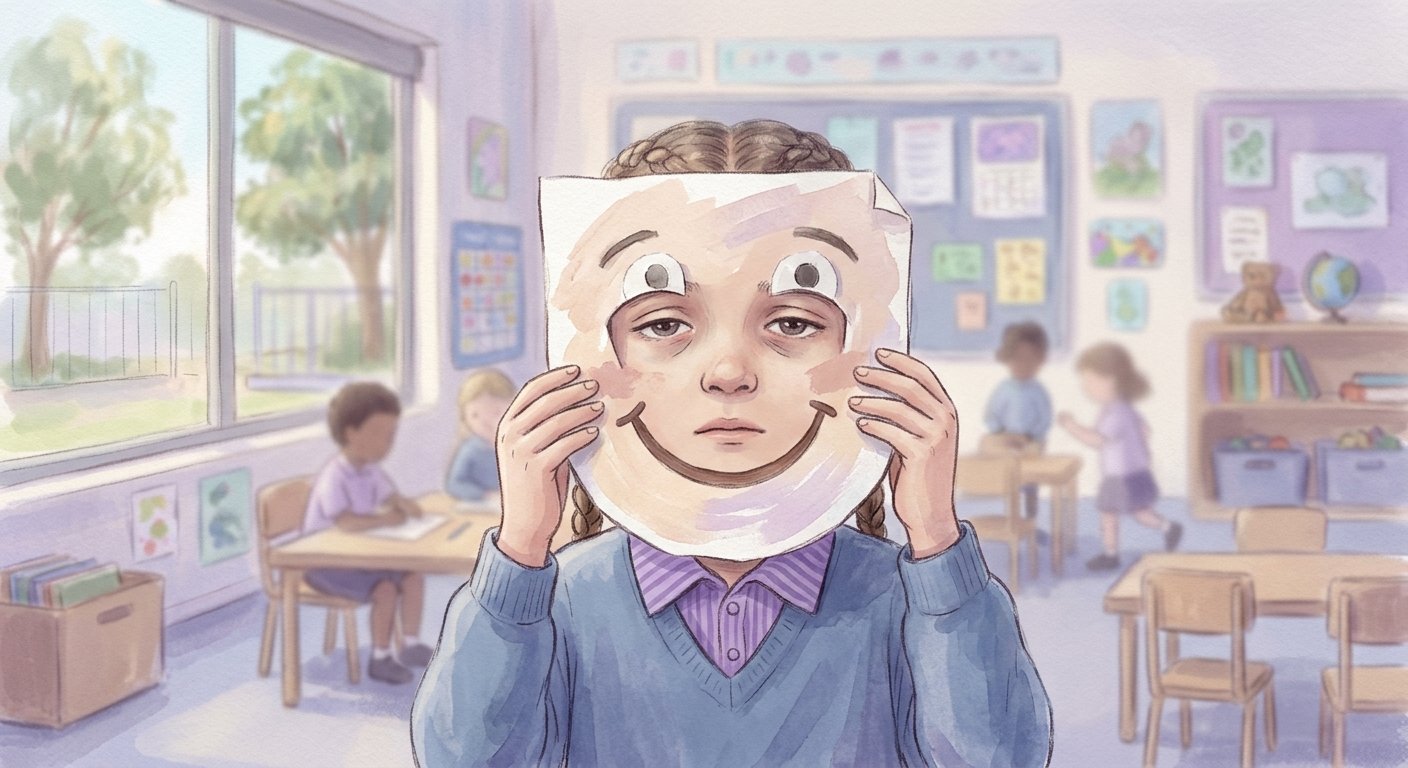
Autistic masking is when an autistic person hides or holds back their natural ways of moving, talking, looking and reacting so that they seem less autistic to others. Many do it because the world expects them to. It can help them get by in the moment, but research links it with exhaustion, anxiety and poorer mental health.
This article looks at six everyday expectations, from “Look at me when I’m talking to you” to “Why bring children out if they can’t behave?” It explains what masking is and why children start doing it. It separates fair boundaries from pressure to mask, covers eye contact, movement and ADHD, and offers six easy expectation swaps. It includes a free Expectation Swap Cards printable and twelve related free PDFs.
“Look at me when I’m talking to you.” Most of us have heard it, and many of us have said it. It sounds like a simple request for respect. But for some children, looking at you is the very thing that stops them from hearing you.
Before you read on, think back to a time you saw a child in the community who didn’t behave the way you expected. A child who wouldn’t look at the adult speaking to them. A child rocking or flapping in a queue. A child playing alone at a party.
What did you feel? Maybe puzzlement, mild discomfort, worry for the child, or frustration on behalf of the adult.
What did your mind tell you? Perhaps “that’s rude”, “they need to learn manners” or “why won’t they just join in?”
What did you do? Did you say something, look away, encourage the child to “be normal”, or simply let them be?
Keep that moment in mind. Most of us were raised with the same expectations. By the end, you may wonder what that child was holding together, and what it cost them.
- How This Article Helps
- Two Everyday Moments
- Four More Everyday Expectations
- The Five Steps
- What Is Autistic Masking?
- Masking in Children
- Why Do Autistic People Mask?
- What Masking Costs
- Eye Contact and Autism
- Movement, Stimming and ADHD
- Inclusion, Fair Boundaries and Pressure to Mask
- So, Who Should Change?
- 6 Easy Expectation Swaps
- For Parents, Educators and the Community
- Free Printable: Expectation Swap Cards
- More Free PDFs
- FAQs
How This Article on Autistic Masking Helps
- Understand autistic masking, what it looks like in children and adults, and why people do it.
- See what it costs, based on research with autistic people themselves.
- Tell the difference between fair boundaries and pressure to look “less autistic”.
- Try six easy swaps that make room for children without lowering expectations.
- Print free cards to share with family, educators and support workers.
There’s a finding about eye contact further down this page that surprised me the first time I read it. It comes from autistic teenagers and adults describing in their own words what eye contact feels like. When you reach that section, the opening line of this article will read very differently.
This is the second article in the Everyday Stories. Lived Experiences. Better Understanding. series, part of our Inclusion Beyond the Classroom hub. The first article looked at what happens when an autistic child melts down in public.
Two Everyday Moments Behind Autistic Masking
Both of these are moments I’ve witnessed myself. I don’t know whether the children involved were autistic, and that isn’t the point. The point is the expectation underneath each one, because autistic children meet these expectations every day.
In a classroom. An educator I worked alongside assumed the children in front of her weren’t listening. She said, “Look at me when I’m talking to you.”
The expectation: listening must look a certain way.
A more inclusive response: understand that eye contact is not a reliable measure of attention or respect.
In a GP clinic waiting room. I heard a parent say to their child, “Sit still. You are too old to behave like that.”
The expectation: the child must keep their body still to appear polite.
A more inclusive response: consider whether movement helps the child feel comfortable and take part.
Neither adult was being cruel. Both were doing what most of us were taught: that good children look at adults and keep their bodies still. But for autistic children, and many children with ADHD, those rules ask them to hide the very things that help them cope. That is how autistic masking often begins.
Four More Everyday Expectations That Push Children to Mask
The two moments above aren’t unusual. Here are four more situations many autistic people and families describe. These are general examples rather than one family’s story, and each follows the same pattern: an expectation, and a more inclusive response.
At a birthday party. An autistic child prefers to play alone rather than join the other children. An adult says, “Go and play with everyone. Don’t be antisocial.”
The expectation: every child should enjoy group play.
A more inclusive response: allow different ways of taking part. Watching, playing alongside others or taking a break can all be meaningful participation.
Birthday parties pack a lot into a small space: loud music, games with changing rules, crowds of children, unfamiliar food and the pressure to look happy. For an autistic child, playing alone with the Lego in the corner may be the thing that lets them stay at the party at all. Playing beside others, or watching from the edge, is how many children learn the rhythm of a group before they join in. Calling it “antisocial” teaches a child that their way of enjoying the party is wrong, and that next time they should hide it. That is autistic masking in the making. A gentler line is, “You can come and join us whenever you’re ready.”
When plans change. A family member says to an upset child, “You can’t always have things your way. Just get over it.”
The expectation: the child should accept changes immediately.
A more inclusive response: give clear explanations, allow processing time and help the child understand what happens next.
For many autistic children, predictability is what makes the world feel safe. A cancelled swimming lesson or a different route home isn’t a small thing when you’ve been holding the plan in your head all day. The upset is about losing their footing, not getting their own way. Saying “get over it” asks the child to hide that distress, which is autistic masking by another name. What helps is the opposite: tell them what’s changed and why, give them a little time, and show them what happens next. Our First Then starter tiles and countdown cards can make a new plan visible, so the child has something solid to hold onto.
A direct answer. An autistic teenager answers a question directly, without smiling or using the expected social expressions. Someone responds, “You don’t have to be so rude.”
The expectation: communication must follow familiar social conventions.
A more inclusive response: consider differences in communication style before assuming someone means to offend.
Many autistic people communicate in a clear, direct way. They answer the question that was asked, without the softening phrases, smiles and small talk that others expect. That is a different style, not rudeness, and the double empathy problem described below suggests the misunderstanding runs both ways. When an autistic teenager is told again and again that they sound rude, they often start rehearsing every sentence and copying other people’s expressions. That is exactly the effortful autistic masking that research links with exhaustion. Asking “What did you mean by that?” works far better than assuming the worst.
Leaving a restaurant early. A family leaves because their child is becoming overwhelmed by the noise. Another customer comments, “Why bring children out if they can’t behave?”
The expectation: families should stay in public spaces even when the environment is too hard.
A more inclusive response: understand that leaving can be a sensible way to support a child’s needs, not a parenting failure.
This one shows how the pressure to mask reaches whole families, not just children. Leaving early is often the wisest thing a parent can do: they’ve noticed the early signs of overload and acted before it became a meltdown. Yet the comment suggests the family shouldn’t have come at all. If families hear that often enough, many simply stop going out, and the child loses the chance to practise the very things that make outings easier. Our Out and About Together plan includes an agreed break signal, so leaving early can be part of the plan rather than a sign that it failed.
Look at all six examples together and a pattern appears. Each one asks a child, or a family, to look a certain way so that others feel comfortable. None of them is about safety. That’s the heart of autistic masking: not a single big demand, but hundreds of small ones.
The Five Steps: Everyday Stories. Lived Experiences. Better Understanding.
Every article in this series works through a situation in the same five steps. This is the classroom moment.
What happened
An educator was talking to a group of children. Some were looking away, at the floor, out the window or at their hands. She took this to mean they weren’t listening and told them to look at her.
What did people assume
That eye contact shows attention and respect, and that looking away shows the opposite. It’s one of the most common assumptions adults make about children, and it’s built into many classroom routines.
What might we not understand
For some children, especially autistic children, eye contact can be uncomfortable, distracting or even overwhelming. Looking away may be how they free up enough attention to actually listen. In some cultures, lowering your eyes with an adult is also a sign of respect.
What could have helped
Checking understanding in another way: asking a question, watching whether children follow the instruction, or simply saying, “You can look wherever helps you listen.”
What can we learn
When we judge attention by how it looks, we can teach children to perform listening instead of doing it. Over time, that performance becomes a mask.
What Is Autistic Masking?
Autistic masking, sometimes called camouflaging, is when an autistic person hides, holds back or covers up autistic traits to fit in with non autistic people. It can be deliberate or so practised that it happens automatically. Common examples include:
- Forcing eye contact, or looking at someone’s forehead or mouth instead.
- Holding back stims like rocking, flapping or humming.
- Rehearsing conversations and copying other people’s phrases, tone or facial expressions.
- Hiding intense interests or pretending to like things others like.
- Putting up with painful noise, light, clothing or touch without saying anything.
- Smiling and saying “I’m fine” when overwhelmed.
In a well known study, autistic adults described masking as “putting on my best normal”. They said it helped them get through social situations, make friends and find work. But they also said it left them drained, anxious and, for some, unsure who they were underneath.1
Researchers Amy Pearson and Kieran Rose, who is autistic himself, have argued that autistic masking is best understood as a response to stigma. People mask because being openly autistic has so often led to bullying, exclusion or punishment. They describe the “choice” to mask as something of an illusion: when not masking carries serious costs, it isn’t much of a choice at all.2
Autistic Masking in Children
Masking doesn’t start in adulthood. Children learn very early which of their behaviours earn smiles and which earn frowns. A child told again and again to “use quiet hands” or “look at me” learns that their natural way of being is a problem to hide.
Many parents describe the same pattern: a child who seems settled at kinder or school, then falls apart the moment they get home. Educators may say “she’s fine here”, and parents may start to doubt themselves. Often, the child has been masking all day. Home is the first safe place to let it go.
Masking also helps explain why many autistic children, especially girls, are identified late. When a child works hard to blend in, the signs adults are looking for may be hidden. Our article on autism in girls explores this in more depth.
Why Do Autistic People Mask?
Because the world often asks them to. In 2026, Autism Spectrum Australia (Aspect) commissioned a YouGov survey. It found that 24% of Australian adults expect autistic people to adapt their behaviour to fit into society.3 Aspect’s CEO Jacqui Borland said too many autistic people still feel pressure to change their behaviour just to be accepted.
Michael Theo, an autistic actor and autism consultant with Aspect, put it simply: people on the spectrum don’t want special treatment, they want the same things as everybody else.3
There’s also a two way problem here. Autism researcher Damian Milton described the “double empathy problem”: when autistic and non autistic people misunderstand each other, the gap goes both ways.4 If that’s true, it doesn’t make sense to ask only one side to change. Autistic masking puts the whole job of bridging the gap on the autistic person.
What Autistic Masking Costs
Masking takes effort, and effort uses energy. Many autistic adults describe masking as like running a programme in the background all day, monitoring their face, voice, body and words while also trying to follow the conversation.
Research backs up what autistic people have long said. In the “best normal” study, camouflaging was linked with exhaustion and anxiety.1 A UK study of autistic adults found that camouflaging was one of the factors associated with a higher risk of suicidal thoughts and behaviours.5 That doesn’t mean masking causes these outcomes on its own, and the research is still growing. But it’s a serious signal that constantly hiding who you are can take a toll.
For children, the cost often shows up as after school meltdowns, trouble sleeping, refusing to go to kinder or school, or big reactions to small things at home. If your child seems to fall apart at the end of the day, it may be the mask coming off. Our article on autistic child meltdowns in public looks at overwhelm from another angle.
When to get more help. A child or adult may seem exhausted, withdrawn or very anxious, or a child may often fall apart after kinder or school. If so, talk with your GP, paediatrician, psychologist or the person’s NDIS supports. If you or someone you know is in crisis or thinking about suicide, call Lifeline on 13 11 14 or 000 in an emergency.
Eye Contact and Autism
This is the finding I mentioned earlier. In a study that analysed first hand accounts from autistic teenagers and adults, many described eye contact as uncomfortable, and some described it as intense, overwhelming or even painful. Several said that making eye contact made it harder to understand what the other person was saying.6
Go back to the opening line: “Look at me when I’m talking to you.” For some children, that request splits their attention. Part goes on coping with eye contact, and part on listening to the words. The adult may get the look they asked for, and lose the listening they actually wanted.
Eye contact also isn’t a universal sign of respect. In some cultures, children are taught to lower their eyes when an adult is speaking. A child who looks away may be showing exactly the respect they were taught at home.
That doesn’t mean eye contact is bad, or that we should never mention it. Some autistic people are comfortable with eye contact, and some choose to use it in particular situations. The shift is simply to stop using it as the measure of whether someone is listening.
Movement, Stimming and ADHD
Now the waiting room. “Sit still. You are too old to behave like that.”
Stimming, short for self stimulatory behaviour, includes rocking, bouncing, flapping, spinning, tapping or humming. For many autistic people, stimming helps them regulate, focus, cope with stress or express joy. Asking a child to stop stimming can take away one of their main coping tools at the exact moment they need it. A busy waiting room before a doctor’s appointment is a good example.
Movement matters for children with ADHD too. One study found that children with ADHD moved more during tasks that demanded working memory, and that this extra movement was linked with better performance for them, not worse.7 So for some children, wriggling may be part of how their brain stays switched on.
Children with ADHD can mask as well, holding themselves rigidly still or copying others to avoid being told off. That effort can leave little energy for anything else. Our guide to ADHD behaviour strategies looks at this from the home and learning side.
A practical alternative to “sit still” is “find a way to wait that works for your body.” A fidget, a wobble cushion, standing near the wall, pushing palms together or carrying something heavy can all help. Our Pocket Heavy Work cards fit in a bag and give quick movement ideas for waiting rooms and queues. The Calm Shapes breathing cards offer a quieter option.
Inclusion, Fair Boundaries and Pressure to Mask
Does accepting autistic children mean there are no expectations at all? No. Every child needs boundaries that keep them and others safe and help them get along with people. The question is whether an expectation is about safety and kindness, or about making a child look less autistic so others feel comfortable.
| Fair boundary | Pressure to mask |
|---|---|
| “We don’t hit people.” | “Stop flapping your hands.” |
| “Stay with me in the car park.” | “Sit still and stop wriggling.” |
| “Use a kind voice with your sister.” | “Look at me when I’m talking to you.” |
| “It’s someone else’s turn now.” | “Stop talking about trains, nobody’s interested.” |
| “Please wait here until the doctor calls us.” | “You’re too old to behave like that.” |
The left column protects people and relationships. The right column mostly protects other people’s comfort. Fair boundaries can be taught with patience and visual supports. Our First Then Regulation Reset Mats are one way to make expectations clear without shame.
It’s also fair for autistic people to learn skills that help them, like ways to ask for a break or explain what they need. The difference is who those skills serve. Skills that help a child take part are support. Rules that only help a child look “normal” are pressure to mask.
So, Should Autistic People Have to Change to Fit In?
Everyone adapts a little to the people around them. Autistic people do, and so does everyone else. The problem with autistic masking is who carries most of the load, and what it costs them.
A fairer answer might sound like this: autistic people shouldn’t have to hide who they are to be included. Everyone, autistic and non autistic, can learn a little about each other and meet somewhere in the middle. In practice, that means the non autistic majority, which holds most of the power in classrooms, shops and workplaces, does more of the adjusting than it does now.
That’s what autism acceptance looks like in everyday life. Not a world with no expectations, but one where looking away, wriggling, stimming and talking about trains are seen as differences rather than problems.
6 Easy Expectation Swaps That Reduce Autistic Masking
You don’t need to change everything at once. Start with one swap and notice what happens. All six are on our free Expectation Swap Cards, ready to print and share.
Eye contact
Instead of: “Look at me when I’m talking to you.”
Try: “You can look wherever helps you listen.”
Check understanding by asking a question or watching what the child does next.
Sitting still
Instead of: “Sit still. You’re too old to behave like that.”
Try: “Find a way to wait that works for your body.”
Offer a fidget, a wall to lean on or a quiet spot to stand.
Quiet hands
Instead of: “Quiet hands.”
Try: Nothing at all, unless the movement is unsafe.
If it’s unsafe, offer a safe alternative instead of just stopping it.
Joining in
Instead of: “Go and play with the other kids.”
Try: “You can watch first, or play beside them.”
Playing alongside is still playing.
Big interests
Instead of: “Nobody wants to hear about dinosaurs again.”
Try: “Tell me one thing about dinosaurs, then it’s my turn.”
Interests are a bridge to connection, not a problem to shut down.
“I’m fine”
Instead of: accepting “I’m fine” at face value after a long day.
Try: “You did a lot today. Do you want quiet time first?”
Give a child permission to drop the mask at home.
For Parents, Educators and the Community
For parents
Make home a mask free zone where you can. Expect that your child may be tired, irritable or flat after kinder, school or a busy outing, and build in quiet time before questions or chores. Our Reading Feelings Thermometer can help a child show how full their “cup” is without needing many words. Share the swaps in this article with grandparents and other carers so the same expectations travel with your child.
For educators
Look at your everyday routines. Which ones ask children to look a certain way, rather than to learn or stay safe? Mat time, lining up and waiting are common places where masking is expected. Offer options: wobble cushions, standing spots, fidgets, and permission to look away. Tell families honestly when a child seems to be holding it together, so they understand what they’re seeing at home. Our guide to the sensory environment has more ideas.
For the community
In shops, waiting rooms, cafés and on public transport, try not to read stimming, looking away or wriggling as rudeness. If a child is flapping, rocking or humming in a queue, the most helpful thing you can do is let it be. That small choice tells a child, and their parent, that they don’t need a mask to be here.
You can also support children to say who they are in their own words. Our free All About Me storybook lets a child share what they love, what’s hard and what helps, without anyone speaking for them.
Free Printable: Expectation Swap Cards for Autistic Masking
Six everyday expectations, each with a more inclusive swap, plus two blank cards for your own. Print, cut and share with family, educators and support workers.
Download the Free PDFExpectation Swap Cards
Small changes in what we say, so children don’t have to hide who they are
How to Use the Expectation Swap Cards
- Print the sheet and read the six cards on your own first. Notice which “Instead of” lines you hear yourself say most often. Nobody is judging; most of us were raised on these phrases.
- Pick just one swap to practise this week. Cut it out and stick it somewhere you’ll see it, like the fridge, the car dashboard or the room’s planning wall.
- Use the two blank cards for expectations specific to your child or room, such as “Hold my hand” in a car park or “Say hello to Nana”. Ask yourself whether each one keeps people safe and kind, or mostly keeps others comfortable, and write a swap if it’s the second.
- Share the cards with grandparents, educators, support workers and anyone else who spends time with your child, so the same expectations travel with them.
- After a few weeks, look back. Has your child seemed less tired, or more relaxed after outings? Keep the swaps that help and add new ones. Educators can use the cards in staff meetings to review room routines together.
More Free PDFs for Acceptance and Regulation
First Then Regulation Reset Mats
Clear expectations without shame.
Download PDFUse with: fair boundariesAll About Me Storybook
A child tells their own story.
Download A4 PDFFor families and educatorsFight, Flight, Freeze Spotter Card
Spot stress behind the mask.
Download PDFFor carers and educatorsMore free tools are on our printables page.
Back to the Two Moments
A classroom where children were told to look up. A waiting room where a child was told to sit still. Two small sentences, said without any harm intended. Multiply them by every day of a childhood, and you can see how autistic masking takes shape.
The swaps are just as small. “You can look wherever helps you listen.” “Find a way to wait that works for your body.” Said often enough, they teach children something more useful than how to look normal. They can be themselves and still belong.
Now go back to the moment you remembered at the start.
What might have been going on for that child? Eye contact that made listening harder, movement that kept them calm, a party that was simply too much?
What might your mind say now? Perhaps “that’s how they cope” or “they’re taking part in their own way”.
What might you do next time? Let them look where they need to, let them move, or invite them to join “whenever you’re ready”.
- Hub: Inclusion Beyond the Classroom
- Previous: autistic child meltdown in public
- Next in the series: Understanding Sensory Overload: What Others May Not See
- Girls: autism in girls
- Profiles: spiky profiles in neurodivergent children
- Sensory: sensory seeking and proprioception
Autistic Masking FAQs
What is autistic masking?
Autistic masking, or camouflaging, is when an autistic person hides or holds back autistic traits so they seem less autistic to others. Examples include stopping stims, forcing eye contact or not talking about intense interests. It can be deliberate or automatic.
Do young children mask?
Yes. Children can learn early which behaviours adults frown on and start hiding them. A common sign is a child who seems settled at kinder or school but falls apart at home, where they finally feel safe to stop masking.
Is masking harmful?
Masking can help people get through social situations, but research with autistic adults links it with exhaustion, anxiety and poorer mental health. Constantly hiding who you are takes a lot of energy.
Should I stop asking my child to make eye contact?
For many autistic children, yes, or at least stop using it as a sign they’re listening. Many autistic people say eye contact is uncomfortable and makes it harder to follow what’s being said. Check understanding in other ways instead.
Does accepting autistic children mean no rules?
No. Children still need boundaries that keep people safe and help them get along with others. The difference is between expectations about safety and kindness, and rules that only make a child look less autistic so others feel comfortable.
Research: Hull and colleagues on camouflaging, Pearson and Rose on masking and stigma, Aspect’s 2026 YouGov survey, Milton on the double empathy problem, Cassidy and colleagues on risk markers in autistic adults, Trevisan and colleagues on eye contact, and Sarver and colleagues on movement in ADHD. Research on masking in young children is still limited, and much of what we know comes from autistic adults looking back.
Experience: the classroom moment and the GP waiting room moment are things I witnessed myself. I don’t know whether the children involved were autistic, and no other details have been added. The four further examples (the birthday party, the change of plans, the direct answer and the restaurant) are general illustrations of situations many families describe, not specific memories.
This is educational content, not medical advice. Last reviewed: 12 November 2026.
References
- Hull, L., Petrides, K. V., Allison, C., Smith, P., Baron-Cohen, S., Lai, M.-C., & Mandy, W. (2017). “Putting on my best normal”: Social camouflaging in adults with autism spectrum conditions. Journal of Autism and Developmental Disorders, 47(8), 2519-2534. https://doi.org/10.1007/s10803-017-3166-5
- Pearson, A., & Rose, K. (2021). A conceptual analysis of autistic masking: Understanding the narrative of stigma and the illusion of choice. Autism in Adulthood, 3(1), 52-60. https://doi.org/10.1089/aut.2020.0043
- Autism Spectrum Australia. (2026, April 2). One in four Australians believe Autistic people should adapt behaviour to fit into society [Media release]. https://www.aspect.org.au/news/one-in-four-australians-believe-autistic-people-should-adapt-behaviour-to-fit-into-society
- Milton, D. E. M. (2012). On the ontological status of autism: The “double empathy problem”. Disability & Society, 27(6), 883-887. https://doi.org/10.1080/09687599.2012.710008
- Cassidy, S., Bradley, L., Shaw, R., & Baron-Cohen, S. (2018). Risk markers for suicidality in autistic adults. Molecular Autism, 9, 42. https://doi.org/10.1186/s13229-018-0226-4
- Trevisan, D. A., Roberts, N., Lin, C., & Birmingham, E. (2017). How do adults and teens with self-declared autism spectrum disorder experience eye contact? A qualitative analysis of first-hand accounts. PLoS ONE, 12(11), e0188446. https://doi.org/10.1371/journal.pone.0188446
- Sarver, D. E., Rapport, M. D., Kofler, M. J., Raiker, J. S., & Friedman, L. M. (2015). Hyperactivity in attention-deficit/hyperactivity disorder (ADHD): Impairing deficit or compensatory behavior? Journal of Abnormal Child Psychology, 43(7), 1219-1232. https://doi.org/10.1007/s10802-015-0011-1
