
What Makes an Inclusive Playground? 3 Easy Questions and 6 Gentle Ways Every Family Can Help
An inclusive playground is a play space where children of all abilities can get there, play together and stay as long as they like. That includes autistic children, children with ADHD, children with sensory differences and children who use wheelchairs or other aids.
This article starts with a moment from your own playground visits. Then it walks through a playground scene, the three questions behind inclusive design, sensory and physical access, the social side, and what parents can do. It includes a free Playground Check Card and twelve related free PDFs.
Bella climbed everything, ran off fast, hated waiting for a turn and could swing and spin for ages. Zara hugged other children so hard they toppled over. Playgrounds were never quiet for us.
Neither of my girls is autistic. Bella has ADHD, diagnosed in her twenties, and I was diagnosed in my forties. But our playground days taught me a lot about what children need from a play space, and what other families and children need from each other.
So before you read on, think back to a time at a playground when a child caught your attention. A child pushing in at the swings. A child spinning alone for a long time. A child flapping their hands at the top of the slide. A child in a wheelchair watching from the edge.
What did you feel? Maybe worry for your own child, annoyance, curiosity or sympathy.
What did your mind tell you? Perhaps “that child is too rough”, “where is their parent?” or “that’s sad, but what can I do?”
What did you do? Did you move your child away, say something, or help the children play together?
Keep that moment in mind. By the end of this article on what makes an inclusive playground, you might see that child a little differently.
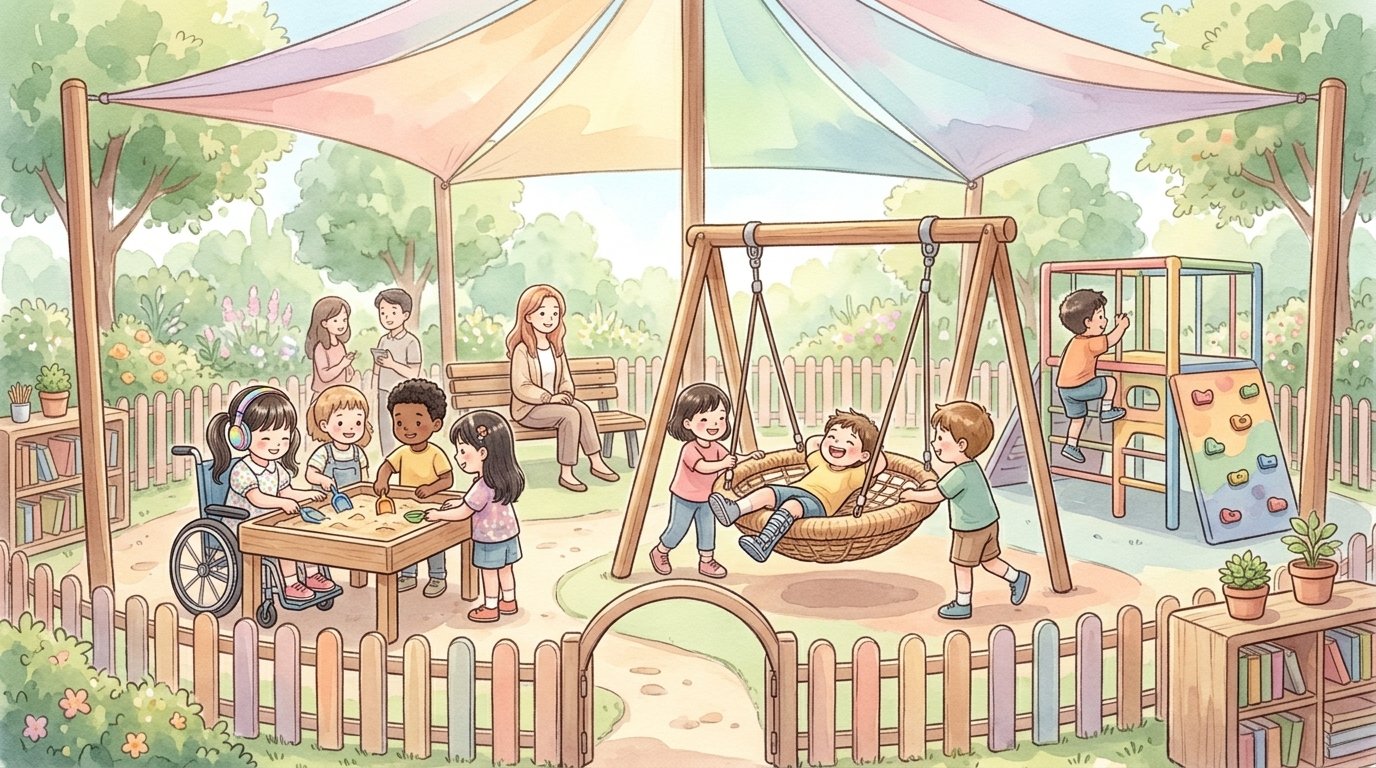
- How This Article Helps
- Our Playground Days
- A Scene at the Swings
- The Five Steps
- Three Questions Behind Every Inclusive Playground
- Sensory Design
- Physical Access
- The Social Side
- What Research Says
- Playgrounds and ADHD
- What Parents Can Do
- Small Things That Help
- Siblings, Friends and Mixed Ages
- Notes for Educators
- Asking Your Council for Change
- 6 Ways Every Family Can Help
- Free Printable: Playground Check Card
- More Free PDFs
- Back to Your Moment
- FAQs
How This Article on the Inclusive Playground Helps
- Reflect on what you’ve seen at playgrounds, and what you might have missed.
- Learn the three questions behind inclusive playground design.
- Understand sensory and physical needs in play spaces.
- See why the social side matters most, and what other families can do.
- Plan a calmer visit with a free Playground Check Card.
Further down, there’s a finding from research on inclusive playgrounds that surprised me. Good equipment helps, but it isn’t the thing that most decides whether a child feels included.
This is the seventh article in the Everyday Stories. Lived Experiences. Better Understanding. series, part of our Inclusion Beyond the Classroom hub.
Our Playground Days
Bella and Zara were small in West Sumatra. Public playgrounds were few there in those years, often hot with little shade. Much of the girls’ play happened in yards, lanes and open spaces, in school play areas and the play corners of shopping centres. We played traditional games together too.
At any playground, Bella climbed everything. She ran off fast, and I had to keep a close eye on her. Waiting for a turn on the swing or the slide was hard for her. And she loved swinging and spinning, for far longer than other children.
In our first year in Melbourne, Zara, nearly five, would wrap other children in bear hugs so fierce they toppled sideways onto the grass. She wasn’t being unkind. She found it hard to judge her own strength.
Looking back, my girls were showing me exactly what an inclusive playground needs to offer. Space to climb safely. Fences and clear sight lines for a child who bolts. Enough swings and spinners that waiting isn’t endless. And other parents and children who understand that a rough hug or a pushed queue isn’t always what it looks like.
I write more about Zara’s strong hugs in the sensory seeking toddler, and about the games the girls played in classic playground games.
An Inclusive Playground Story: A Scene at the Swings
A general illustration of a situation many families describe, not one family’s story.
An autistic boy, about five, is at a busy local playground on a Saturday morning. He goes straight to the only basket swing and lies in it, rocking. He’s been there a long time.
Another child wants a turn. His mother asks him gently to share, but he grips the ropes and starts to cry. Nearby, two parents exchange looks. One says, “Some kids just aren’t taught to take turns.”
His mother lifts him out, crying and kicking, and carries him to the car. They’ve been there ten minutes.
The Five Steps: Everyday Stories. Lived Experiences. Better Understanding.
What happened
An autistic boy found it very hard to leave the only basket swing when another child wanted a turn. He became distressed, and his mother had to take him home.
What did people assume
That he was selfish and hadn’t been taught to share, and that his mother was too soft.
What might we not understand
The swing may have been the one thing helping him cope with a loud, busy playground. The rocking may have been calming his body. Being asked to stop, with no warning and nowhere else to go, removed his support all at once.
What could have helped
More than one basket swing. A quieter corner with something else to rock or spin on. A visual timer or countdown for turns. Other parents who smiled and waited instead of judging.
What can we learn
Design and attitude work together. An inclusive playground gives children enough of what they need, and an inclusive community gives families the benefit of the doubt.
Three Questions Behind Every Inclusive Playground
The NSW Government’s Everyone Can Play guideline asks three simple questions about any play space.1 I find them a helpful way for parents, educators and councils to think about inclusion.
| Question | What it means | Examples |
|---|---|---|
| Can I get there? | Getting to and around the playground | Paths, parking, transport, entrances, fencing |
| Can I play? | Being able to join in the play | Equipment for different bodies and senses, ground level play |
| Can I stay? | Being comfortable for as long as you want | Shade, seats, toilets, water, quiet spaces |
A playground that answers yes to all three is far more likely to work for every child, and for their parents and grandparents too.
Sensory Design in an Inclusive Playground
For autistic children and children with ADHD, sensory design can matter as much as ramps. Playgrounds can be loud, bright, crowded and unpredictable.
| Feature | Why it helps |
|---|---|
| Fencing and clear gates | Keeps children who bolt safe, and lets parents relax |
| Shade | Cuts glare and heat, which can overwhelm |
| Quiet nooks | A cubby, tunnel or small enclosed space to retreat to |
| Several swings and spinners | Movement many children seek, with less waiting |
| Basket and supportive swings | Rocking and lying down, for children who need more support |
| Sand, water and texture | Calm, hands on sensory play |
| Zones | Busy and quiet areas, so children can choose |
Bella’s love of swinging and spinning makes sense through this lens. Many children who seek movement find it settling. See sensory overload in public for the other side, when a busy playground becomes too much. The Venue Sensory Snapshot works for playgrounds too.
Physical Access in an Inclusive Playground
Physical access means a child who uses a wheelchair, walker or other aid can get to the play and join in, not just watch from the edge.
- Smooth, firm paths all the way to and around the equipment.
- Soft, firm ground surfaces that wheels can move across.
- Ground level play, like sensory panels, musical pieces and sand tables at wheelchair height.
- Ramps or transfer platforms onto raised play.
- Accessible toilets nearby, ideally with adult change facilities.
- Seats with backs for parents and grandparents.
Physical and sensory needs often overlap. A child with both may need a quiet, accessible space more than anything else.
The Social Side of an Inclusive Playground
This is the finding I promised. Researchers who reviewed studies on inclusive playgrounds found that good design helps, but social inclusion, being welcomed and playing with others, is often what children and families care about most.2 Equipment alone doesn’t make a child feel included.
That matches what I saw. Zara’s bear hugs weren’t a design problem. They needed patient adults and children who understood her strength, and gentle guidance on softer hugs.
- Other children notice how adults react. If we’re curious and kind, they usually are too.
- Other parents can make a family feel welcome with a smile, or unwelcome with a look.
- Families of disabled children often describe feeling watched and judged at playgrounds. See when people judge a parent.
What Research Says About Inclusive Playgrounds
Play matters for every child. The American Academy of Pediatrics describes how play supports thinking, language, social skills and wellbeing.3
A Swedish study by Maria Prellwitz and Lisa Skär looked at how usable playgrounds were for children with different abilities. They found many playgrounds didn’t fully meet the needs of children with disabilities, especially for playing together with other children.4
The scoping review by Alice Moore and colleagues found that “inclusive” is defined in many ways, and that universal design is promising but often focused mainly on physical access.2 Sensory and social needs, which matter so much for autistic children and children with ADHD, get less attention.
Research on autistic children’s playground use specifically is still limited. Much of what we know comes from families and autistic adults. I’ve tried to keep that in mind.
An Inclusive Playground for Children With ADHD
For a child with ADHD, like Bella, the playground can be wonderful and stressful at once. She climbed everything, ran off fast, found turns hard and loved to swing and spin.
| What you might see | What can help |
|---|---|
| Climbing everything | Plenty of safe climbing, at different heights |
| Running off | Fenced playgrounds, clear sight lines, a meeting spot |
| Hard to wait for turns | More swings, countdowns, choosing quiet times |
| Swinging and spinning for ages | Several swings and spinners, so others aren’t kept waiting |
See ADHD behaviour strategies and hopscotch for more big body play ideas.
What Parents Can Do for a Calmer Playground Visit
Before you go
- Choose quieter times, like weekday mornings or late afternoons.
- Pick fenced playgrounds if your child runs off.
- Look at photos online together, so it feels familiar.
- Pack water, a snack and a hat. Heat and hunger make everything harder.
- Plan the ending, like “five more swings, then the car”.
While you’re there
- Agree a meeting spot your child can find.
- Use countdowns for turns: “ten more pushes, then it’s her turn”.
- Find the quiet corner early, in case it’s needed.
- Model kind play, like softer hugs and asking to join.
The Countdown Cards help with turns and leaving, and the Out and About Together plan helps with any outing.
Leaving the playground
Leaving can be the hardest part. Give warnings, use a countdown, and end with something to look forward to. If your child falls apart, stay calm and close. See meltdowns and co regulation and the Storm Plan.
Small Things That Make a Big Difference
Not every family lives near a purpose built play space. Happily, small everyday choices can make an ordinary local playground work much better for your child and the whole family.
| If your child finds this hard | Try this |
|---|---|
| Crowds and noise | Weekday mornings, or the last hour before dinner |
| Heat and glare | Early or late in the day, a hat and sunglasses |
| Waiting for turns | Smaller local playgrounds with fewer children |
| Running off | Fenced playgrounds, or a parent at each exit |
| Leaving | Countdowns and something to look forward to next |
A familiar playground, visited often, can become a confident place. Many children enjoy the same playground over and over, and that’s a strength, not a limit. Knowing where the swings, the shade and the toilets are lets a child relax and play, instead of spending energy working out a new place.
Siblings, Friends and Mixed Ages
Many families arrive at the playground with more than one child. A sibling who wants the big slide and a child who needs the quiet corner can pull a parent in two directions.
- Choose playgrounds with clear sight lines, so you can see both areas from one seat.
- Take turns choosing where the family plays first.
- Give siblings a role, like timing the swing countdown, if they enjoy it.
- Notice siblings’ feelings too. They sometimes miss out when plans change, and a little one on one time helps.
Friends can be great allies. Some children love showing a friend how to play a game, and simple games with clear rules, like hopscotch or follow the leader, can bring children of different abilities together.
Notes for Educators and Excursions
Kinder and school excursions to parks and playgrounds are a lovely part of the year, and a little planning makes them work for every child.
| Before | On the day | After |
|---|---|---|
| Visit or check photos, toilets and shade | Agree a meeting spot children can see | Ask children what they liked and found hard |
| Share a picture story of the visit with families | Offer a quiet base with shade and water | Share notes with families |
| Plan staff for children who run off | Use countdowns for turns and leaving | Adjust the plan for next time |
A short picture story about the trip can help children know what to expect. See visual storytelling. For how sensory needs show up in early learning settings, see the sensory environment guide.
Asking Your Council for Change
Local councils build and upgrade most public playgrounds, and many invite community feedback. Families and educators can make a difference by speaking up.
- Watch for consultations when a park is being upgraded.
- Be specific: more shade, fencing, a basket swing, a quiet nook, smooth paths, accessible toilets.
- Share your family’s experiences, like how long your family can stay and what makes you leave early.
- Mention guidelines like Everyone Can Play, which many councils already know.
- Ask for autistic and disabled people to be part of the design process.
Small changes, like adding shade or a second swing, can make a big difference to who can stay, play and come back again.
6 Ways Every Family Can Help Make an Inclusive Playground
Give the benefit of the doubt
A child who won’t leave a swing or hugs too hard may have a reason you can’t see.
Help children play together
“Would you like to play sand with him?” opens a door. Children often follow our lead.
Be patient at the swings
Waiting a few extra minutes can save another family’s whole outing.
Answer children’s questions kindly
“Why does he flap his hands?” can be answered simply: “That’s how his body shows he’s happy.”
Offer a smile, not advice
Parents of disabled children often feel watched. A friendly look helps.
Speak up to your council
Ask for shade, fencing, more swings, quiet nooks and accessible paths when playgrounds are upgraded.
Safety and support. Always supervise near roads, water and high equipment, especially if your child runs off. Check equipment is suitable for your child’s size and abilities. Use hats and sunscreen in Australian sun. If you’re worried about your child’s play, movement or social skills, your GP, Maternal and Child Health nurse or an occupational therapist can help.
Free Printable: Playground Check Card for an Inclusive Playground
Can we get there? Can we play? Can we stay? Use it to choose a playground or plan a visit.
Download the Free PDFPlayground Check Card
Can we get there? Can we play? Can we stay?
Smooth paths
Fenced, clear gates
Parking or transport close
Toilets nearby
Shade on the way in
Our note:
Several swings
Basket swing
Ground level play
Sand or water
Climbing at different heights
Our note:
Shade and seats
Quiet nook or cubby
Drinking water
Clear sight lines
Quieter time of day
Our note:
How to Use the Playground Check Card
- Print the card and take it on a quick visit, or check photos online.
- Tick what you find in each column, and note anything missing.
- Choose the playground that ticks the most boxes your child needs.
- Before each visit, run the “Our visit” strip.
- Share your notes with your local council if you’d like to see changes.
Tips for using the card
- Keep a list of your family’s best playgrounds.
- Share it with educators planning excursions.
- Use it with councils when an inclusive playground upgrade is planned.
More Free PDFs for Inclusive Play and Outings
More free tools are on our printables page.
Back to Your Moment
Think back to the child you remembered at the start. The child at the swing who wouldn’t leave. The child hugging too hard. The child watching from the edge.
Maybe the swing was the only thing helping them cope. Maybe they couldn’t judge their strength yet, like Zara. Maybe the play simply wasn’t built for them.
Next time, you’ll know a little more. And a smile, a little patience or an invitation to play might help make that playground inclusive for one more child.
- Hub: Inclusion Beyond the Classroom
- Previous: eating out with an autistic child
- Next in the series (coming soon): When Public Places Feel Overwhelming
- Travel: travelling with an autistic child
- Sensory: sensory overload in public
- Hidden needs: invisible disability
Inclusive Playground FAQs
What makes a playground inclusive?
An inclusive playground lets children of all abilities get there, play and stay. That means accessible paths, equipment for different bodies and senses, shade, seating, quiet spaces and a welcoming community.
What features help autistic children at playgrounds?
Fencing, shade, quiet nooks, several swings including basket swings, sand and water play, and areas that separate busy and quiet play often help.
Why won’t my child get off the swing?
For many children, swinging is calming and helps them cope in a busy space. Countdowns, visual timers and quieter times can make turns easier.
How can I help my child with ADHD at the playground?
Choose fenced playgrounds, agree a meeting spot, use countdowns for turns and leaving, and pick quieter times. Plenty of climbing and swinging helps too.
Is an all abilities playground the same as an inclusive playground?
Mostly, yes. “All abilities” is a common Australian term. The best ones consider sensory and social needs, not only physical access.
Research and guidance: the NSW Government’s Everyone Can Play guideline; Moore and colleagues on inclusive playground design; Prellwitz and Skär on playground usability; and the American Academy of Pediatrics on play.
Experience: the playgrounds of West Sumatra when my girls were small, Bella climbing, running off, finding turns hard and loving to swing and spin, and Zara’s strong bear hugs in our first year in Melbourne are my own memories. Neither of my girls is autistic; Bella was diagnosed with ADHD in her twenties. The swing scene is a labelled general illustration.
This is educational content. Last reviewed: 15 November 2026.
References
- NSW Government Department of Planning and Environment. (2019). Everyone can play: A guideline to create inclusive playspaces. https://www.planning.nsw.gov.au/sites/default/files/2023-03/everyone-can-play-a-guideline-to-inclusive-playspaces.pdf
- Moore, A., Boyle, B., & Lynch, H. (2023). Designing for inclusion in public playgrounds: A scoping review of definitions, and utilization of universal design. Disability and Rehabilitation: Assistive Technology, 18(8), 1453-1465. https://doi.org/10.1080/17483107.2021.2022788
- Yogman, M., Garner, A., Hutchinson, J., Hirsh-Pasek, K., Golinkoff, R. M., Committee on Psychosocial Aspects of Child and Family Health, & Council on Communications and Media. (2018). The power of play: A pediatric role in enhancing development in young children. Pediatrics, 142(3), e20182058. https://doi.org/10.1542/peds.2018-2058
- Prellwitz, M., & Skär, L. (2007). Usability of playgrounds for children with different abilities. Occupational Therapy International, 14(3), 144-155. https://doi.org/10.1002/oti.230
