
When Public Places Feel Overwhelming: A Gentle Guide to Overwhelming Public Places, With 6 Easy Ways to Help
Overwhelming public places are the everyday spaces, like supermarkets, shopping centres, trams, markets and festivals, where noise, crowds, lights and waiting can become too much. Autistic people, people with ADHD and many others can find these places draining, and children often show it through tears, bolting or shutting down.
This article is the practical companion to sensory overload in public. It goes place by place, from supermarkets to festivals, and covers planning, breaks, leaving and recovery afterwards. It includes a free Outing Energy Plan and twelve related free PDFs.
For our family, some of the hardest places were markets, festivals, and crowded trams and trains. Those were where things most often became too much, for my girls and for me.
I’m an adult with ADHD, diagnosed in my forties, and I find busy public places draining. Bella has ADHD too, diagnosed in her twenties. Neither of my girls is autistic. But between us, we learnt a lot about what helps when a place starts to feel like too much.
I learnt to go at quiet times, keep trips short with a list, take breaks outside or in the car, and leave early when we needed to, without apologising.
So before you read on, think back to a time in a busy public place when someone caught your attention. A child crying in the supermarket. A teenager with headphones pressed to their ears on a crowded tram. A parent leaving a festival with a child slung over their shoulder. An adult standing very still at the edge of a busy market.
What did you feel? Maybe irritation, sympathy, curiosity or discomfort.
What did your mind tell you? Perhaps “that child is spoilt”, “why bring them here?” or “they look rude”.
What did you do? Did you stare, look away, move on, or offer some space?
Keep that moment in mind. By the end of this article on overwhelming public places, you might see it differently.
- How This Article Helps
- A Scene at the Market
- The Five Steps
- Why Some Places Feel So Much Harder
- What Research Says
- Place by Place
- When the Adult Is Overwhelmed Too
- Planning an Outing
- Leaving Without Shame
- Recovery Afterwards
- Supports in Australia
- 6 Easy Ways to Help
- Free Printable: Outing Energy Plan
- More Free PDFs
- Back to Your Moment
- FAQs
How This Guide to Overwhelming Public Places Helps
- Reflect on what you’ve seen in busy places, and what you might have missed.
- Understand why some places are harder than others.
- Get place by place ideas for supermarkets, shopping centres, transport, markets and events.
- Plan for the parent’s energy too, not just the child’s.
- Use a free Outing Energy Plan for before, during and after.
Further down, I’ll share the part of an outing that most families forget to plan for. It comes after the trip, and it’s often where the hardest moments of the day happen.
This is the eighth article in the Everyday Stories. Lived Experiences. Better Understanding. series, part of our Inclusion Beyond the Classroom hub.
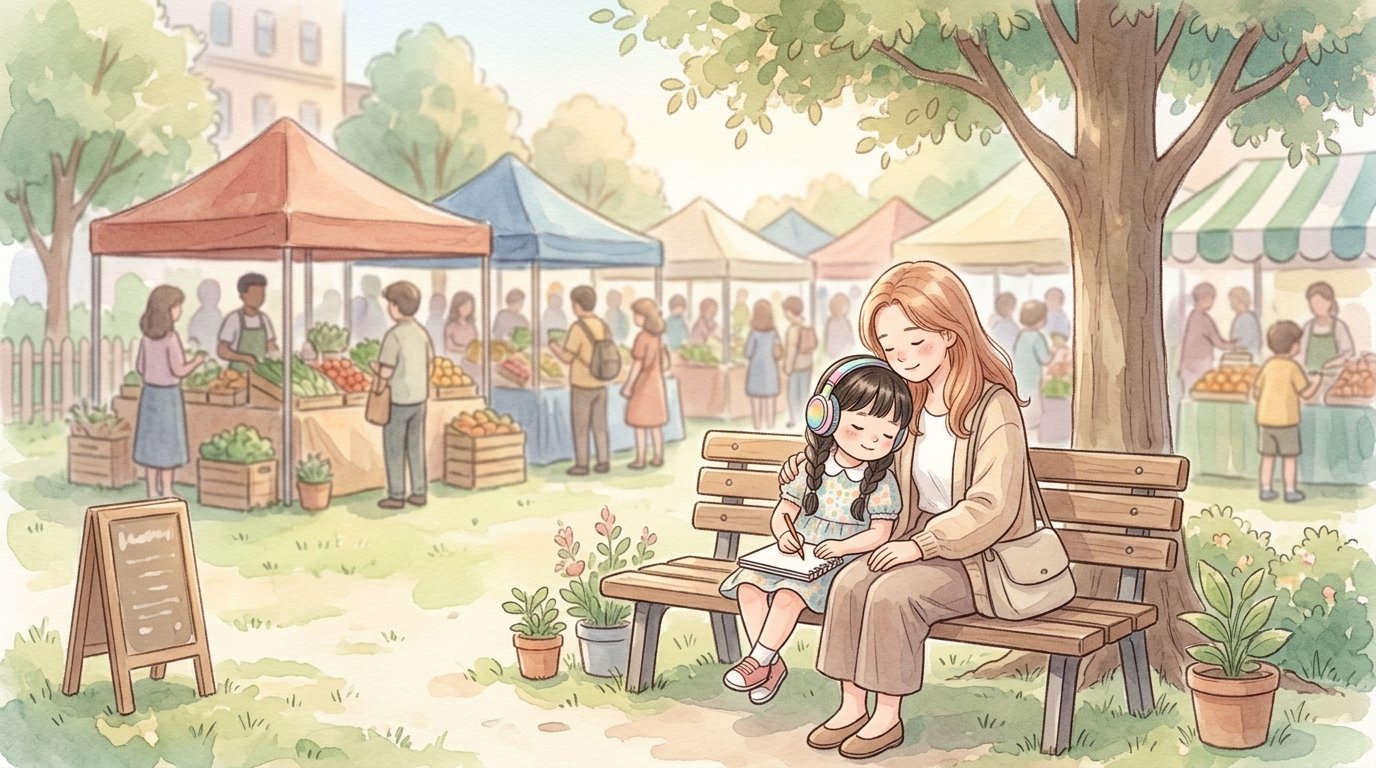
Overwhelming Public Places: A Scene at the Market
A general illustration of a situation many families describe, not one family’s story.
A mother takes her eight year old son with ADHD to a Saturday market. It’s sunny and packed. There’s a busker with a drum, the smell of frying food, and people brushing past on every side.
For the first half hour he’s excited, darting between stalls. Then he starts grabbing things, bumping into people and talking louder and louder. When his mother says it’s time to go, he drops to the ground and won’t move.
A stallholder says, “Can you move him? He’s blocking my stall.” People step around them, some shaking their heads. His mother crouches beside him, holding his hand, waiting.
The Five Steps: Everyday Stories. Lived Experiences. Better Understanding.
What happened
A boy with ADHD became more and more wound up at a busy market, then dropped to the ground when it was time to leave. People stepped around them and a stallholder asked them to move.
What did people assume
That he was naughty and overexcited, and that his mother should have kept him under control.
What might we not understand
The noise, crowd, smells and constant movement had been building for half an hour. His excitement and his overwhelm looked similar from the outside. By the time it showed, his tank was empty, and leaving felt like one demand too many.
What could have helped
A shorter visit, planned breaks at a quieter edge of the market, and leaving before the tank ran dry. A stallholder who said “take your time” instead of “move him”.
What can we learn
Overwhelm often builds quietly before it shows. Leaving early, with a plan, is usually kinder than waiting for the moment it all tips over.
Why Some Places Feel So Much Harder
The sensory overload in public article explains overload in depth. Here, I focus on what makes some everyday places harder than others.
| Feature | Why it adds up |
|---|---|
| Unpredictable noise | Announcements, music, buskers and crowds you can’t control |
| Crowds and touch | Being bumped and brushed past, with little personal space |
| Bright or flickering light | Fluorescent lights, screens and sun glare |
| Waiting | Queues and delays with nothing to do |
| No easy exit | Trams, trains and crowded venues can feel trapping |
| Being watched | Feeling judged adds stress to an already hard moment |
Markets, festivals and public transport combine many of these at once. That’s why they were often the hardest places for us.
Early signs in overwhelming public places
Overwhelm rarely arrives out of nowhere. Most children show small signs first, and adults do too. Spotting them early gives you time to take a break or leave calmly.
| You might notice | What it can mean | Try |
|---|---|---|
| Louder talking, faster moving | Energy rising as the input builds | A break at the quiet edge |
| Covering ears or eyes | Noise or light is too much | Headphones, sunglasses, step outside |
| Grabbing, bumping, crashing | Seeking body input to stay steady | Carry the bag, push the trolley |
| Going quiet or very still | Shutting down to cope | Fewer words, a calm spot |
| Clinging or asking to go home | The tank is nearly empty | Believe them and head off |
| Snapping at small things | Tired from holding it together | Food, water and a pause |
The quiet signs are the easiest to miss. A child who goes still in a crowd can look calm and settled. Yet they may be working very hard to cope. Check in with them as gently as you would with a child who is getting loud.
Why the same place can feel different each time
Overwhelming public places don’t feel the same every visit. The supermarket that was fine on Tuesday morning can be too much on Saturday afternoon. A child who coped with the tram last week may struggle today.
Tiredness, hunger, a busy day at school, a new routine or feeling unwell can all lower how much a person can take in. This is part of a spiky profile, and it isn’t a sign of being difficult. Checking the battery before you head out helps you choose the right trip for today.
It helps adults too. On a low battery day, a shorter trip, a quieter time or a different day altogether can be the kinder choice.
What Research Says About Overwhelming Public Places
Sensory differences are part of how autism is described, and many autistic adults describe busy places as exhausting and sometimes painful.1 In their own words, autistic adults describe sensory experiences as complex: sometimes overwhelming, sometimes enjoyable, and often affected by tiredness and stress.2
Sensory sensitivity isn’t only an autism experience. Research has found links between ADHD traits and sensory sensitivity in adults in the general population.3 That makes sense to me. My own tiredness in busy places has a reason.
Many autistic people also describe “camouflaging”, working hard to appear fine in public. Adults in one study described this as exhausting.4 A child who holds it together in the supermarket may fall apart in the car.
There’s little research on specific places like markets or trams. Much of what we know comes from autistic people, ADHD adults and families. I’ve kept that in mind.
Overwhelming Public Places, Place by Place
Supermarkets
- Go at quiet times, like early weekday mornings.
- Keep trips short with a list. This was one of my main strategies.
- Give your child a job, like finding three items or pushing the trolley.
- Check for a quiet hour at your local store.
A list can work for more than shopping, too. Writing down two or three stops for an outing keeps everyone focused, and it gives a clear point to finish. When the list is done, you can go home feeling good, rather than wandering until someone is tired.
Shopping centres
- Plan one or two shops, not a long wander.
- Know where the quieter spots are, like a bench away from the food court or a carpark exit.
- Avoid school holidays and weekends if you can.
Trams, trains and buses
- Travel outside peak times where possible.
- Choose a seat near the doors or the end, with fewer people brushing past.
- Use headphones and something to look at.
- Get off a stop early and walk if it’s getting too much.
Markets, festivals and events
- Arrive early, before the biggest crowds.
- Find the quiet edge first: a park bench, a side street, the car.
- Plan breaks every half hour or so, not just when things go wrong.
- Decide on a leaving time before you arrive.
Appointments and waiting rooms
- Book the first appointment of the day, when waits are shortest.
- Ask to wait outside or in the car and be called in.
- Bring a quiet activity for the wait.
For other places in this series, see eating out, inclusive playgrounds and travelling. The Venue Sensory Snapshot helps you check a place before you go.
When the Adult Is Overwhelmed Too
Most advice about overwhelming public places focuses on the child. But parents get overwhelmed too, especially parents who are autistic or have ADHD themselves.
I find busy public places draining. Since my diagnosis, I understand that my own sensory load matters too, not just my girls’.
- Notice your own battery, not just your child’s.
- Plan your break, as well as theirs.
- Lower your own input: sunglasses, earplugs, a list so you don’t have to think.
- Share the load with another adult where you can.
A calm adult helps a child stay calmer. Looking after yourself is part of looking after them. See being a parent with ADHD and parent and teacher burnout. The Weekly Battery Check In helps you notice your own tank.
Planning an Outing to Overwhelming Public Places
| When | What helps |
|---|---|
| Choosing | Quiet times, shorter trips, familiar places |
| Preparing | A list, a visual plan, photos of the place, a break spot picked in advance |
| Packing | Headphones, sunglasses, water, a snack, something to hold or fiddle with |
| Arriving | Find the exit and the quiet edge first |
| During | Planned breaks, one task at a time, checking in |
| Leaving | Go before the tank runs dry |
A simple picture plan helps many children know what’s coming. See visual routine cards, the First Then Starter Tiles and the Out and About Together plan.
Check in with a battery question
Asking “how’s your battery?” every half hour gives children a simple way to say they’re getting tired before it shows as a meltdown. It works for adults too. See spiky profiles for the battery idea.
For educators: excursions to overwhelming public places
Excursions are a lovely part of early childhood programmes. They can also mean buses, crowds, noise and lots of waiting in one morning. A little planning helps every child, and it helps neurodivergent children most of all.
- Visit or look online first, and note the quiet spots, toilets and exits.
- Share photos with children a few days before, so the place feels familiar.
- Talk with families about what helps their child, and what to pack.
- Plan a calm buddy or small group for children who need more breaks.
- Build in breaks on the timetable, not just when someone is upset.
- Keep the return calm. A quiet afternoon back at the centre helps everyone recover.
Families are often the best guides here. Ask them what has worked on their own outings, and use the Outing Energy Plan below to share ideas.
Leaving Overwhelming Public Places Without Shame
Leaving early was one of my most useful strategies. Leaving early is a plan, and it doesn’t mean the outing failed.
- Leave on a good note when you can, before the tank is empty.
- Use a countdown rather than a sudden “we’re going”.
- Keep words few and calm if your child is already overwhelmed.
- Head somewhere quiet first, like outside or the car, before the drive home.
- Count it as a success. You went, and you came home. That’s enough.
If your child melts down, see autistic child meltdown in public and the Rumble to Recovery Card.
Recovery Afterwards: The Part Families Forget
This is the part I promised. Families often plan the trip, the bag and the route, then forget the recovery afterwards. Yet the hardest moment often comes in the car or at home, after a child has held it together all day.
- Plan nothing else straight after a big outing.
- Offer quiet, food and water before talking.
- Expect a wobble. Tears or anger at home don’t mean the outing failed.
- Talk it through later, when everyone is calm: what was fun, what was hard.
- Note what helped for next time.
The free Outing Energy Plan has an After column, so recovery gets planned along with the trip.
Movement or quiet can both help recovery, depending on the child. See pocket heavy work cards and calm corner design.
Supports for Overwhelming Public Places in Australia
- Supermarket quiet hours. Some Coles and Woolworths stores run a quiet hour with dimmer lights and less noise. Times and stores vary, so check your local store.5
- The Hidden Disabilities Sunflower. Metro Trains Melbourne and V/Line in Victoria recognise the Sunflower lanyard, which lets staff know someone may need extra time or help.6 See invisible disability.
- Sensory friendly sessions at some cinemas, museums and events. Check their accessibility pages.
- Accessibility information on many venue and event websites, including quiet spaces and maps.
These supports help, but they’re not enough on their own. Kindness from the people around us matters just as much.
6 Easy Ways to Help in Overwhelming Public Places
Give space, not an audience
If someone is struggling, step back and look away kindly. Staring adds pressure.
Turn it down if you can
Lower your voice, turn down your music, or move your trolley out of the way.
Offer, don’t fix
“Is there anything I can do?” is kinder than advice. Accept “no thanks”.
Make room on transport
Offer a seat near the door or move along so a family can sit together.
For staff: “Take your time”
Three words that can change a family’s whole day. Point quietly to a calmer spot or exit if there is one.
For staff: know the Sunflower
If you see a Sunflower lanyard, offer patience and help without fuss.
When to get more support. If outings are becoming impossible, your child is very distressed in many places, or you’re avoiding going out because it’s too hard, talk with your GP or Maternal and Child Health nurse. An occupational therapist or psychologist can help with sensory needs and anxiety. If you’re feeling overwhelmed yourself, please reach out to your GP too.
Free Printable: Outing Energy Plan for Overwhelming Public Places
Before, during and after. Plan the outing and the recovery, for your child and for you.
Download the Free PDFOuting Energy Plan
Plan the trip. Plan the breaks. Plan the recovery.
Quiet time chosen
Short list made
Break spot picked
Headphones and snack
Leaving time set
Our idea:
Find the exit first
One task at a time
Break outside or in the car
“How’s your battery?”
Leave before it’s empty
Our idea:
Nothing else planned
Food and water first
Quiet time
Talk it through later
Note what helped
Our idea:
How to Use the Outing Energy Plan
- Print the plan and fill in column 1 the day before an outing.
- Circle today’s place on the strip, and pick a break spot for it.
- During the outing, use column 2 and ask “how’s your battery?” every half hour.
- Afterwards, follow column 3 for your child and for yourself.
- Note what helped, and keep the plan for next time.
Tips for using the plan
- Start with short, familiar trips and build up.
- Share it with grandparents, carers and educators planning excursions.
- Use it for yourself before trips to overwhelming public places, even without children.
More Free PDFs for Outings and Busy Places
More free tools are on our printables page.
Back to Your Moment
Think back to the moment you remembered at the start. The child crying in the supermarket. The teenager pressing headphones to their ears. The adult standing very still at the edge of the market.
Maybe their tank had been emptying quietly for a long time. Maybe leaving was their bravest choice that day. Maybe, like me, they simply find busy places draining.
Next time, you’ll know a little more. And a little space, a quieter voice or “take your time” might be what helps them get home calmly.
- Hub: Inclusion Beyond the Classroom
- Previous: what makes a playground inclusive
- Next in the series (coming soon): How Businesses Can Be More Autism Inclusive
- Sensory: sensory overload in public
- Meals: eating out with an autistic child
- Travel: travelling with an autistic child
Overwhelming Public Places FAQs
Why do public places feel overwhelming for autistic children?
Noise, crowds, lights, smells and waiting can add up quickly. Many autistic children notice sensory input more strongly, and it can build until it becomes too much.
Can people with ADHD find public places overwhelming too?
Yes. Research links ADHD traits with sensory sensitivity, and many adults and children with ADHD find busy places draining or overstimulating.
How can I make shopping easier for my child?
Go at quiet times, keep trips short with a list, give your child a job, check for a quiet hour, and plan a break spot or early exit.
Why does my child fall apart after an outing?
Many children hold it together while out, then release the stress somewhere safe. Plan quiet recovery time, food and water, and nothing else straight afterwards.
Is the Sunflower lanyard recognised on Melbourne public transport?
Metro Trains Melbourne and V/Line have Sunflower programs, which let staff know someone may need extra time or help. Check current details with each operator.
Research and guidance: the American Psychiatric Association on sensory differences; MacLennan and colleagues on autistic adults’ sensory experiences; Panagiotidi and colleagues on ADHD traits and sensory sensitivity; Hull and colleagues on camouflaging; and Coles, Woolworths, Metro Trains and V/Line on local supports.
Experience: finding markets, festivals and public transport hardest, my own experience of busy places as an adult with ADHD, and the strategies I used (quiet times, short trips with a list, breaks outside or in the car, and leaving early) are my own. Neither of my girls is autistic; Bella was diagnosed with ADHD in her twenties. The market scene is a labelled general illustration.
This is educational content. Supports change, so check current details with each provider. Last reviewed: 15 November 2026.
References
- American Psychiatric Association. (2022). Diagnostic and statistical manual of mental disorders (5th ed., text rev.). American Psychiatric Publishing.
- MacLennan, K., O’Brien, S., & Tavassoli, T. (2022). In our own words: The complex sensory experiences of autistic adults. Journal of Autism and Developmental Disorders, 52(7), 3061-3075. https://doi.org/10.1007/s10803-021-05186-3
- Panagiotidi, M., Overton, P. G., & Stafford, T. (2018). The relationship between ADHD traits and sensory sensitivity in the general population. Comprehensive Psychiatry, 80, 179-185. https://doi.org/10.1016/j.comppsych.2017.10.008
- Hull, L., Petrides, K. V., Allison, C., Smith, P., Baron-Cohen, S., Lai, M.-C., & Mandy, W. (2017). “Putting on my best normal”: Social camouflaging in adults with autism spectrum conditions. Journal of Autism and Developmental Disorders, 47(8), 2519-2534. https://doi.org/10.1007/s10803-017-3166-5
- Lucio, R. (2019, August 26). Woolworths expands Quiet Hour following successful trial. Inside Retail. https://insideretail.com.au/?p=22977
- Metro Trains Melbourne. (n.d.). Metro launches Hidden Disabilities Sunflower program. https://www.metrotrains.com.au/metro-launches-hidden-disabilities-sunflower-program/
