
How Businesses Can Be More Autism Inclusive: An Easy Autism Inclusive Business Guide in 8 Practical Steps
An autism inclusive business is a shop, café, clinic or service that autistic people, people with ADHD and their families can use with less stress. It plans for sensory needs, gives clear information, offers flexible ways to book and wait, and has staff who respond with patience.
This guide is for business owners, managers and staff. It covers the sensory environment, information before a visit, booking and forms, queues, staff training, layout, and hiring neurodivergent staff. It includes a free Autism Inclusive Business Checklist and twelve related free PDFs.
I’m an adult with ADHD, diagnosed in my forties. Long queues, long forms, phone only bookings and busy, cluttered shops drain me quickly.
The businesses I go back to have a few things in common. They let me book or order online. They put clear information on their website before I go. Their staff are calm and patient, and they don’t rush me. And I can visit at quiet times.
I’ve also worked as an NDIS support worker, supporting people in everyday life. That work showed me how much small choices by a business can shape a person’s whole day.
So before you read on, think back to a time at work, or as a customer, when someone seemed to struggle in a business. A child crying at the hairdresser. An adult who left a queue suddenly. A customer who didn’t answer when staff spoke to them. A parent who asked for something that seemed unusual.
What did you feel? Maybe impatience, confusion, sympathy or worry about other customers.
What did your mind tell you? Perhaps “they’re being rude”, “we can’t make exceptions” or “I don’t know what to do”.
What did you or your staff do? Did you carry on as usual, step in, or wait for it to pass?
Keep that moment in mind. By the end of this autism inclusive business guide, you might see it differently.
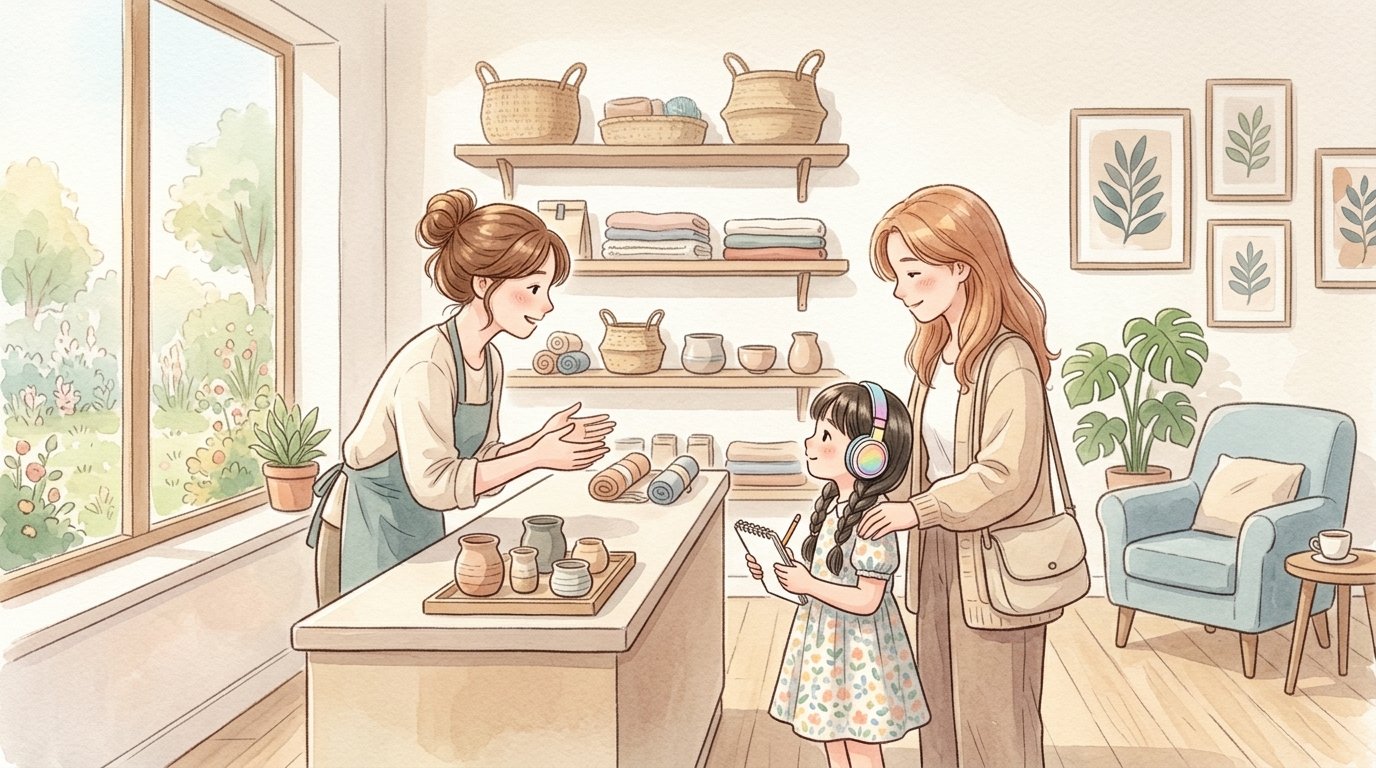
How This Autism Inclusive Business Guide Helps
- Reflect on what you’ve seen at work, and what you might have missed.
- Understand why small barriers can stop people coming back.
- Get 8 practical steps, most of them free or low cost.
- Think about your team, including neurodivergent staff.
- Use a free checklist to plan your first changes.
Further down, I’ll share the cheapest change most businesses can make this week. All it needs is an hour of someone’s time, and it helps before a customer even walks in.
This is the ninth article in the Everyday Stories. Lived Experiences. Better Understanding. series, part of our Inclusion Beyond the Classroom hub.
An Autism Inclusive Business Story: A Scene at the Hairdresser
A general illustration of a situation many families describe, not one family’s story.
A father brings his six year old autistic daughter for a haircut. The salon is busy. Music is playing, hair dryers are running, and the booking is running twenty minutes late.
His daughter waits on a stool, rocking and humming. When the stylist finally calls her, she covers her ears at the sound of the clippers and slides off the chair.
The stylist says, “She needs to sit still or I can’t do it.” Another customer sighs loudly. The father apologises, pays a cancellation fee, and carries his daughter out to the car.
The Five Steps: Everyday Stories. Lived Experiences. Better Understanding.
What happened
An autistic girl couldn’t manage a haircut in a busy, noisy salon after a long wait. Her father paid a fee and left.
What did people assume
That she was being difficult, and that her father should have prepared her better or kept her still.
What might we not understand
The wait, the music, the dryers and the buzz of the clippers had added up. Haircuts also involve touch near the head and face, which many autistic children find very hard. Rocking and humming were her ways of coping while she waited.
Why online booking matters so much
For many neurodivergent adults, a phone call is a big task. You have to listen, think and answer quickly, often with background noise or hold music. It’s easy to forget a question or miss a detail.
Online booking lets people take their time, check details and come back later. It also gives them a written record of the time and place. For me, it makes booking much easier.
Keep a phone option for people who prefer it. The aim is choice, so each person can use the way that works for them.
What could have helped
A first or last booking of the day, a text when the chair was ready, music turned down, scissors instead of clippers, and a stylist who explained each step. No fee for a visit that needed to stop.
What can we learn
Most of what would have helped was free. An autism inclusive business plans for these needs ahead, so families don’t have to ask at the hardest moment.
Why an Autism Inclusive Business Matters
Autistic people and people with ADHD are customers, clients, patients and staff. So are their parents, partners and grandparents. When a business is hard to use, the whole family often stays away.
Many of the changes that help autistic customers also help others. Older people, people with anxiety, people with chronic pain, tired parents and anyone having a hard day can all benefit from a calmer space and clear information.
In Australia, the Disability Discrimination Act 1992 makes it unlawful to discriminate against people with disability when providing goods and services.1 Inclusion is good practice, and it’s also part of a business’s responsibilities. This article is general information, not legal advice.
What Research Says About Autism Inclusive Business Practice
Autistic adults describe sensory experiences as complex. Busy places can be overwhelming, especially when someone is already tired or stressed.2 Research has also found links between ADHD traits and sensory sensitivity in adults.3 That fits my own experience of busy shops.
Many autistic people describe “camouflaging”, working hard to appear fine in public. Adults in one study described this as exhausting.4 So a customer who seems calm at the counter may be working very hard to get through the visit.
Employment matters too. In 2022, the unemployment rate for autistic Australians of working age was 18.2%. That compares with 7.5% for all people with disability and 3.1% for people without disability.5
There’s less research on specific customer changes, like quiet hours. Much of what we know comes from autistic people, families and the businesses that have tried them. I’ve kept that in mind.
8 Practical Steps to Become an Autism Inclusive Business
Look at your sensory environment
Stand in your space for ten minutes and notice what you hear, see and smell. Then ask what you could turn down or take away.
| Sensory load | Easy change |
|---|---|
| Loud music | Turn it down, or off during quiet times |
| Announcements and beeps | Lower volume, fewer announcements |
| Flickering or harsh lights | Fix flickering tubes, dim some lights where possible |
| Strong smells | Skip air fresheners and diffusers |
| Nowhere to step away | A quiet corner, a chair outside or a spare room |
See fluorescent flicker and ADHD and the sensory environment for more on light and noise. The Venue Sensory Snapshot is a quick way to check your space.
Put clear information online before people visit
This is the cheapest change I promised earlier. A simple “What to expect” page on your website helps people plan before they even leave home.
- Photos of the entrance, inside, the counter and the toilets.
- Your quietest times, and any quiet hour.
- What happens step by step, from arriving to paying.
- Prices, so there are no surprises.
- Parking and transport, including the nearest drop off spot.
- A contact by email or text, not just phone.
Clear information before I go is one of the things that helps me most. It means I can make decisions at home, where I’m calm, rather than in a busy shop.
Make booking and forms easier
Forms and phone calls are some of the hardest parts of a business for me. Online booking and ordering help me a lot.
- Offer online booking, or booking by text or email.
- Keep forms short. Ask only what you need.
- Let people fill forms in before they arrive.
- Add a question: “Is there anything that would make your visit easier?”
- Send reminders with the time, place and what to bring.
Rethink queues and waiting
Long queues and waiting drain me fast, especially when I don’t know how long it will be. Many autistic people and children find waiting very hard too.
- Tell people the wait time, and update it if it changes.
- Text when you’re ready, so people can wait outside or in the car.
- Offer first or last appointments to people who need a shorter wait.
- Provide seats in a quieter spot.
- Avoid cancellation fees when a visit has to stop because of distress.
Train staff in patience and clear words
Calm, patient staff who give clear answers and don’t rush me make a big difference. Staff attitude often matters more than any equipment.
| Instead of | Try |
|---|---|
| “You need to calm down.” | “Take your time. I’m here when you’re ready.” |
| “Can you hurry up?” | “No rush. Would a quieter spot help?” |
| A long list of instructions | One step at a time, or written down |
| “Look at me when I’m talking.” | Talk calmly without expecting eye contact |
| Asking a parent to explain their child | “Is there anything that would help?” |
Remember that some autistic people don’t speak, or speak less when stressed. Offer a pen and paper, pointing, or a phone to type on. Accept that someone may not reply straight away.
When someone is overwhelmed in your business
Even with good planning, someone may still become overwhelmed. A calm response from staff can help it pass more quickly and keep everyone safe.
- Stay calm and quiet. Lower your voice and slow down.
- Reduce the input. Turn music down, and gently ask others to give some space.
- Offer a quieter spot, like a back room, a chair outside or a corner.
- Use few words. “Take your time” is often enough.
- Ask the parent or carer what helps, and follow their lead.
- Don’t rush them out, and don’t charge for a visit that needed to stop.
Afterwards, a short, kind word like “Come back any time” can mean a family returns. The autistic child meltdown in public article explains more about what’s happening during a meltdown.
Know the Hidden Disabilities Sunflower
The Sunflower lanyard lets people show they have a disability that isn’t visible and may need more time or help. Transport operators like Metro Trains Melbourne recognise it.6
Teach staff what it means, and to offer help quietly without asking for details. See invisible disability and the What You Can’t See About Me card.
Keep layout and signs simple
Busy, cluttered layouts are hard for me. Too many signs, displays and changes to where things go make me tired before I find what I need.
- Keep paths clear and displays out of walkways.
- Use clear, simple signs with pictures where possible.
- Avoid moving things around often, or tell regular customers when you do.
- Make the exit easy to find from anywhere in the space.
Include neurodivergent staff
An autism inclusive business is inclusive for its staff as well as its customers. Many autistic people want to work and bring skills like focus, honesty and attention to detail.
- Make interviews clearer: share questions ahead, or offer a work trial.
- Give instructions in writing as well as out loud.
- Ask what helps, and offer small adjustments like headphones or a quieter desk.
- Offer some flexibility with hours and breaks where you can.
- Keep routines predictable, and give notice of changes.
A Victorian campaign by Amaze and the state government notes that simple adjustments, like noise reducing headsets or written directions, help autistic workers and others.7 Some large companies have also described neurodiversity programs as good for their teams.8
For the adult side of this, see ADHD work environment, work that gives me more flexibility and autistic masking. The Work Spot Planner can help staff think about their own setup.
Walk through the visit as an autism inclusive business
It helps to picture a whole visit from the customer’s side. Each stage has its own barriers, and each has small fixes.
| Stage | What can be hard | What helps |
|---|---|---|
| Finding out | No photos, no prices, phone only contact | A “What to expect” page and email or text contact |
| Booking | Phone calls, hold music, long forms | Online booking and short forms filled in ahead |
| Arriving | Hard to find entry, busy doorway, loud music | Clear signs, a calm greeting, quieter sound |
| Waiting | No idea how long, nowhere quiet to sit | Wait times shared, text when ready, a quiet seat |
| The service | Surprises, touch, fast talking | Explain each step, ask before touching, slow down |
| Paying and leaving | Queues, small talk, a cluttered counter | Simple payment, an easy exit, a kind goodbye |
Pick the stage where most customers seem to struggle, and start there.
An Autism Inclusive Business on a Small Budget
| Cost | Ideas |
|---|---|
| Free | Turn music down, add a “What to expect” page, text when ready, kind scripts for staff |
| Low cost | A quiet chair or corner, simple picture signs, fixing flickering lights, online booking |
| Bigger steps | A regular quiet hour, staff training, a separate calm room |
Start with one free change this month. The free Autism Inclusive Business Checklist helps you choose it. Then ask customers what helped, and choose the next one.
What an Autism Inclusive Business Avoids
- A sign without the follow through. An “autism friendly” sticker means little if staff don’t know what to do.
- Asking for proof or a diagnosis before offering simple help.
- Talking about a person instead of to them.
- One quiet hour, then nothing else. Quiet hours help, but other days matter too.
- Making decisions without autistic people. Ask autistic customers and staff what helps.
For Early Childhood Services
Kinders, childcare centres and playgroups are businesses too. Many of the same steps apply to enrolment, orientation and pick up.
- Share photos and a short guide before a child’s first day.
- Make enrolment forms simple, and ask what helps each child.
- Offer quieter drop off times or a calm entry for children who need it.
- Support neurodivergent educators with clear rosters and written plans.
See calm corner design and visual routine cards for ideas you can use in your room.
For Families Looking for an Autism Inclusive Business
- Check websites for accessibility pages, photos and quiet times.
- Email or message ahead to ask what’s possible.
- Share a short card about what helps your child.
- Give feedback, including when something went well.
Kind feedback helps businesses keep doing what works. For planning visits, see overwhelming public places and eating out with an autistic child.
When to get more advice. This page is general information, not legal advice. For questions about your obligations under disability discrimination law, contact the Australian Human Rights Commission or a legal service. For staff training, look for programs designed with autistic people, such as those offered by autism organisations in your state.
Free Printable: Autism Inclusive Business Checklist
Before they arrive, while they’re here, and your team. Tick what you already do, then choose your next step.
Download the Free PDFAutism Inclusive Business Checklist
Tick what you do now. Circle your next step.
“What to expect” page
Photos of the space
Quiet times listed
Online or text booking
Short forms
Our idea:
Music turned down
Quiet spot to wait
Text when ready
Clear, simple signs
Easy to find exit
Our idea:
“Take your time”
Knows the Sunflower
One step at a time
Written instructions
Asks staff what helps
Our idea:
How to Use the Autism Inclusive Business Checklist
- Print the checklist and circle your type of business on the strip.
- Walk through your space and tick what you already do.
- Circle one free change from column 1 or 2 to start this month.
- Share column 3 with your team at your next meeting.
- Ask customers and staff what helped, and choose your next step.
Tips for using the checklist
- Do the walk through at a busy time, so you notice what customers notice.
- Ask an autistic customer or staff member to walk through with you, if they’d like to.
- Review it every few months. Small steps add up.
More Free PDFs for Inclusive Spaces
More free tools are on our printables page.
Back to Your Moment
Think back to the moment you remembered at the start. The child crying at the hairdresser. The adult who left the queue. The customer who didn’t answer.
Maybe the wait had been too long, the music too loud, or the form too much. Maybe they’d been holding it together all day. Maybe, like me, they find queues and phone calls draining.
Next time, you’ll have more options. A quieter spot, a text when you’re ready, or “take your time” might be what brings that person back.
- Hub: Inclusion Beyond the Classroom
- Previous: when public places feel overwhelming
- Next in the series (coming soon): What Does a Neurodiversity Inclusive Community Look Like?
- Sensory: sensory overload in public
- Hidden needs: invisible disability
- Meals: eating out with an autistic child
Autism Inclusive Business FAQs
What makes an autism inclusive business?
A calmer sensory environment, clear information before a visit, flexible booking and waiting, patient staff who use clear words, and support for neurodivergent employees.
Does becoming autism inclusive cost a lot?
Most first steps are free, like turning music down, adding a “What to expect” page, texting when ready and training staff to say “take your time”.
What is a quiet hour?
A regular time when a business lowers music, lights and announcements. Some Australian supermarkets run them, and many smaller businesses can offer something similar.
What does the Sunflower lanyard mean?
It shows that the wearer has a disability that may not be visible, and may need more time or help. Staff can offer support quietly without asking for details.
How can businesses support autistic employees?
Clearer interviews, written instructions, small adjustments like headphones or a quieter desk, some flexibility, and asking each person what helps them work well.
Research and guidance: the Disability Discrimination Act 1992; MacLennan and colleagues on autistic adults’ sensory experiences; Panagiotidi and colleagues on ADHD traits and sensory sensitivity; Hull and colleagues on camouflaging; the Australian Bureau of Statistics on autism and employment; the Victorian Government and Amaze on autism friendly workplaces; Austin and Pisano on neurodiversity at work; and Metro Trains Melbourne on the Sunflower.
Experience: what drains me (long queues and waiting, forms and phone calls, busy cluttered layouts) and what helps me (online booking, clear information, calm patient staff and quiet times) are my own, as an adult with ADHD. I’ve also worked as an NDIS support worker. The hairdresser scene is a labelled general illustration.
This is general information, not legal advice. Last reviewed: 15 November 2026.
References
- Disability Discrimination Act 1992 (Cth). https://www.legislation.gov.au/C2004A04426/latest/text
- MacLennan, K., O’Brien, S., & Tavassoli, T. (2022). In our own words: The complex sensory experiences of autistic adults. Journal of Autism and Developmental Disorders, 52(7), 3061-3075. https://doi.org/10.1007/s10803-021-05186-3
- Panagiotidi, M., Overton, P. G., & Stafford, T. (2018). The relationship between ADHD traits and sensory sensitivity in the general population. Comprehensive Psychiatry, 80, 179-185. https://doi.org/10.1016/j.comppsych.2017.10.008
- Hull, L., Petrides, K. V., Allison, C., Smith, P., Baron-Cohen, S., Lai, M.-C., & Mandy, W. (2017). “Putting on my best normal”: Social camouflaging in adults with autism spectrum conditions. Journal of Autism and Developmental Disorders, 47(8), 2519-2534. https://doi.org/10.1007/s10803-017-3166-5
- Australian Bureau of Statistics. (2024). Autism in Australia, 2022. https://www.abs.gov.au/articles/autism-australia-2022
- Metro Trains Melbourne. (n.d.). Metro launches Hidden Disabilities Sunflower program. https://www.metrotrains.com.au/metro-launches-hidden-disabilities-sunflower-program/
- Department of Families, Fairness and Housing. (2024, January 22). Autism friendly workplaces work for everyone. Victorian Government. https://dffh.vic.gov.au/news/autism-friendly-workplaces-work-everyone
- Austin, R. D., & Pisano, G. P. (2017). Neurodiversity as a competitive advantage. Harvard Business Review, 95(3), 96-103.
