
Invisible Disability: Why Autism and ADHD Are Not Always Visible, and 5 Easy Ways to Respond Well
An invisible disability is one you can’t see from the outside. Autism and ADHD are often invisible: a child or adult can look “fine” while working very hard to cope with noise, change, communication or attention. Because people can’t see the need, they often misread the behaviour.
This article explains what an invisible disability is and why autism and ADHD so often go unseen. It covers what people may not understand and what research shows about first impressions. It also looks at the Sunflower lanyard, choosing whether to tell people, and five easy ways to respond well. It includes a free What You Can’t See About Me card and twelve related free PDFs.
Before you read on, think back to a time you were out in the community and someone’s behaviour didn’t make sense to you. A teenager who wouldn’t give up a seat. A child who wouldn’t answer a simple question. An adult at the counter who seemed rude for no reason.
What did you feel? Maybe irritation, embarrassment, impatience or pity.
What did your mind tell you? Perhaps “there’s nothing wrong with them”, “they should know better” or “someone needs to sort that child out”.
What did you do? Did you stare, sigh, say something, look away, or offer help?
Hold on to that moment. There’s no wrong answer, and most of us have had all of those thoughts at some point. But by the end of this article, you may see that moment differently. What we see from the outside is often only a small part of what someone with an invisible disability is managing.
- How This Article Helps
- Invisible Even in My Own Family
- An Everyday Scene
- The Five Steps
- What Is an Invisible Disability?
- What People May Not Understand
- A Hidden Disability Across One Day
- What Research Shows About First Impressions
- “You Don’t Look Autistic”
- ADHD: The Invisible Effort
- The Sunflower Lanyard
- To Tell or Not to Tell
- 5 Easy Ways to Respond Well
- For Families, Educators and Businesses
- Free Printable: What You Can’t See About Me
- More Free PDFs
- FAQs
How This Article on Invisible Disability Helps
- Understand why autism and ADHD so often go unseen, even by the people closest to us.
- Learn what may be going on behind behaviour that looks rude, lazy or odd.
- See what research says about how quickly people judge, and what changes it.
- Try five easy ways to respond, whether you’re a stranger, a teacher or a shop assistant.
- Print a free card a child or family can use to share what others can’t see.
Further down, there’s a study showing that people form less favourable impressions of autistic people within seconds. But the same study found a detail that shows where much of the problem lies. I’ll explain it when we get there.
This is the fourth article in the Everyday Stories. Lived Experiences. Better Understanding. series, part of our Inclusion Beyond the Classroom hub.
An Invisible Disability, Even in My Own Family
I know how invisible ADHD can be, because it was invisible in our family for decades. My daughter Bella has ADHD, but she wasn’t diagnosed until her twenties. I have ADHD too, and I wasn’t diagnosed until my forties. All through my PhD, my teaching and my years raising two girls, neither of us had a name for it.
If something can stay hidden that long from a mother with a doctorate in early childhood education, it can certainly stay hidden from a stranger in a queue. That’s not a criticism of anyone. It’s simply how invisible disabilities work: the effort happens on the inside, and the outside only shows the end result.
An Invisible Disability in Public: An Everyday Scene
A general illustration of a situation many families describe, not one family’s story.
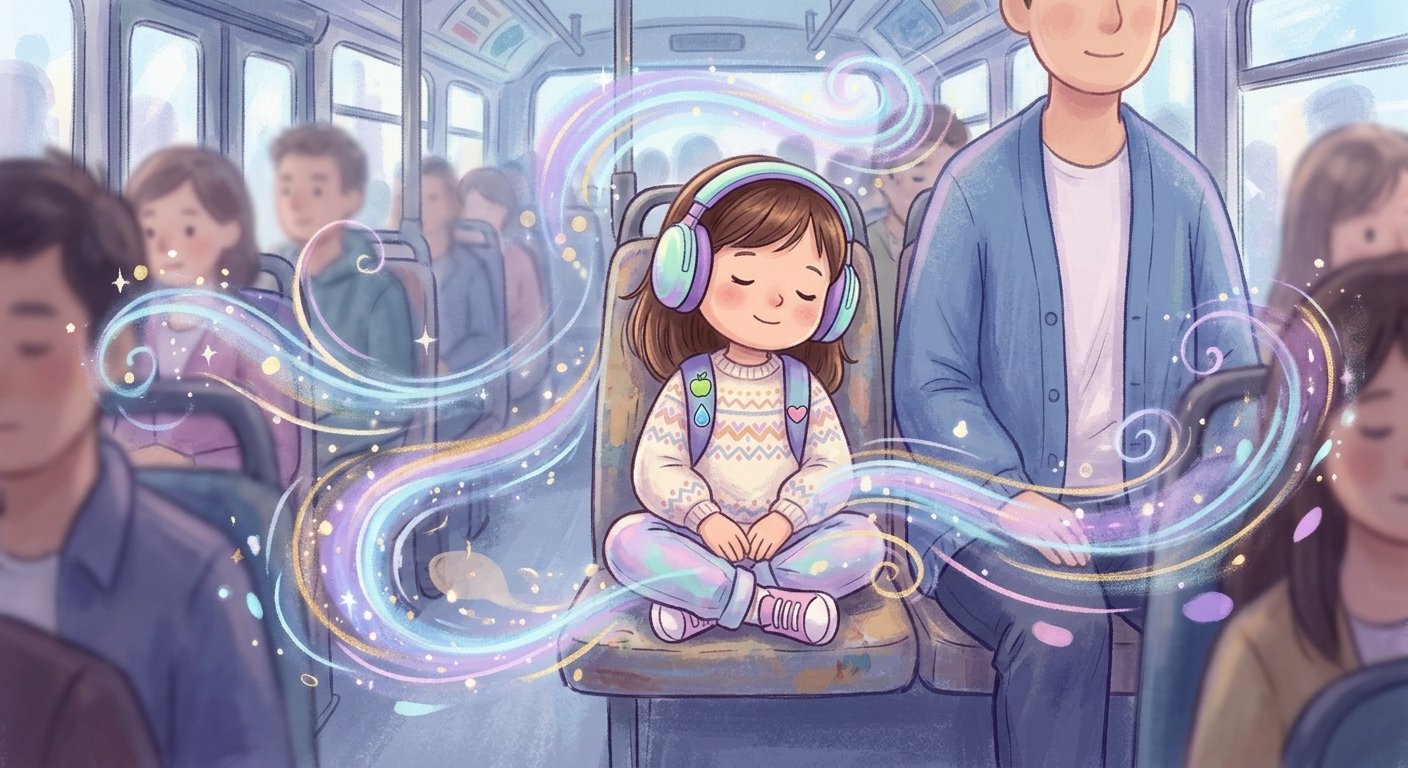
A twelve year old autistic boy is on a crowded bus home from school, wearing a Sunflower lanyard. The bus is noisy, hot and packed, and he’s been holding it together all day. He’s sitting in a priority seat, eyes down, headphones on.
An older man gets on and stands beside him. The boy doesn’t notice at first, then freezes, unsure what to do. The man says loudly, “Kids these days. Get up, there’s nothing wrong with you.” A woman nearby nods.
The boy stands up, shaking, and spends the rest of the trip pressed against the door, counting the stops.
The Five Steps: Everyday Stories. Lived Experiences. Better Understanding.
What happened
An autistic boy wearing a Sunflower lanyard was sitting in a priority seat on a crowded bus. An adult told him loudly to get up because there was “nothing wrong” with him.
What did people assume
That a young person who looks well has no reason to need a seat, and that not standing straight away was rudeness rather than uncertainty.
What might we not understand
He may have been close to overload after a long day of masking, crowds and noise. Sitting with headphones on may have been how he was coping. A sudden loud demand from a stranger can be very hard to process. The lanyard was there to signal exactly this kind of hidden need.
What could have helped
A quiet, polite question instead of a public comment. Or simply asking someone else for a seat. Other passengers could have offered their seats instead of nodding along.
What can we learn
“Nothing wrong with you” is something we can’t know from looking. When we can’t see a need, the kind default is to assume there might be one.
What Is an Invisible Disability?
An invisible disability, sometimes called a hidden or non visible disability, is a condition that affects someone’s daily life but isn’t obvious from the outside. It includes many conditions, such as autism, ADHD, anxiety, chronic pain, hearing loss, epilepsy and more. This article focuses on autism and ADHD.
These aren’t rare. In 2022, the Australian Bureau of Statistics estimated that 290,900 Australians were autistic, about 1.1% of the population, up from 205,200 in 2018. For people under 25, the rate was 3.1%.1 Many more are undiagnosed, as Bella and I were for years with ADHD.
The same report found that among autistic school students with disability aged 5 to 20, 68.9% had difficulties at school, and the most common difficulty was fitting in socially.1 Fitting in is exactly the kind of struggle that others rarely see.
What People May Not Understand About an Invisible Disability
| What it might look like | What may be going on |
|---|---|
| Ignoring a question | Needing more time to process words, especially in noise |
| Being blunt or rude | A direct communication style, not an intent to offend |
| Not making eye contact | Eye contact may be uncomfortable or make listening harder |
| Lazy or not trying | Struggling to start a task, plan steps or switch attention |
| Overreacting to a small change | Change removes the predictability that makes things feel safe |
| Fine yesterday, struggling today | Energy, sleep and sensory load vary from day to day |
| Fidgeting or wandering off | Movement may help them focus or stay regulated |
| Seems fine at school, falls apart at home | Masking all day, then letting go somewhere safe |
Every row in that table has something in common: the left column is visible, and the right column isn’t. That gap is where most misunderstanding happens.
Many of these ideas are explored further on this site. Our article on autistic masking looks at the “fine at school, falls apart at home” pattern. Our guide to why a child can do it some days and not others explains day to day variation. Our article on spiky profiles explains why a child can be advanced in one area and struggle in another.
A Hidden Disability Across One Day
It can help to picture how a hidden disability plays out over a single day. This is a general illustration, not one child’s story.
- Morning: a scratchy school jumper, a rushed breakfast and a changed drop off routine. Nobody else notices. The child arrives at school already tired.
- Mid morning: a noisy classroom, a relief teacher and an instruction given only out loud. The child copies others to work out what to do, and looks like they’re coping.
- Lunch: a crowded playground with unclear rules. The child walks the fence line alone. An adult thinks they’re happy in their own world.
- Afternoon: a surprise assembly in an echoey hall. The child holds it together, just.
- Home: a small request, like “shoes off, please”, and everything falls apart.
Each moment on its own is invisible. Together, they explain the meltdown at home that seems to come from nowhere. When we understand that a hidden disability builds up across a day, we can look for ways to lighten the load earlier, not just respond to the end of it.
What Research Shows About First Impressions
This is the study I mentioned earlier. In 2017, Noah Sasson and colleagues ran three experiments where people watched very short clips of autistic and non autistic people, some as short as two to ten seconds. Viewers rated autistic people as more awkward and less approachable, and said they’d be less willing to sit next to them, talk to them or hang out with them. These judgements formed within seconds and didn’t improve with more exposure.2
Then came the important detail. When viewers read only a written transcript of what the autistic people said, with no voice, face or body language, the difference disappeared. Their words were judged just as favourably as anyone else’s.2
So the problem was how others reacted to the way autistic people looked and sounded, not what they had to say. That shifts at least part of the responsibility for social difficulties away from the autistic person and onto the people doing the judging.
A follow up study by Sasson and Morrison found two things that helped. First impressions of autistic adults were more positive when viewers were told the person was autistic, and when viewers knew more about autism.3 Knowledge and context made people kinder. That’s a strong reason for everyday autism understanding, and a reason this hub exists.
“You Don’t Look Autistic”
It’s one of the most common things autistic people hear, and often one of the most frustrating. It’s usually meant as a compliment. But it carries a hidden message: that autism has a “look”, and that if you don’t match it, your struggles can’t be that serious.
Autism doesn’t have a look. Many autistic people, especially girls and women, learn to mask their traits so well that even professionals miss them. Our article on autism in girls explains why so many are identified late.
Better responses include: “Thanks for telling me. Is there anything that helps?” or simply “That makes sense. Let me know if you need anything.” Neither needs any knowledge of autism, just respect for what the person has shared.
ADHD: The Invisible Effort
ADHD is often invisible in a different way. People can see the results, like the lost hat, the late arrival or the half finished task, but not the effort behind them. A child with ADHD may have tried harder than anyone in the room to remember their library bag and still forgotten it.
Because the effort is invisible, the result gets read as carelessness. “If you cared, you’d remember.” Most people with ADHD have heard some version of this many times. Over the years, it can turn into a belief that they’re lazy or not good enough. Our articles on ADHD and forgetfulness and signs of ADHD in girls look at this more closely. Parenting with ADHD covers what it’s like when a parent has it too.
Children with ADHD can also find public places hard: waiting in queues, keeping their bodies still, and managing big, quick feelings. Our article on sensory overload in public looks at how noise and crowds can add to the load.
The Sunflower Lanyard and Invisible Disability
The Hidden Disabilities Sunflower began at Gatwick Airport in the UK in 2016, developed with charities including the National Autistic Society. It’s a simple symbol, usually a green lanyard with yellow sunflowers, that lets people quietly signal they may need extra time, help or understanding without having to explain. In 2019 it came to Australia and New Zealand through a partnership with Bayley House.4
Many Australian airports, shopping centres and businesses now recognise the Sunflower. If you see someone wearing one, the best response is simple: be patient, offer help if it seems needed, and don’t ask them to explain or prove anything.
The Sunflower is useful, but it isn’t a solution on its own. A lanyard only works if the people who see it know what it means. And many people with invisible disabilities don’t wear one at all, so the absence of a lanyard tells you nothing.
To Tell or Not to Tell
Should families tell strangers, teachers or staff that a child is autistic or has ADHD? There’s no single right answer. The research above suggests that knowing someone is autistic can make first impressions kinder.3 But telling also has risks: some people respond badly, and some autistic people and families prefer privacy.
A few things to weigh:
- Whose information is it? As children grow, their own views about who knows should count more and more.
- What’s the goal? Explaining to a teacher who’ll see your child every day is different from explaining to a stranger in a queue.
- How much is enough? Often a short line works better than a full explanation: “She’s autistic and needs a minute.”
- What helps, not just what it’s called. “Loud noises are hard for him” is often more useful than a diagnosis.
Our free What You Can’t See About Me card focuses on that last point: what helps, rather than what it’s called. Children can choose what to share.
5 Easy Ways to Respond Well to an Invisible Disability
Assume there might be a reason
When behaviour seems odd or rude, pause and assume there may be something you can’t see. You’ll often be right.
Ask quietly, not publicly
If you need something, like a seat or a turn, ask gently and privately. Don’t make a scene or recruit an audience.
Believe what people tell you
If someone says they or their child is autistic or has ADHD, take it as true. Don’t ask for proof or say they don’t look it.
Give time
Pause after a question. Speak clearly. Offer information in writing if you can. Processing time is one of the most helpful things you can give.
Focus on what helps
Instead of asking what’s “wrong”, ask “Is there anything that would make this easier?”
For Families, Educators and Businesses
For families
Help your child build a simple way to explain their needs, in words, pictures or a card. Our free All About Me storybook lets a child decide what to share about themselves. For outings, the Out and About Together plan includes a kindness card you can show to staff. And the Venue Sensory Snapshot helps you check a place before you go.
For educators
Remember that a child who seems fine in your room may be using a great deal of energy to stay that way. Tell families honestly what you see, and listen when they describe a different child at home. Visual supports help many children with invisible disabilities, and they help other children too. Our Expectation Swap Cards offer gentler alternatives to common phrases like “look at me” and “sit still”.
For businesses and services
Train staff to recognise the Sunflower and to respond to unusual behaviour with patience rather than suspicion. Offer information in writing as well as speech. Make it easy to ask for help without having to explain a diagnosis. Small things, like a quieter place to wait or a staff member who doesn’t rush, make a large difference to people whose needs can’t be seen.
When to get more help. If you think your child, or you, might be autistic or have ADHD, start with your GP, who can refer you to a paediatrician, psychiatrist or psychologist for assessment. For children, your Maternal and Child Health nurse or kinder or school can also help. A diagnosis isn’t required to use supports like the Sunflower or to ask for reasonable adjustments, but it can open doors to understanding and services.
Free Printable: What You Can’t See About Me for Invisible Disability
Two matching cards on one page, so a child or family can explain what helps without needing to explain a diagnosis. Fill in one with your child and keep a spare.
Download the Free PDFHow to Use the What You Can’t See About Me Card
- Print the page and cut it down the middle to make two cards. Fill one in together with your child on a calm day, and keep the other spare for updates or a second carer.
- Start with “I’m good at”, so the card begins with a strength. Let your child choose the words, or draw if they prefer. Older children may want to fill it in themselves.
- Circle the “Sometimes I might” and “What helps me” options that fit, and add your own on the lines. Explain “That’s because” in simple, practical words, such as “loud places make it hard to hear” rather than a diagnosis, unless your child wants to name it.
- Use “Please don’t” for one or two things that make it worse, like “touch me without asking” or “rush me”. Keep the whole card short, so a busy adult can read it in seconds.
- Share the card with new teachers, relief educators, coaches, babysitters or shop staff when it helps. Laminate it or keep a photo on your phone, and update it as your child grows and changes.
More Free PDFs for Hidden Needs and Everyday Inclusion
Fight, Flight, Freeze Spotter Card
Spot hidden stress early.
Download PDFFor carers and educatorsMore free tools are on our printables page.
Back on the Bus
A boy in a priority seat, headphones on, a sunflower lanyard around his neck. A man who saw a healthy kid being rude. Both were looking at the same scene. Only one of them could see what it was costing.
Now go back to the moment you remembered at the start. What you felt was understandable, and what you thought made sense with what you could see.
What might have been going on that you couldn’t see? Processing time, a long day of masking, noise that hurt, an invisible effort to cope?
What might your mind say now? Perhaps “there might be something I can’t see”.
What might you do next time? Ask quietly instead of publicly, give a little time, or simply believe what someone tells you.
We’ll never be able to see every invisible disability. But we can change our default. Instead of “there’s nothing wrong with you”, we can start from “there might be something I can’t see”. It takes no money or training, and for the people living with invisible disabilities, it can change an entire day.
- Hub: Inclusion Beyond the Classroom
- Previous: sensory overload in public
- Next in the series (coming soon): Travelling with an Autistic Child
- Meltdowns: autistic child meltdown in public
- Masking: autistic masking
- ADHD: ADHD behaviour strategies
Invisible Disability FAQs
What is an invisible disability?
An invisible disability is a condition that affects someone’s daily life but isn’t obvious from the outside. Autism, ADHD, anxiety, chronic pain and hearing loss are common examples.
Are autism and ADHD invisible disabilities?
Often, yes. A child or adult can look fine while working very hard to cope with noise, change, communication or attention. Many people with autism or ADHD aren’t diagnosed until adulthood because their needs weren’t visible.
What does the Sunflower lanyard mean?
The Hidden Disabilities Sunflower lets people quietly signal they may have a hidden disability and need extra time, help or understanding. If you see one, be patient and don’t ask the person to explain or prove anything.
Why is “you don’t look autistic” hurtful?
It suggests autism has a look, and that someone who doesn’t match it can’t be struggling much. Autism has no look, and many autistic people mask their traits to fit in.
Should I tell people my child is autistic?
It’s a personal choice. Research suggests knowing someone is autistic can make first impressions kinder, but some families prefer privacy. Often, explaining what helps is more useful than naming a diagnosis.
Research: the Australian Bureau of Statistics’ Autism in Australia 2022 report; Sasson and colleagues’ 2017 studies on first impressions; Sasson and Morrison’s 2019 study on disclosure and autism knowledge; and Hidden Disabilities Sunflower’s own history of the scheme.
Experience: that Bella and I were diagnosed with ADHD in our twenties and forties is true. The bus scene is a general illustration of a situation many families describe, not one family’s story. The five ways to respond and the What You Can’t See About Me card come from my own practice.
This is educational content, not medical advice. Last reviewed: 12 November 2026.
References
- Australian Bureau of Statistics. (n.d.). Autism in Australia, 2022. https://www.abs.gov.au/articles/autism-australia-2022
- Sasson, N. J., Faso, D. J., Nugent, J., Lovell, S., Kennedy, D. P., & Grossman, R. B. (2017). Neurotypical peers are less willing to interact with those with autism based on thin slice judgments. Scientific Reports, 7, Article 40700. https://doi.org/10.1038/srep40700
- Sasson, N. J., & Morrison, K. E. (2019). First impressions of adults with autism improve with diagnostic disclosure and increased autism knowledge of peers. Autism, 23(1), 50-59. https://doi.org/10.1177/1362361317729526
- Hidden Disabilities Sunflower. (n.d.). How the movement grew. https://hdsunflower.com/au/insights/post/history

One Comment
Comments are closed.