
Travelling With an Autistic Child: What Families Wish Others Understood, and 6 Easy Ways to Help
Travelling with an autistic child can bring together almost everything that makes public places hard: crowds, noise, queues, waiting, security checks, broken routines and long stretches with nowhere to go. Many families travel happily with good planning. But how staff and other travellers respond can make or break the day.
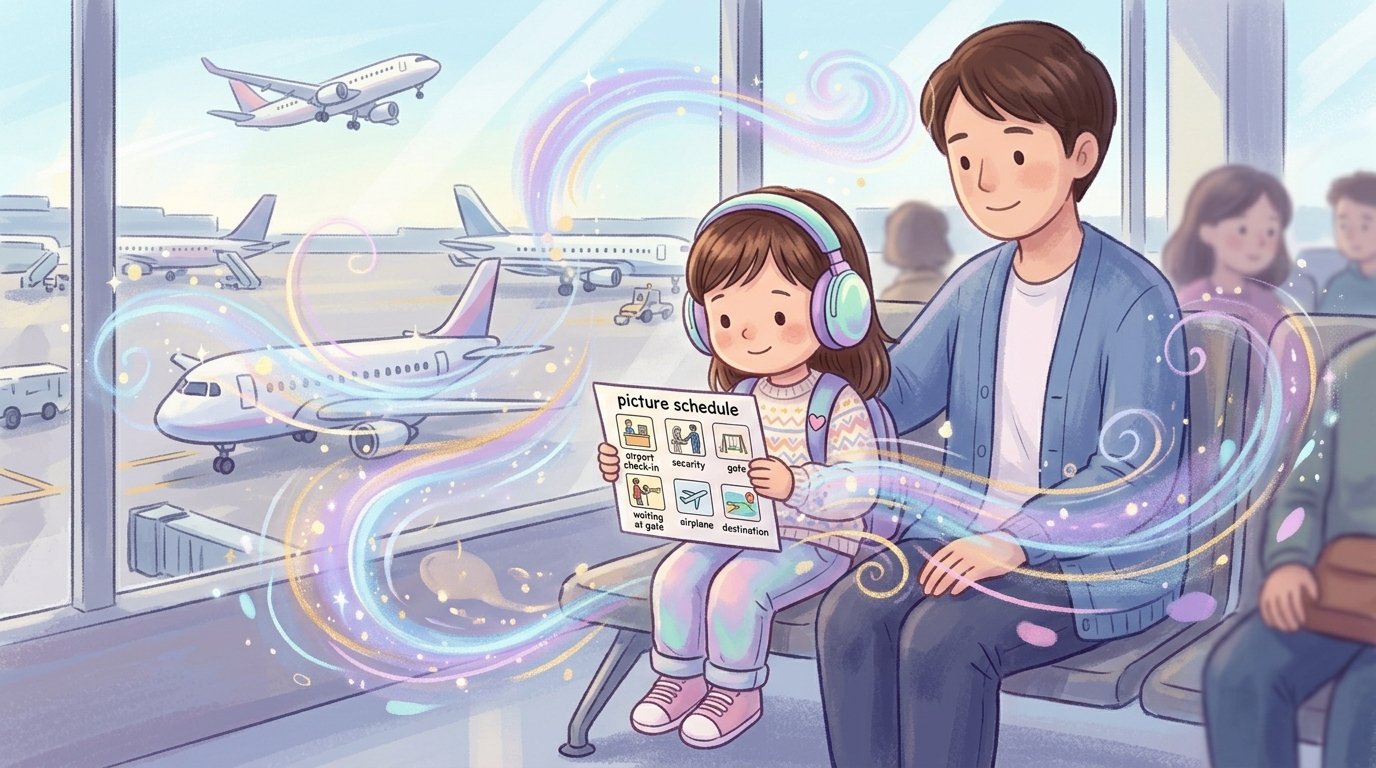
This article starts with a moment from your own travels. Then it walks through an airport scene and each stage of a travel day. It covers what research with families shows, what families wish others understood, what Australian airports now offer, and six easy ways to help. It includes a free Travel Day Plan and twelve related free PDFs.
I still remember the end of our first flight from Jakarta to Melbourne in October 2010. We were about to get off the plane after roughly six hours in the air. A senior couple near us leaned over and told me how good my girls were. So quiet, they said.
They had no idea how nervous I was. It was the first flight of Bella’s and Zara’s lives. Bella was seven and Zara was nearly five, and Zara had been sick and thrown up on the way. I had packed a sick bag and travel sickness tablets just in case, along with books, pencils and their soft toys to hug. Inside, I’d spent much of that flight panicking.
Parents today often travel with tablets and devices. We had paper, pencils and a lot of hoping. But that kind couple taught me something I’ve thought about ever since: what other travellers see is only a small part of what a family is managing. Sometimes they see calm and miss the panic. Often, especially when a family is travelling with an autistic child, they see the meltdown and miss everything that came before it.
So before you read on, think back to a time you were travelling and a child or family caught your attention. A child screaming in the security queue. A small foot kicking the back of your seat for an hour. A family boarding first while you waited. A parent trying to calm a child in the aisle while everyone watched.
What did you feel? Maybe frustration, tiredness, embarrassment for the parent, or worry about the flight ahead.
What did your mind tell you? Perhaps “why can’t they control that child”, “some people shouldn’t fly with kids” or “why do they get to go first?”
What did you do? Did you sigh, put your headphones in, turn around and stare, say something, or offer a smile?
Keep that moment in mind. Most of us have had those thoughts on a long travel day, especially when we’re tired ourselves. By the end of this article, you might see what was happening for that family a little differently.
- How This Article Helps
- A Scene at Security
- The Five Steps
- Why Travel Can Be So Hard
- What Research With Families Shows
- What Families Wish Others Understood
- When Travel Doesn’t Go to Plan
- Autism Friendly Airport Supports in Australia
- Planning a Trip, Step by Step
- Travelling With a Child Who Has ADHD
- 6 Easy Ways to Help
- Free Printable: Travel Day Plan
- More Free PDFs
- Back to Your Moment
- FAQs
How This Article on Travelling With an Autistic Child Helps
- Reflect on what you’ve seen on your own travels, and what you might not have been able to see.
- Understand why each stage of a travel day can be hard for autistic children.
- Learn what research with families shows about airports.
- Find the supports Australian airports now offer.
- Plan a trip step by step, with a free Travel Day Plan.
- Try six easy ways to help as a fellow traveller or staff member.
There’s a finding in the research section that surprised me. Researchers followed families of autistic children through an airport. The hardest moment was usually something much smaller than the flight, the noise or the crowds. It came at a point most of us barely think about.
This is the fifth article in the Everyday Stories. Lived Experiences. Better Understanding. series, part of our Inclusion Beyond the Classroom hub.
Travelling With an Autistic Child: A Scene at Security
A general illustration of a situation many families describe, not one family’s story.
A mother and her seven year old autistic son are in the security line at a busy Australian airport, early on a holiday morning. They’ve practised this for weeks with pictures. He’s holding his tablet, which plays the same calming video he always watches.
At the scanner, an officer tells him the tablet has to go in the tray. He clutches it. His mother explains, but the officer repeats the instruction more firmly. The tablet goes into the tray, the tray disappears into the machine, and he starts screaming and pulling at the barrier.
Behind them, someone sighs loudly. A man says, “Some people shouldn’t travel with kids.” The queue stops. His mother kneels on the floor, trying to calm him, while every eye in the line is on her.
The Five Steps: Everyday Stories. Lived Experiences. Better Understanding.
What happened
An autistic boy became distressed when he had to hand over his tablet at airport security. He screamed and pulled at the barrier while his mother tried to help him. Other travellers sighed and commented.
What did people assume
That the child was spoilt, that his mother couldn’t manage him, and that the family was holding everyone up for no good reason.
What might we not understand
The tablet was more than a toy. It was his way of coping with a loud, unfamiliar, crowded place. Losing it, even for a minute, removed his main support at the most stressful point of the day. He may also not have understood that it would come back.
What could have helped
An officer who explained, with a picture or gesture, that the tablet would come out the other side in a moment. Letting his mother hold it until the last second, or go through right beside it. Fellow travellers who gave them space instead of comments.
What can we learn
Small rules, applied without flexibility, can have big effects. And the families who seem least prepared in a queue have often prepared the most.
Why Travelling With an Autistic Child Can Be So Hard
A travel day is a chain of challenges, one after another, with very little control and very few ways out.
| Stage | What can be hard | What can help |
|---|---|---|
| Getting to the airport | Early starts, broken routines, traffic, parking | A visual plan, a familiar snack, extra time |
| Check in | Long queues, bright lights, announcements | Online check in, a quieter time, a Sunflower lanyard |
| Security | Handing over comfort items, beeping, being touched | Practise beforehand, ask staff for patience, explain what will happen |
| Waiting at the gate | Crowds, delays, nothing to do | A quiet room, headphones, movement breaks |
| Boarding | Pushing, narrow aisles, unclear order | Ask about boarding early, or board last when it’s quieter |
| The flight | Ear pressure, engine noise, sitting still, seatbelt sign | Headphones, chewy snacks, a window seat, familiar activities |
| Arrival | Baggage halls, new places, tired bodies | A clear plan for what happens next, a calm first evening |
When travelling with an autistic child, each stage on its own might be manageable. Together, with no chance to rest in between, they can fill a child’s sensory cup to overflowing. Our article on sensory overload in public explains why predictability and a way out matter as much as noise.
What Research With Families Shows
The finding I promised
In a study at Barcelona’s El Prat Airport, researcher Mónica Cerdan Chiscano worked with 25 families of autistic children during a practice airport visit. Most had never flown before. She found that security was the most difficult point. In particular, families struggled when children had to hand over tablets and other comfort devices to go through the scanner.1
Long queues, large noisy spaces, confusing signs and staff who weren’t aware of autism also caused stress. Several things helped. Families saw a storybook of the airport process before the visit. They had priority check in and security, a quiet room and clearer signs. Airport and airline staff also had a day of autism awareness training. Families who took part in designing these supports were very satisfied, though the study was small and at one airport.1
Think back to the scene at security. The tablet was the hardest part of the whole day, and it’s one of the easiest things for staff to handle with a little flexibility.
Australian research
In 2024, the Aspect Research Centre for Autism Practice, led by Dr Chris Edwards, carried out interviews. They spoke with autistic adults and parents of autistic children who had travelled through Sydney and Gold Coast airports. Three themes stood out. Airports need to be more accessible for autistic travellers. The Sunflower lanyard helps when staff recognise it. And the air travel industry needs more awareness and more consistent practices.2
The researchers recommended fewer sensory triggers and more quiet spaces, better signs, ongoing staff training, and involving autistic people in airport policy.2 Together, these studies give a clear picture of what an autism friendly airport needs, and what makes travelling with an autistic child easier.
What Families Wish Others Understood About Travelling With an Autistic Child
- We’ve planned for weeks. What you see in the queue is the part that didn’t go to plan, not the whole picture.
- Crying isn’t bad parenting. It may be the only way a child can show that everything is too much.
- The tablet and headphones are coping tools. They work like a seatbelt for the nervous system.
- Boarding early isn’t queue jumping. A quieter plane and an extra few minutes to settle can prevent a meltdown for everyone.
- Seat kicking can be sensory. Some children need movement to cope. A kind word to the parent works better than turning around to glare.
- A short explanation is all we can manage. “He’s autistic” may be all you get, and that’s enough.
- A smile helps more than you know. One kind face in a crowd of stares can carry a parent through a hard day.
When Travel Doesn’t Go to Plan
Sometimes, despite every plan, things go badly wrong. In October 2026, Australian media reported on a family stranded in Japan after their 18 year old autistic son, Ryan, developed an intense fear of flying during their holiday. Ryan had flown before without problems. The family said they were advised he would need to be sedated and flown home on a specialist medical flight, which their fundraiser put at around $500,000.3
We don’t know more than what’s been reported, and Ryan is a young adult, so his story is his and his family’s to tell. But it shows something many families quietly fear when travelling with an autistic child. A child who coped before might not cope next time, and the systems around air travel aren’t always built for that.
Here is a related example, though not an autism story. In May 2026, UK media reported that a 13 year old boy with Tourette syndrome wasn’t allowed to board a British Airways flight. He had been heard saying “bomb”. His parents said they had told the airline about his diagnosis and that he wore a disability lanyard. The airline said its decision was about safety and security, not his condition.4 It raises a question many autistic families share: when you tell an airline about a hidden disability in advance, does that information reach the people making decisions at the gate?
Autism Friendly Airport Supports in Australia
Many Australian airports have made changes in recent years that make travelling with an autistic child easier. These are the details I’ve confirmed directly from airport websites. Check with your own airport before you travel, as programs change.
Melbourne Airport
A Hidden Disability Program with free Sunflower lanyards from the Visitor Information desk in the T2 Arrivals Hall. There are sensory maps of every terminal showing high, medium and low sensory areas. Picture based social stories cover international departures and arrivals. Staff are trained in the program.5
Sydney Airport
A Quiet Room in the T1 International Terminal, past security and border control, designed with autistic people and Aspect. It can be booked for free, holds up to four people for 45 minutes, and gives priority to neurodivergent travellers. Sydney Airport also takes part in the Sunflower program.6
The Hidden Disabilities Sunflower is recognised at many Australian airports. It lets staff know a traveller may need extra time or help, without the family having to explain. As the Aspect research found, it works best when staff know what it means.2
Planning a Trip When Travelling With an Autistic Child
Weeks before
Look at the airport’s sensory maps and social stories together. Watch videos of planes taking off and landing. Talk through each stage in order, using pictures. Our Big Adventure storybook lets your child make their own travel story, and the Three Picture Story breaks the trip into before, during and after.
Days before
Pack a travel kit: headphones, a tablet loaded with familiar shows, chewy snacks for ear pressure, a favourite comfort item, spare clothes and wipes. Tell the airline about your child’s needs and ask what they can offer. Collect a Sunflower lanyard if your airport has them. Practise handing over the tablet and getting it back, so security isn’t a surprise.
On the day
Leave far more time than you think you need. Use a visual plan so your child can tick off each stage. Our free Travel Day Plan sets out all seven stages, from leaving home to arriving, on one page. Our First Then starter tiles and countdown cards can show “first security, then the quiet room”. Find quiet spots on the sensory map. Use movement breaks at the gate: our Pocket Heavy Work cards have ideas like wall pushes and carrying a backpack.
Flying with an autistic child
Keep routines as familiar as possible: the same snacks, the same shows, the same words. Warn your child before announcements, the seatbelt sign, take off and landing. If things build up, our Calm Shapes breathing cards fit in a seat pocket.
When you arrive
Plan a calm first evening. New places take energy, and many children need time to recover from the trip before they can enjoy the destination. Recreate a piece of home, like a familiar blanket or bedtime story. If a meltdown happens, our Rumble to Recovery card helps you plan what to do during and after.
Travelling With a Child Who Has ADHD
Many of the supports for travelling with an autistic child also help children with ADHD, but the hardest parts can be different. Long waits, sitting still with a seatbelt on, and quick changes of plan can be especially tough. Pack plenty of activities that change often, plan for movement whenever you can, and give lots of warning before transitions. A child running ahead in a terminal isn’t being naughty for the sake of it; their body may be telling them it needs to move. Our guide to ADHD behaviour strategies has more ideas.
6 Easy Ways to Help a Family Travelling With an Autistic Child
Whether you’re a fellow passenger or work at the airport, small actions can make travelling with an autistic child much easier.
Give space, not stares
If a child is distressed in a queue or on a plane, look away kindly and give the family room. An audience makes everything harder.
Hold back the comment
“Some people shouldn’t travel with kids” helps no one. If you want to say something, try “Take your time”.
Let them go first, or last
If a family needs to board early or skip ahead in a line, let them. A calmer child makes a calmer flight for everyone.
Talk to the parent, kindly
If a seat is being kicked, a quiet word to the parent works better than turning to glare. They may not have noticed, or may already be trying.
For staff: explain and show
Use simple words, gestures or pictures. Show a child that their tablet will come back. Allow a little flexibility where rules permit.
For staff: know the Sunflower
If you see a Sunflower lanyard, offer patience, time and help without asking for an explanation.
When to get more help. Your child may have a very strong fear of flying, or past trips may have ended in severe distress. If so, talk with your GP, paediatrician or psychologist well before you go. Never give sedating medication for travel without your doctor’s advice. If a child is at risk of harm at an airport, such as running towards a road or a tarmac door, alert staff straight away. For international travel, check that your travel insurance covers your child’s needs.
Free Printable: Travel Day Plan for Travelling With an Autistic Child
A one page plan for the whole travel day. It has seven stages in order, what helps at each one, a travel kit checklist and a plan for when it all gets too much.
Download the Free PDFTravel Day Plan
Tick each stage as we go. Draw or write what helps.
How to Use the Travel Day Plan
- Print the plan a week or two before you travel. Go through the seven stages with your child, one at a time, using the airport’s sensory map and social story if it has them.
- For each stage, write or draw what will happen on the first line, such as “put tablet in tray” at security. On the second line, add what helps, such as “Mum holds my hand” or “headphones on”.
- Tick the travel kit items as you pack, and add anything special to your child. Practise the tricky parts at home, like handing over the tablet and getting it back.
- Agree on a signal for “I need a break”, find a quiet place on the map, and practise the line you’ll say to staff or strangers. Having the words ready makes them easier to use.
- On the day, keep the plan in your bag or on your phone and tick off each stage together. Afterwards, note what worked and what to change for next time. Educators can use the same plan to prepare children for excursions or school trips.
More Free PDFs for Travelling With an Autistic Child
More free tools are on our printables page.
Back to Your Moment
Now go back to the moment you remembered at the start: the screaming child, the kicked seat, the family who boarded first, the parent in the aisle.
What might that family have been managing that you couldn’t see? Weeks of planning, a comfort item taken away, a body that needed to move, a parent running on no sleep?
What might your mind say now? Perhaps “they’re doing their best” or “this is harder for them than it is for me”.
What might you do next time? Look away kindly, offer a smile, let them go first, or say “take your time”.
What you felt back then was understandable. Travel days are long, and we’re all tired. That couple on our flight to Melbourne saw two quiet girls and missed a nervous mother with a sick bag. Most of us, most of the time, only see the surface. But travelling with an autistic child is a lot harder than travelling next to one, and a single kind response can change how that family remembers the whole trip.
- Hub: Inclusion Beyond the Classroom
- Previous: invisible disability: autism and ADHD
- Next in the series (coming soon): Eating Out With an Autistic or ADHD Child
- Meltdowns: autistic child meltdown in public
- Sensory: sensory overload in public
- Masking: autistic masking
Travelling With an Autistic Child FAQs
How do I prepare for flying with an autistic child?
Start weeks before: look at the airport’s sensory map and social story, watch videos of planes, and walk through each stage with pictures. Pack a travel kit, practise security at home, tell the airline about your child’s needs, and leave plenty of time on the day.
Which Australian airports are autism friendly?
Many Australian airports now offer autism friendly airport supports. Melbourne Airport has Sunflower lanyards, sensory maps and social stories. Sydney Airport has a bookable Quiet Room in T1 International, designed with Aspect. Check your own airport’s website before you travel.
What is the hardest part of air travel for autistic children?
It varies, but research with families at Barcelona airport found security was the hardest point, especially when children had to hand over tablets and comfort items. Queues, noise and unclear signs also caused stress.
What does the Sunflower lanyard do at airports?
It quietly signals that a traveller may have a hidden disability and need extra time or help. Australian research found it helps most when airport staff recognise it and know how to respond.
How can I help a family with an autistic child on a flight?
Give them space, don’t stare or comment, let them board first or last if they need to, and speak kindly to the parent rather than glaring if something bothers you. A smile can help more than you think.
Research and reporting: Cerdan Chiscano’s 2021 study with 25 families at Barcelona airport (small, one airport); Aspect’s 2024 research with autistic travellers and parents at Sydney and Gold Coast airports; Melbourne and Sydney Airport websites, checked November 2026; reporting on the family stranded in Japan; and reporting on the British Airways case, included as a related example only, as it involves Tourette syndrome, not autism.
Experience: the story of our first flight from Jakarta to Melbourne in 2010 is my own memory, shared to show how little other travellers can see. The security scene is a general illustration of a situation many families describe, not one family’s story. The six ways to help and the Travel Day Plan come from my own practice.
This is educational content, not medical or travel advice. Airport programs change, so check before you fly. Last reviewed: 12 November 2026.
References
- Cerdan Chiscano, M. (2021). Autism spectrum disorder (ASD) and the family inclusive airport design experience. International Journal of Environmental Research and Public Health, 18(13), Article 7206. https://doi.org/10.3390/ijerph18137206
- Autism Spectrum Australia. (2024, November 14). New research finds ways to make airports more autism friendly. https://www.aspect.org.au/news/new-research-finds-ways-to-make-airports-more-autism-friendly
- Newcastle Weekly. (2026, October). Australian family stranded in Japan facing staggering $500,000 bill to bring son home. https://newcastleweekly.com.au/family-stranded-in-japan-staggering-500000-to-bring-son-home/
- IBTimes UK. (2026, May 25). British Airways under fire for refusing teen with Tourette’s syndrome board the plane for shouting ‘bomb’. https://www.ibtimes.co.uk/british-airways-denies-boarding-teen-tourettes-1798641
- Melbourne Airport. (n.d.). Hidden disability program. https://melbourneairport.com.au/hidden-disability-program
- Sydney Airport. (n.d.). Quiet room. https://www.sydneyairport.com.au/quiet-room
