
Autistic Child Meltdown in Public: Why We Judge the Parent, and 5 Easy Ways to Help Instead
An autistic child meltdown in public is an intense response to overwhelm, often from noise, light, crowds, waiting or a sudden change. It is not the same as a tantrum, and it is not a sign of poor parenting. Yet the parent beside the child is often the one who gets judged.
This article walks through a supermarket scene using our five step Everyday Stories format. It explains what onlookers see and what they may miss, and compares meltdowns and tantrums. It looks at the research on why parents get judged, and offers practical steps for parents, bystanders, staff and educators. It includes a free Rumble to Recovery card and twelve related free PDFs.
When we see a child struggling in public, why is our first reaction so often to judge the parent, rather than wonder what the child might be going through? That question sits underneath every story in this article. By the end, I hope you’ll answer it differently the next time you’re in the checkout queue.
- How This Article Helps
- A Supermarket Scene
- The Five Steps
- What People See and What They May Miss
- Meltdown vs Tantrum
- A Reported Story: The Zoo
- Why Do We Judge the Parent?
- What the Research Says
- What Judgement Costs Families
- For Parents: Before, During and After
- 5 Easy Ways Bystanders Can Help
- For Shop Staff and Venues
- For Educators
- Free Printable: Rumble to Recovery Card
- More Free PDFs
- FAQs
How This Article on an Autistic Child Meltdown in Public Helps
- See the moment from the inside, not just from the next aisle.
- Tell a meltdown from a tantrum, without assuming every outburst is one or the other.
- Understand why parents get judged, and what that judgement costs.
- Get practical steps for before, during and after, whether you’re the parent, a stranger or a staff member.
- Print a free card to plan your own family’s response.
There’s an Australian survey figure further down this page that describes almost exactly what the strangers in our supermarket scene do. When you reach the research section, you’ll see how ordinary that reaction is, and why that’s the bigger problem.
This is the first article in the Everyday Stories. Lived Experiences. Better Understanding. series, part of our Inclusion Beyond the Classroom hub on autism awareness and acceptance in everyday community life.
An Autistic Child Meltdown in Public: A Supermarket Scene
An illustration drawn from situations I’ve seen through my work, not one family’s story.
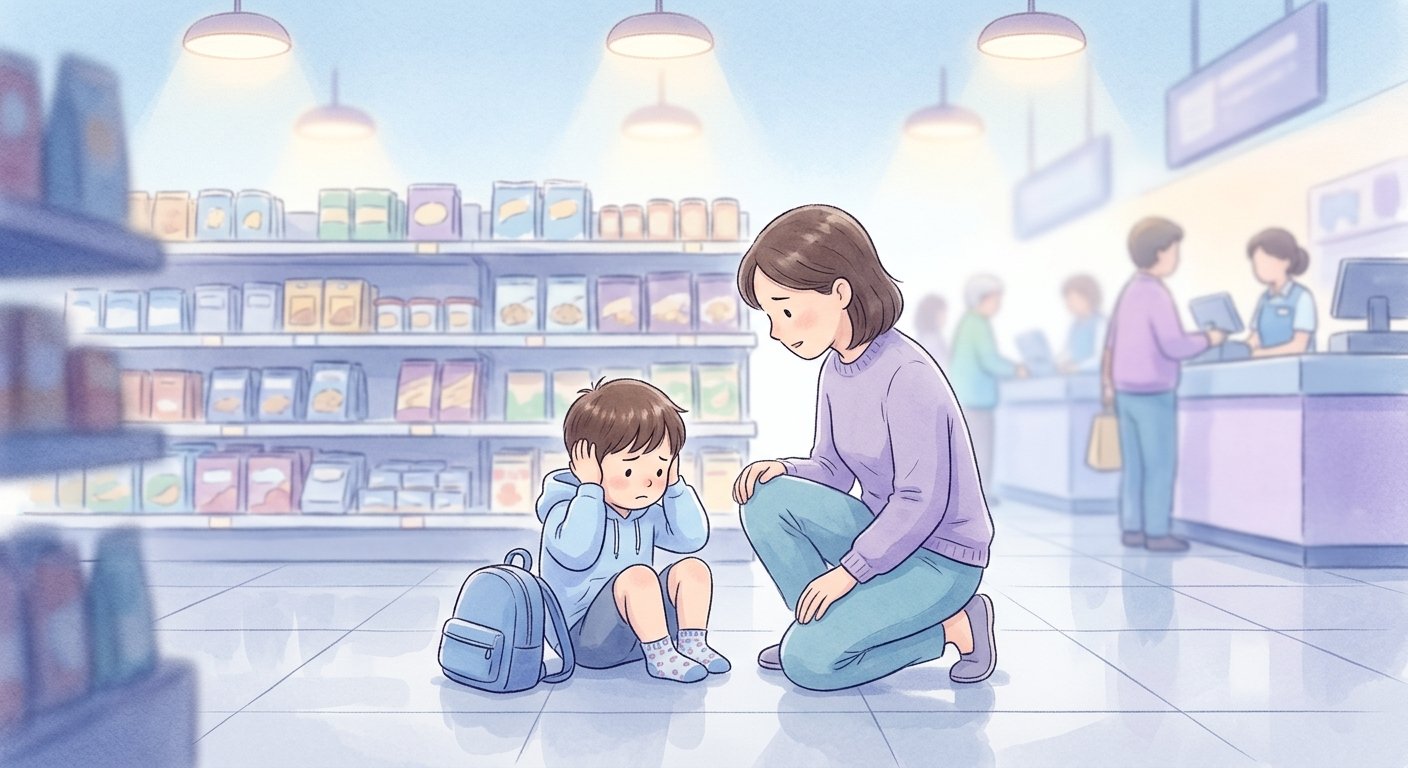
A mother takes her five year old autistic son to a busy Melbourne supermarket. At first, everything seems fine. They walk the aisles, put a few groceries in the trolley and head towards the checkout.
Then the store gets louder. People talking, trolley wheels rattling, checkout beeps, bright lights overhead. The boy starts covering his ears. His mother notices and tells him they just need to wait in the queue.
That’s when it tips over. He cries loudly, drops to the floor and screams. He pushes the basket away. He can’t answer her questions.
His mother kneels beside him. She speaks gently, but he’s too overwhelmed to tell her what’s wrong.
People nearby start looking. One shakes their head. Another says, “Why can’t his mother control him?” Someone else adds, “Children shouldn’t behave like that in public.”
The mother feels embarrassed and under pressure. She’s trying to help her child while feeling every pair of eyes on her back.
If you’ve ever been the parent during an autistic child meltdown in public, you’ll know the feeling: your whole attention is needed in two places at once. Your child needs you calm and close. The crowd seems to need you to make it stop, right now. Those two needs pull in opposite directions, and no parent can meet both.
If you’ve been one of the onlookers, that’s okay too. Most of us have been. This article is about understanding what the people in the queue couldn’t see, not about blaming them.
The Five Steps: Everyday Stories. Lived Experiences. Better Understanding.
Every article in this series works through a situation in the same five steps. This is how this autistic child meltdown in public looks when we slow it down.
What happened
A young autistic boy became more and more distressed in a noisy supermarket, then dropped to the floor, cried, screamed and couldn’t communicate. His mother stayed beside him and tried to comfort him. Nearby shoppers stared, shook their heads and made comments about her parenting.
What did people assume
The onlookers seemed to assume three things: that the child was misbehaving, that the mother had lost control, and that the situation was mainly a disturbance to them. Each assumption makes sense from a few metres away. Each one was probably wrong.
What might we not understand
The child was likely in sensory overload. The noise, lights and waiting had been building for a while before anyone noticed, and covering his ears was an early sign. By the time he dropped to the floor, he may not have been able to process instructions or put his distress into words. And his mother may already have been trying several ways to help that nobody saw.
What could have helped
Space instead of staring. Silence instead of commentary. A staff member offering a quieter spot or opening a register so they could pay later or leave. Perhaps one shopper saying quietly to the mother, “Take your time. You’re doing fine.”
What can we learn
What we see in public is usually the end of a story, not the beginning. When a child is struggling, the most useful first question isn’t “what’s wrong with that parent?” It’s “what might this child be experiencing right now?”
What People See During an Autistic Child Meltdown in Public, and What They May Miss
| What onlookers see | What they may not understand |
|---|---|
| A child screaming and lying on the floor | The child may be in sensory overload, with the noise, light and waiting adding up long before it showed |
| A child ignoring his mother | In that moment he may be unable to process words or explain what’s wrong |
| A mother who can’t control her child | She may already have tried several calming strategies, and knows that raising her voice would make it worse |
| A scene disturbing other shoppers | The child is the one most disturbed, and the fastest way to end it is usually less attention, not more |
| A sudden outburst | The early signs, like covering ears, may have started minutes earlier |
The gap between those two columns is where judgement lives. When we only see the left side, a parent kneeling quietly on the floor looks like a parent doing nothing. When we know the right side, she looks like someone doing exactly the right thing in a very hard moment.
Meltdown vs Tantrum: What’s the Difference?
People often use these words as if they mean the same thing. They don’t, and the difference changes how we respond.
| Tantrum | Meltdown | |
|---|---|---|
| What drives it | Often frustration or wanting something, like a lolly or more time at the park | An intense response to overwhelm, such as sensory overload, a sudden change or exhaustion |
| Awareness of others | The child may check whether anyone is watching | The child usually isn’t aware of, or can’t respond to, the audience |
| What ends it | Often stops when the goal is met or clearly won’t be met | Ends when the person has had enough time, space and calm to recover |
| What helps | Calm, clear limits and connection | Less input, fewer words, safety and time |
The National Autistic Society describes a meltdown as an intense response to a situation that has become too much, where the person temporarily loses control of their behaviour. It stresses that a meltdown is not naughty behaviour and not deliberate.1 Some autistic people show overwhelm in quieter ways too, by withdrawing or shutting down.
Here’s an important caution, though. We shouldn’t automatically assume every public outburst by an autistic child is a meltdown. Autistic children have tantrums too, just like every other child. And a child having a hard time may not be autistic at all. They might have ADHD, be unwell, be hungry or simply be four. Knowing the difference helps us slow down our judgement when we think we’re watching an autistic child meltdown in public. We’re seeing a few seconds of a much longer day.
The “rumble” before the storm
Many autistic people show warning signs before a meltdown, sometimes called the rumble stage. These can include pacing, rocking, asking the same question again and again, going very still, or covering ears.1 In our supermarket scene, the boy covering his ears was the rumble. This is often the best moment to prevent an autistic child meltdown in public: lower the input, offer a familiar comfort, or leave the queue before it tips over.
Our Fight, Flight, Freeze Spotter Card helps parents and carers notice these early stress signs in their own child, so the rumble is easier to catch next time. Then write those signs into our free Rumble to Recovery card, so everyone who takes your child out knows what to look for.
A Reported Story: The Zoo Restroom
The supermarket scene is an illustration. But families describe the same thing again and again. In November 2026, writer Jennifer Jay Palumbo shared an essay in Business Insider about a day at the Bronx Zoo in New York, when her autistic son was about three.2
Juice spilled on his shorts, and he had a meltdown. She took him into a women’s restroom to dry the shorts under a hand dryer while trying to calm him. A woman there complained loudly about the “screaming, crying kid” and said the family should take him somewhere else. Palumbo’s husband explained that their son is autistic and having a hard time. Then another woman spoke up for them.
Palumbo wrote that, over the years, she stopped trying to make strangers comfortable and focused on her son instead. She now briefly tells people he’s autistic and needs a moment, and she finds most people respond kindly. Notice the two strangers in her story. One made things harder. One made them easier. Both were ordinary people in a public toilet, and each one chose how to respond.
Why Do We Judge the Parent After an Autistic Child Meltdown in Public?
If most people are kind, why are parents judged in public so quickly? A few things seem to be going on.
We explain behaviour by character, not circumstance
Psychologists have long described a tendency to explain other people’s behaviour by who they are, while underestimating the situation they’re in.3 In a supermarket, that means “bad kid” or “weak parent” comes to mind faster than “too much noise”. We do it because we can see the people but not the pressure on them.
Autism often isn’t visible
A five year old autistic boy usually looks like any other five year old. There’s no sign above him saying “this place is too loud for me”. So onlookers fall back on the explanation they already know: parenting. Our hub explores this more in the upcoming article Autism and ADHD Are Not Always Visible.
Old ideas about good parenting
Many of us grew up with the idea that a good parent can make a child behave anywhere, instantly. A quiet child in public is read as proof of good parenting, and a loud one as proof of the opposite. For parents of autistic children, that idea sets an impossible standard. It also explains why so many mothers in particular feel watched.
What the Research Says About Parents Judged in Public
This is the figure I mentioned earlier. In 2018, Amaze, the peak body for autistic people and their families in Victoria, commissioned national research into community attitudes and the experiences of autistic people and families. It found that 81% of autistic people reported being stared at, and 61% reported people “tutting” or shaking their heads at them. Only 4% of autistic respondents felt the community knew how to support them.4
That head shake in the supermarket scene is not rare. Most autistic people in this country say they have experienced it. And the same research found that 98% of Australians had heard of autism. Plenty of people know the word. Far fewer know what to do.
Older research tells the same story from the parents’ side. In an Australian study, sociologist David Gray interviewed parents of autistic children. Most had experienced both “felt” stigma, which is the fear of being judged, and “enacted” stigma, which is being stared at, avoided or spoken to rudely. Mothers were more likely than fathers to face hostile staring and rude comments.5
A larger US study of 502 parents of autistic children found that parents experienced stigma with some frequency. That stigma, alongside their child’s autism related behaviours, was among the biggest reasons they found parenting hard.6 So the meltdown is only part of what makes the day hard. The rest is what other people do while an autistic child meltdown in public is happening.
More recently, the 2026 survey commissioned by Autism Spectrum Australia found that 24% of Australian adults expect autistic people to adapt their behaviour to fit into society.7 A child melting down in the checkout queue is about as far from “fitting in” as it gets, which helps explain why those reactions can be so sharp.
What Judgement Costs Families
Every family handles this differently. But the pattern many parents describe is the same: after enough stares and comments during an autistic child meltdown in public, going out starts to feel risky. So they shop online, skip birthday parties, or only go out at quiet times. The Amaze research found that more than half of autistic people are socially isolated.4 A UK survey by the National Autistic Society found that 55% of autistic people who answered avoid going out because they worry about how people will treat them. That was a UK survey of people who chose to take part, so it may not reflect Australia, but the message is hard to ignore.8
Isolation isn’t only lonely. It also means fewer chances for a child to practise the very things that make outings easier: waiting, coping with noise, and learning that the world can be safe. When judgement keeps families at home, everyone loses a little.
And there’s the parent’s own wellbeing. Many parents of neurodivergent children are already running on very little sleep and a lot of worry. Our article on burnout in neurodivergent care looks at what that load can do over time.
For Parents: Handling an Autistic Child Meltdown in Public
There’s no perfect script, and you already know your child better than any article does. These are starting points to adapt.
Before you go
- Know your child’s rumble. Write down the early signs: covering ears, pacing, going quiet, repeated questions.
- Plan the outing. Shorter trips, quieter times, a clear end point. Some Australian supermarkets run a regular quiet hour with lower lights and less noise.9
- Show the order. Our First Then starter tiles and countdown cards can show “First shopping, then home” and count down to the end.
- Pack a kit. Headphones, a favourite fidget, a familiar snack, water.
- Agree on an exit. Our Out and About Together plan helps you agree in advance on what might feel big, what helps, and a break signal.
During
- Safety first. Move anything hard or sharp, and keep your child away from trolleys, doors and car parks.
- Lower the input. Headphones on, fewer words, softer voice. If you can, move to a quieter spot or step outside.
- Stay close and calm. You don’t need to fix it. You need to be the steady thing in the room.
- Ignore the audience if you can. If you need to say something, keep it short: “He’s autistic. He needs a few minutes.”
- Wait. A meltdown ends when the nervous system has had enough time. Talking it through can come later.
Our Storm Plan helps you write these steps down for your own child in a calm moment, so you’re not making decisions under pressure. For a deeper look at staying calm alongside a child, see our guide to child meltdowns and co regulation.
Afterwards
Let your child rest. Many children need quiet time, a snack or a familiar activity before they’re ready to talk. Later, when everyone is calm, you might look back together at what felt hard. Our Big Feelings storybook can help a child tell what happened in their own way, through drawings or words.
And look after yourself. Being judged in public stays with you. Talk to someone who gets it, or simply let yourself off the hook. You did the hard part: you stayed.
When to get more help. Your child may be at risk of hurting themselves or someone else, or may run towards a road or car park. Step in to keep everyone safe and call 000 if needed. Meltdowns may be happening often or getting longer, or your family may be starting to avoid going out. If so, talk with your GP, paediatrician, Maternal and Child Health nurse or your child’s NDIS supports. You don’t have to work this out alone.
5 Easy Ways Bystanders Can Help During an Autistic Child Meltdown in Public
If you’re the person in the queue, here’s what actually helps when you see a child struggling in public.
- Look away kindly. Staring adds pressure to an already overloaded child and a stressed parent. Giving them space is a gift.
- Keep your comments to yourself. “Why can’t she control him?” helps no one. If you must say something, make it kind: “Take your time.”
- Offer, don’t fix. A quiet “Is there anything I can do?” is enough. Accept “no, thanks” without taking offence.
- Don’t film. A child’s hardest moment shouldn’t end up online.
- Back up the parent. If someone else is being unkind, a calm word like the second woman at the zoo can change the whole moment.
You don’t need to know whether the child is autistic, has ADHD or is just having a rough day. These five steps work in every case. That’s the beauty of kindness: it doesn’t need a diagnosis.
What about children with ADHD?
Children with ADHD are judged in public too, often in different ways. Running ahead, grabbing things, calling out or big, fast emotions can all be read as rudeness or poor discipline. The same principle applies: look for what might be making it hard before deciding what kind of family you’re watching. Our guide to ADHD behaviour strategies explores this side more.
For Shop Staff and Venues
Staff are often the people with the most power to change an autistic child meltdown in public into something more manageable. A few simple steps go a long way.
- Ask the parent, not the crowd: “Is there anything I can do? Would a quieter spot help?”
- Offer practical help: holding the trolley, letting the family pay later, opening another register, or showing them a staff room or quiet corner.
- Gently move others on if a crowd is gathering: “Let’s give them some space.”
- Never ask the family to leave because a child is distressed. They usually want to leave more than anyone.
- Plan ahead with quiet hours, staff training and a short visual guide to the store on your website.
If you manage a space, our free Sensory Space Audit Checklist was written for early learning rooms. Its questions about noise, lighting and quiet spaces work in shops and cafés too.
For Educators
Many families of autistic children share their hardest public moments, like an autistic child meltdown in public, with their child’s educator first. You can help by listening without judgement. Share visual supports that work in the room so families can use them at the shops. Help children practise outings through play, with a pretend supermarket, a queue game with turn cards or a role play bus ride.
You can also help build understanding among other families. A short note about how children are different, or a picture book about sensory overload read to the whole group, plants a seed. The children in your room today are the shoppers in the queue tomorrow.
Free Printable: Rumble to Recovery Card for an Autistic Child Meltdown in Public
A one page plan for an autistic child meltdown in public. It covers your child’s early signs, what you’ll do during, how you’ll recover after, and a short line to say to strangers.
Download the Free PDFRumble to Recovery
Our plan for big moments when we’re out
How to Use the Rumble to Recovery Card
- Print the card and fill it in on a calm day, ideally with anyone else who takes your child out, such as a partner, grandparent or support worker.
- In the Rumble column, circle the early signs you see in your child and write any others on the lines. These are your cue to act before things tip over.
- Read the During steps and add anything specific to your child. That might be a favourite song, a word that helps, or a place you can always go in your local shopping centre.
- In the Recovery column, choose what helps your child afterwards. Practise your stranger line out loud at home, or write your own in the blank space, so it comes easily when you need it.
- Fold it into your bag or take a photo on your phone. After a hard outing, look back at the card together and update it. Educators and support workers can use it to agree on one shared plan with the family.
More Free PDFs for Meltdowns and Outings
Fight, Flight, Freeze Spotter Card
Catch the rumble earlier.
Download PDFUse with: the rumble stageFirst Then Regulation Reset Mats
Visual mats for tricky moments.
Download PDFUse with: leaving the shopsPocket Heavy Work Cards
Push the trolley, carry the bag.
Download PDFUse with: the rumble stageSensory Space Audit Checklist
Check noise, light and quiet spaces.
Download PDFFor shops and servicesMore free tools are on our printables page.
The Question to Carry With You
Back to the supermarket. A boy on the floor with his hands over his ears. A mother kneeling beside him. A queue of people deciding what kind of family they’re looking at.
Next time you’re in that queue, try the question from the start of this article: what might this child be experiencing right now? You don’t need to know the answer. Just asking it is usually enough to turn a stare into a little space, and a comment into silence or kindness. For a family in the middle of an autistic child meltdown in public, that small change can be the difference between never coming back and trying again next week.
- Hub: Inclusion Beyond the Classroom
- Next in the series: Should Autistic People Have to Change to Fit into Society?
- Meltdowns: child meltdown and co regulation
- Stress responses: fight, flight and freeze in children
- Sensory: the sensory environment
- Families: burnout in neurodivergent care
Autistic Child Meltdown in Public FAQs
Meltdown vs tantrum: how can I tell the difference?
A tantrum often has a goal and may stop when that goal is met, and the child may check whether anyone is watching. A meltdown is a response to overwhelm, the child usually can’t respond to others, and it ends when they’ve had enough time and calm. But don’t assume: autistic children can have tantrums too, and you’re only seeing a few seconds of their day.
What should I do if my autistic child has a meltdown in public?
During an autistic child meltdown in public, keep your child safe. Lower the input with headphones, fewer words and a quieter spot if possible. Stay close and calm, and give them time. You don’t owe strangers an explanation, but a short line like “He’s autistic and needs a few minutes” can help.
How can I help a parent whose child is melting down?
Look away kindly, don’t comment or film, and if you want to help, quietly ask the parent if there’s anything you can do. Accept their answer. If someone else is being unkind, a calm word in the parent’s support can help.
Why are parents of autistic children judged in public?
Autism often isn’t visible, people tend to explain behaviour by character rather than circumstance, and many still believe good parents can make children behave anywhere. Research with parents of autistic children has found that staring and rude comments are common, especially for mothers.
Can shops do anything to help?
Yes. Staff can offer a quieter spot, hold the trolley, let a family pay later and gently move onlookers on. Shops can also run quiet hours, train staff and publish a visual guide so families can prepare.
Research and reporting: the National Autistic Society on meltdowns, Amaze’s 2018 national research on community attitudes and lived experience, Gray on felt and enacted stigma, Kinnear and colleagues on parent stigma, Aspect’s 2026 YouGov survey, and Palumbo’s 2026 essay. The National Autistic Society survey is from the UK and drew on people who chose to take part.
Experience: the supermarket scene is a clearly labelled composite, drawn from situations I’ve seen through my work, not one family’s story. My relief educator years in Melbourne’s east and my NDIS support work are my own experience.
This is educational content, not medical advice. Last reviewed: 11 November 2026.
References
- National Autistic Society. (n.d.). Meltdowns: A guide for all audiences. https://www.autism.org.uk/advice-and-guidance/behaviour/meltdowns/all-audiences
- Palumbo, J. J. (2026, November 4). I thought being a good mom meant keeping my autistic son from upsetting strangers. I was wrong. Business Insider, via Yahoo Life. https://www.yahoo.com/lifestyle/articles/thought-being-good-mom-meant-151101598.html
- Ross, L. (1977). The intuitive psychologist and his shortcomings: Distortions in the attribution process. In L. Berkowitz (Ed.), Advances in experimental social psychology (Vol. 10, pp. 173-220). Academic Press.
- Amaze. (2018). Awareness and understanding of autism: Community attitudes and lived experiences research. https://www.amaze.org.au/creating-change/research/understanding/
- Gray, D. E. (2002). “Everybody just freezes. Everybody is just embarrassed”: Felt and enacted stigma among parents of children with high functioning autism. Sociology of Health and Illness, 24(6), 734-749. https://doi.org/10.1111/1467-9566.00316
- Kinnear, S. H., Link, B. G., Ballan, M. S., & Fischbach, R. L. (2016). Understanding the experience of stigma for parents of children with autism spectrum disorder and the role stigma plays in families’ lives. Journal of Autism and Developmental Disorders, 46(3), 942-953. https://doi.org/10.1007/s10803-015-2637-9
- Autism Spectrum Australia. (2026, April 2). One in four Australians believe Autistic people should adapt behaviour to fit into society [Media release]. https://www.aspect.org.au/news/one-in-four-australians-believe-autistic-people-should-adapt-behaviour-to-fit-into-society
- National Autistic Society. (n.d.). Misinformation appeal. https://www.autism.org.uk/get-involved/donate/misinformation
- Amaze. (2024, February). Coles expands quiet hour in supermarkets nationwide to increase accessibility for customers. https://www.amaze.org.au/2024/02/coles-expands-quiet-hour/
