
Let Neurodivergent Children Tell Their Own Stories: 7 Easy Ways to Hear Neurodivergent Children’s Voices
Neurodivergent children’s voices are the ways autistic children, children with ADHD and other neurodivergent children tell us about their own lives. They share through words, play, drawing, movement, devices, behaviour and silence. Listening to them helps adults understand what a child needs, and helps the child feel known.
This article is for parents and educators. It covers the many ways children communicate, tools for listening, children’s rights and the Early Years Learning Framework, and consent and privacy when sharing children’s stories. It includes a free My Story Page and twelve related free PDFs.
One day, Bella told me she couldn’t sleep because her head wouldn’t stop. It was so busy, buzzing with thoughts. This was long before she was diagnosed with ADHD.
I understood more than I could say at the time, because I had the same busy head. As a child growing up in Sumatra, I remember starting lots of things at once and leaving them unfinished when I lost interest.
Now I’m about 48, and my head is still busy. I get easily overwhelmed with ideas and plans, and there’s never enough time to make them all happen. I was diagnosed with ADHD in my forties. Bella was diagnosed in her twenties.
Bella’s words that night were her own story of how her brain worked. She told it before any adult had a name for it. That’s why this article matters so much to me.
So before you read on, think back to a time a child told you something you didn’t understand at first. It might have been in words, in play, in a drawing, or in what they did. A child who wouldn’t go inside. A child who drew the same picture every day. A child who said something that sounded odd.
What did you feel? Maybe confusion, worry, amusement or impatience.
What did your mind tell you? Perhaps “they’re just tired”, “they’re being silly” or “they’re avoiding it”.
What did you do? Did you ask more, move on, or decide what it meant for them?
Keep that moment in mind. By the end of this article on neurodivergent children’s voices, you might hear it differently.
- How This Article Helps
- A Scene at Kinder
- The Five Steps
- Stories About Children and Stories by Children
- “My Head Won’t Stop”
- What Research and Rights Say
- Many Ways Children Tell Their Stories
- 7 Easy Ways to Listen
- For Educators
- For Parents
- Consent and Privacy
- Free Printable: My Story Page
- More Free PDFs
- Back to Your Moment
- FAQs
How This Guide to Neurodivergent Children’s Voices Helps
- Reflect on what children have told you, in all kinds of ways.
- Notice the difference between stories about children and stories by children.
- Learn the many ways neurodivergent children communicate.
- Try 7 easy ways to listen, at home and in early childhood settings.
- Think about consent before sharing a child’s story or photo.
- Use a free My Story Page with a child.
Further down, I’ll share four questions worth asking before you post or share any child’s story. They take less than a minute, and they protect the child for years.
This is the eleventh article in the Everyday Stories. Lived Experiences. Better Understanding. series, part of our Inclusion Beyond the Classroom hub.
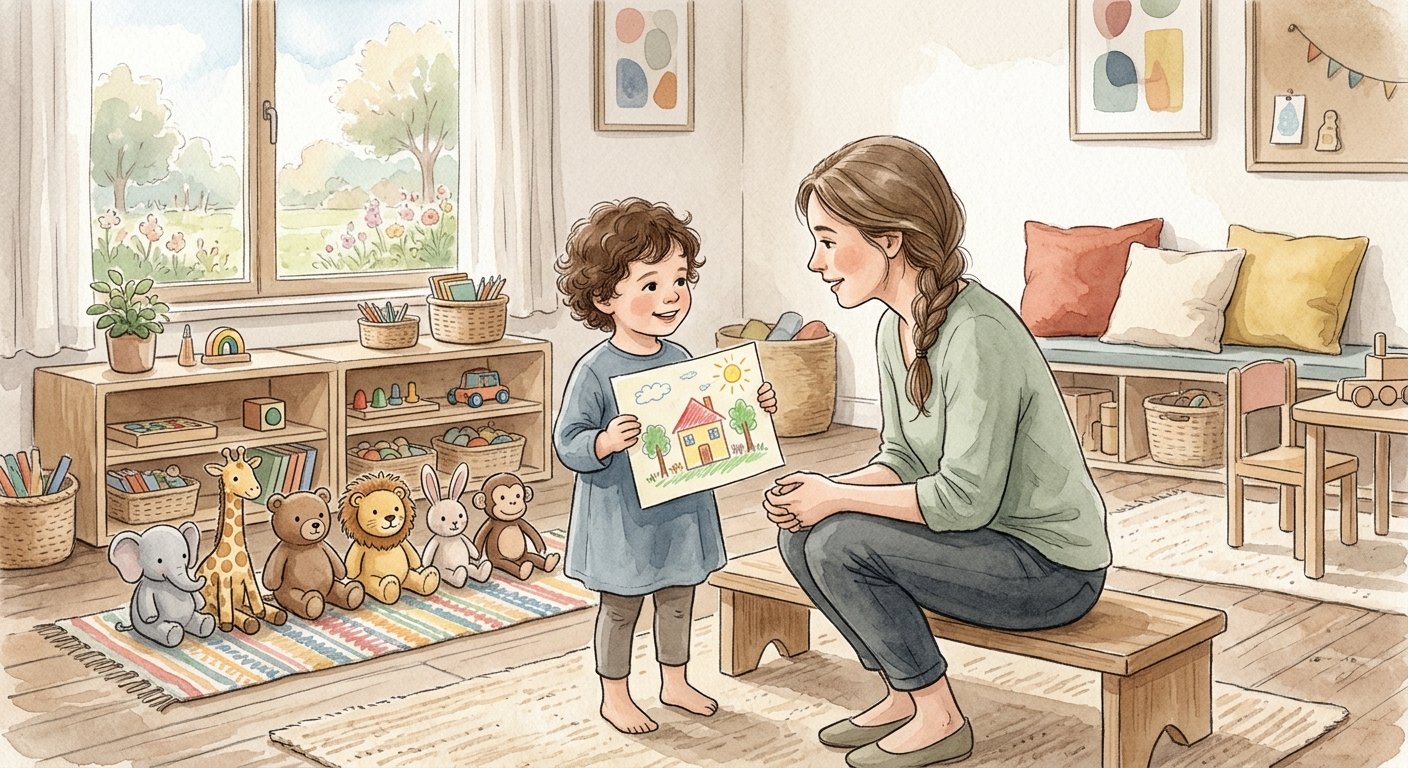
Neurodivergent Children’s Voices: A Scene at Kinder
A general illustration of a situation many educators describe, not one child’s story.
A four year old autistic girl lines up toy animals along the edge of the mat every morning. She gets upset if anyone moves them.
Her educator writes in her notes: “Repetitive play. Struggles to share.” One morning, a relief educator sits beside her and asks, “Where are they going?”
The girl looks up and says, “They’re waiting for the bus. The kangaroo is first because he’s the driver.” She then tells a long story about where each animal is going.
The Five Steps: Everyday Stories. Lived Experiences. Better Understanding.
What happened
An autistic girl lined up animals each morning. Adults described it as repetitive play, until someone asked her about it.
What did people assume
That the play had no story or meaning, and that she was struggling to share.
What might we not understand
Her line of animals was a story with a plan, a driver and places to go. Moving them broke the story. Her play was how she told it.
What could have helped
Asking her sooner. Writing her words in her notes, alongside the adult’s view. Making room for her bus story in group time, if she wanted to share it.
What can we learn
Children are often telling us a story before we notice. Asking, and writing down their words, lets them tell it themselves.
Neurodivergent Children’s Voices: Stories About Them and Stories by Them
Many stories about neurodivergent children are written by adults. Reports, behaviour notes, referral letters and social media posts all tell a story. The child’s own view is often missing.
| A story about a child | The same story told by the child |
|---|---|
| “Refuses to join group time.” | “It’s too loud on the mat. I like listening from the cushion.” |
| “Poor sleep, won’t settle.” | “My head won’t stop. It’s too busy.” |
| “Repetitive play.” | “They’re waiting for the bus.” |
| “Doesn’t finish activities.” | “I had a better idea, so I started that one.” |
| “Avoids eye contact.” | “I can listen better when I look at the floor.” |
Both kinds of story have a place. But when a child’s own words sit beside the adult’s view, everyone understands more. The child also learns that their view counts.
“My Head Won’t Stop”: What Bella Taught Me
When Bella told me her head wouldn’t stop, she gave me a clear picture of what was happening inside. Her bedtime struggle came from a busy, buzzing brain that couldn’t switch off.
I recognised it because it’s how my head works too. As a child, I started lots of things at the same time and left them unfinished once I lost interest. Nobody called it ADHD back then.
Now, in my late forties, my head is often busier than ever. I’m easily overwhelmed with ideas and plans, and I never have time to do them all. And I’ve never been able to sit still for long. I fold my legs, put my feet up and jiggle my legs, and I worked hard to hide it.
Looking back, Bella’s words were one of the first clues. Children often describe their own brains before adults have the words. When we listen, we learn things no checklist can show.
If your child struggles to settle at night, see toddler sleep resistance and ADHD and the Bedtime Bridge Card. For more on girls, see signs of ADHD in girls.
What Research and Rights Say About Neurodivergent Children’s Voices
Article 12 of the United Nations Convention on the Rights of the Child says children have the right to express their views on matters that affect them. Those views should be given weight according to the child’s age and maturity.1 Australia ratified this convention in 1990.
Laura Lundy, a children’s rights researcher, argues that voice alone isn’t enough. Children need space to share, support to express their voice, an audience who listens, and influence on what happens next.2
In Australia, the Early Years Learning Framework (V2.0) asks educators to recognise children’s agency. It describes children as capable of making choices and decisions that affect their lives.3
The Mosaic approach, developed by Alison Clark and Peter Moss, shows how young children can share their views through photos, tours, maps and drawings, as well as talk.4 This suits many neurodivergent children who find talking harder.
Bella’s sleepless nights fit research too. A review found that children with ADHD have more sleep difficulties than other children, both in parent reports and in sleep studies.5
There’s less research on how best to hear neurodivergent children in everyday settings. Much of what we know comes from autistic adults, families and educators. I’ve kept that in mind.
Many Ways Neurodivergent Children’s Voices Are Heard
| Way of sharing | What it can look like | How to listen |
|---|---|---|
| Words | Telling, asking, describing feelings | Write down their exact words |
| Scripts and repeated phrases | Lines from shows, books or past moments | Ask what the phrase means to them |
| Play | Lining up, building, role play | Sit beside and ask about the story |
| Drawing and making | Pictures, models, the same theme again and again | “Tell me about this.” |
| Movement | Leaving, hiding, rocking, jumping | Notice when and where it happens |
| Devices and pictures | AAC, choice boards, pointing | Give time, and keep the device close |
| Behaviour | Meltdowns, refusal, clinging | Ask what the behaviour is telling you |
| Silence | Not answering, turning away | Respect it, and offer another way later |
Some autistic children don’t speak, or speak less when stressed. They still have plenty to say. AAC (augmentative and alternative communication) means any way of communicating besides speech, from picture cards to talking apps. Keep a child’s AAC close, and treat it as their voice.
For more on behaviour as communication, see fight, flight or freeze in children with ADHD and autistic masking. The Expectation Swap Cards help adults let go of demands that hide a child’s voice.
7 Easy Ways to Hear Neurodivergent Children’s Voices
Ask about the play
Sit beside a child and ask, “Where are they going?” or “What’s happening here?” Then wait, and follow their lead.
Draw and talk
Invite a child to draw something that matters to them. Write their words next to the drawing, exactly as they say them.
Use photos
Let children take photos of places they like, places that are hard and things that help. Then talk about them together.
Offer a choice board
Pictures of feelings, places or activities let children point to their answer. This helps on hard days, and for children who don’t speak.
Talk side by side
Many children share more in the car, on a walk or while building, without eye contact or a face to face chat.
Make a My Story Page
A simple page about what a child loves, what’s hard and what helps, in their words or pictures. It can travel with them to kinder, school or appointments. The free My Story Page below makes this easy.
Act on what they tell you
Change one thing because of what a child said, and tell them. This is how children learn their voice has influence.
A Capacity Check Card with a simple battery picture is another easy way for children to show how they’re feeling. See visual storytelling for more picture based ideas.
Questions that open up neurodivergent children’s voices
| Instead of | Try |
|---|---|
| “Why did you do that?” | “What was happening for you?” |
| “Are you OK?” | “Show me on the battery how full you feel.” |
| “Stop doing that.” | “Tell me about what you’re making.” |
| “You’re fine.” | “That sounds hard. What would help?” |
| “Use your words.” | “You can tell me, draw it or point.” |
| “How was your day?” | “What was the best bit, and the hardest bit?” |
“Why” questions can feel like blame, especially to a child who already hears a lot of correction. Open, gentle questions make it safer to share. Then the most important part is waiting. Many neurodivergent children need extra time to find their answer.
What to avoid when listening
- Finishing their sentences or guessing what they mean too quickly.
- Correcting how they say it when they’re sharing something that matters.
- Talking about them in front of them as if they can’t hear.
- Asking for eye contact as proof that they’re listening.
- Turning their words into a joke or a cute story to share later.
Neurodivergent children’s voices change as they grow
A child’s story about themselves changes over time. A four year old might say “my legs want to run”. A ten year old might say “I can’t concentrate when it’s noisy”. A teenager might want to tell their story in their own words, or not at all.
That’s why neurodivergent children’s voices need listening again and again, not just once. Keep their old words, and keep asking. Their story belongs to them, and they get to update it.
Neurodivergent Children’s Voices in Early Childhood Settings
Lundy’s four ideas in the room
| Idea | What it asks | In practice |
|---|---|---|
| Space | Is there a safe time and place to share? | Quiet corners, one to one time, no pressure to perform |
| Voice | Can the child share in their own way? | Drawing, photos, AAC, play and words all count |
| Audience | Is someone listening who can act? | Educators read and discuss children’s words |
| Influence | Does it change anything? | Plans, spaces and routines change because of what children say |
- Put children’s words in learning stories, not just adult observations.
- Write behaviour notes with the child’s view where you can.
- Ask children about the room, like where they feel calm and where it’s too loud.
- Include children in planning, using pictures and simple choices.
- Share children’s views with families, and ask what children say at home.
For setting up calmer spaces children can share in, see calm corner design and sensory micro transitions.
Hearing Neurodivergent Children’s Voices at Home
- Notice when your child talks most. Bedtime, bath time and car trips are common.
- Take their words seriously, even when they sound unusual.
- Write down what they say about their brain, body and feelings.
- Share their words with educators and health professionals.
- Ask before you speak for them, like “Do you want to tell her, or shall I?”
Bella’s words about her busy head are some of the most useful notes a parent could keep. They describe what’s happening from the inside. They can also help a child later, when they’re older and trying to understand themselves.
A simple notebook works well. Write the date, where you were and your child’s exact words. Add a drawing if they made one. Over months, you’ll see patterns in what helps, what’s hard and how your child describes their own mind. Bring it to appointments, so professionals hear neurodivergent children’s voices directly, not only an adult’s summary. See being a parent with ADHD for more on parenting with a busy brain of your own.
Consent and Privacy: Sharing Neurodivergent Children’s Voices With Care
This is the part I promised. Parents, educators and services often share children’s stories online, in newsletters and on social media. These four questions take less than a minute, and they protect a child’s privacy for years.
Has the child agreed?
Ask in a way they understand, and accept “no”. A young child’s “yes” also needs an adult’s careful judgement.
Would they be happy with it at sixteen?
Imagine the child as a teenager reading it. Would they feel proud, or embarrassed?
Does it show them with dignity?
Avoid sharing meltdowns, toileting, medical details or moments of distress.
Is the diagnosis mine to share?
A child’s diagnosis is their information. Share it only when it helps them, and with people who need to know.
In this series, each scene is a labelled general illustration rather than one child’s story.
When to get more support. If a child tells you their head won’t stop, they can’t sleep, they feel very worried or sad, or they don’t want to be here, take it seriously. Talk with your GP, Maternal and Child Health nurse or a child psychologist. If a child is in danger, call 000.
Free Printable: My Story Page for Neurodivergent Children’s Voices
What I love, what’s hard and what helps me. In the child’s words or pictures, ready to share with kinder, school or family.
Download the Free PDFMy Story Page
My words. My pictures. My way.
Favourite things
Favourite places
People I like
I’m good at
I feel happy when
My idea:
Too loud or bright
Waiting
Changes
Sitting still
My head gets busy
My idea:
A quiet spot
Moving my body
Knowing what’s next
Time to answer
Someone who listens
My idea:
How to Use the My Story Page
- Print the page, and sit side by side with the child at a calm time.
- Circle how they like to share on the strip, and let them choose where to start.
- Let the child tick, draw or tell you, and write their words exactly.
- Ask if they’re happy for you to share it, and with whom.
- Update it every term, as the child grows and changes.
Tips for using the page
- Don’t fill it in for them. A few of their own words beat a full page of yours.
- Spread it over a few days if a child tires quickly.
- Keep a copy at home as a record of how their story changes.
- Share it with new educators at the start of a year, with the child’s permission, so they hear the child first and the reports second.
More Free PDFs for Listening to Children
More free tools are on our printables page.
Back to Your Moment
Think back to the moment you remembered at the start. The child who wouldn’t go inside. The child who drew the same picture every day. The child who said something that sounded odd.
Maybe they were telling you their story, in the only way they could that day. Maybe, like Bella, they were describing a busy head before anyone had a name for it.
Next time, you’ll know a little more. And a simple “Tell me about it”, followed by a patient wait, might let them tell it themselves.
- Hub: Inclusion Beyond the Classroom
- Previous: what does a neurodiversity inclusive community look like
- Next in the series: Beyond Autism Awareness: Why Understanding and Acceptance Matter
- Masking: autistic masking
- Hidden needs: invisible disability
- Strengths: spiky profiles
Neurodivergent Children’s Voices FAQs
Why do neurodivergent children’s voices matter?
Children know things about their own brains and bodies that adults can’t see. Their views help adults understand what they need, and children have a right to be heard.
How can I hear a child who doesn’t speak?
Watch their play, movement and behaviour, offer choice boards, pictures or AAC, and give plenty of time. Many children who don’t speak still have a lot to say.
What does the EYLF say about children’s voices?
The Early Years Learning Framework (V2.0) asks educators to recognise children’s agency, including their capacity to make choices and decisions that affect their lives.
Should I share my child’s diagnosis online?
Think carefully. A diagnosis is your child’s private information. Ask whether they agree, whether they’d be happy with it as a teenager, and whether sharing helps them.
What if my child says their head won’t stop?
Take it seriously and write down their words. Busy thoughts and trouble sleeping can be linked with ADHD and anxiety. Talk with your GP if it keeps happening.
Research and guidance: the United Nations Convention on the Rights of the Child; Lundy on space, voice, audience and influence; the Early Years Learning Framework (V2.0) on agency; Clark and Moss on the Mosaic approach; and Cortese and colleagues on sleep in children with ADHD.
Experience: Bella telling me her head wouldn’t stop before her ADHD diagnosis, my own childhood of starting many things and leaving them unfinished, my busy head and fidgeting now, and my ADHD diagnosis in my forties are my own. Bella was diagnosed in her twenties. The kinder scene is a labelled general illustration.
This is educational content. Last reviewed: 16 November 2026.
References
- United Nations. (1989). Convention on the Rights of the Child. https://www.ohchr.org/en/instruments-mechanisms/instruments/convention-rights-child
- Lundy, L. (2007). ‘Voice’ is not enough: Conceptualising Article 12 of the United Nations Convention on the Rights of the Child. British Educational Research Journal, 33(6), 927-942. https://doi.org/10.1080/01411920701657033
- Australian Government Department of Education. (2022). Belonging, being and becoming: The Early Years Learning Framework for Australia (V2.0). Australian Government Department of Education for the Ministerial Council.
- Clark, A., & Moss, P. (2011). Listening to young children: The Mosaic approach (2nd ed.). National Children’s Bureau.
- Cortese, S., Faraone, S. V., Konofal, E., & Lecendreux, M. (2009). Sleep in children with attention deficit/hyperactivity disorder: Meta-analysis of subjective and objective studies. Journal of the American Academy of Child and Adolescent Psychiatry, 48(9), 894-908. https://doi.org/10.1097/CHI.0b013e3181ac09c9

One Comment
Comments are closed.